Best Research: Meaning, Objectives and Characteristics | शोध का अर्थ, उद्देश्य एवं विशेषताएँ | Complete UGC NET/JRF Paper-I Notes | 2026

Best Research: Meaning, Objectives and Characteristics 

शोध का अर्थ, उद्देश्य एवं विशेषताएँ

UGC NET/JRF Paper-I Complete Notes

1. शोध का अर्थ (Meaning of Research):-

       Research (शोध) एक व्यवस्थित, वैज्ञानिक एवं तार्किक प्रक्रिया है, जिसके माध्यम से किसी समस्या, प्रश्न या घटना के बारे में नए तथ्यों की खोज, पुराने तथ्यों का पुनः परीक्षण तथा स्थापित ज्ञान की व्याख्या की जाती है।

सरल शब्दों में-

     Research is a systematic and scientific investigation undertaken to discover new facts, verify existing knowledge and establish meaningful relationships.

    अर्थात् शोध केवल सूचना एकत्र करना नहीं है, बल्कि प्रश्न → आँकड़े → विश्लेषण → व्याख्या → निष्कर्ष की व्यवस्थित प्रक्रिया है।

Research शब्द का अर्थ:-

Research = Re + Search

Re → Again (पुनः)

Search → खोज करना

      इस दृष्टि से Research का सामान्य अर्थ “पुनः खोज करना” है। हालांकि वैज्ञानिक शोध का अर्थ केवल किसी चीज को दोबारा खोजना नहीं, बल्कि किसी समस्या की व्यवस्थित एवं प्रमाण-आधारित जाँच करना है।

शोध की प्रमुख विशेषताएँ (Characteristics of Research):

1. व्यवस्थित प्रक्रिया (Systematic Process)- शोध पूर्व निर्धारित एवं व्यवस्थित चरणों के माध्यम से किया जाता है।

2. वैज्ञानिक प्रकृति (Scientific Nature)- इसमें वैज्ञानिक पद्धतियों, तार्किक विश्लेषण और प्रमाणों का प्रयोग किया जाता है।

3. वस्तुनिष्ठता (Objectivity)- शोधकर्ता को व्यक्तिगत पूर्वाग्रहों से बचते हुए निष्पक्ष निष्कर्ष प्राप्त करने का प्रयास करना चाहिए।

4. अनुभवजन्य आधार (Empirical Basis)- विशेषकर empirical research में निष्कर्षों का आधार प्रत्यक्ष अवलोकन, अनुभव या प्राप्त आँकड़े होते हैं।

5. तार्किकता (Logicality)- Research में data collection, analysis और conclusion के बीच तार्किक संबंध होना चाहिए।

6. सत्यापन (Verification)- शोध के निष्कर्षों की जाँच एवं verification संभव होनी चाहिए।

7. नवीनता (Originality)- शोध का उद्देश्य नए ज्ञान, नए दृष्टिकोण, नए संबंध या नई व्याख्या प्रस्तुत करना हो सकता है।

8. समस्या-केंद्रितता (Problem-oriented)- एक अच्छा शोध किसी स्पष्ट research problem या research question से प्रारंभ होता है।

शोध के प्रमुख उद्देश्य (Objectives of Research)

    Research के objectives शोध के वास्तविक लक्ष्य को स्पष्ट करते हैं। सामान्यतः शोध के चार प्रमुख उद्देश्य माने जाते हैं-

1. अन्वेषणात्मक उद्देश्य (Exploratory Objective):-

    जब किसी समस्या या घटना के बारे में पर्याप्त जानकारी उपलब्ध नहीं होती, तब उसके नए पहलुओं, संभावित कारणों और महत्वपूर्ण variables की खोज के लिए exploratory research किया जाता है।

मुख्य प्रश्न:

What? / क्या?

उदाहरण: किसी ग्रामीण क्षेत्र में युवाओं के नए रोजगार विकल्पों की खोज करना।

2. वर्णनात्मक उद्देश्य (Descriptive Objective):-

    किसी घटना, समूह, क्षेत्र या परिस्थिति की विशेषताओं एवं वर्तमान स्थिति का व्यवस्थित वर्णन करना descriptive research का प्रमुख उद्देश्य है।

मुख्य प्रश्न:

What is happening? / क्या हो रहा है?

उदाहरण: किसी जिले में जनसंख्या वितरण, साक्षरता एवं व्यवसायिक संरचना का अध्ययन।

3. व्याख्यात्मक उद्देश्य (Explanatory Objective):-

    किसी घटना के कारणों तथा विभिन्न variables के बीच संबंधों को समझना explanatory research का उद्देश्य है।

मुख्य प्रश्न:

Why? / क्यों?

उदाहरण: किसी क्षेत्र में कृषि उत्पादकता कम होने के कारणों का अध्ययन।

4. पूर्वानुमानात्मक उद्देश्य (Predictive Objective):-

    उपलब्ध data और स्थापित relationships के आधार पर भविष्य की संभावित स्थिति या प्रवृत्ति का अनुमान लगाना predictive research का उद्देश्य है।

मुख्य प्रश्न:

What may happen? / भविष्य में क्या हो सकता है?

उदाहरण: जनसंख्या की वर्तमान वृद्धि दर के आधार पर भविष्य की जनसंख्या का अनुमान लगाना।

Research के अन्य महत्वपूर्ण उद्देश्य

1. नवीन ज्ञान की खोज- ऐसे तथ्यों या relationships की पहचान करना जो पहले पर्याप्त रूप से ज्ञात नहीं थे।

2. मौजूदा ज्ञान का सत्यापन- पहले से स्थापित theories, concepts या findings को नए data या परिस्थितियों में जाँचना।

3. कारण-कार्य संबंध की पहचान- किसी घटना के cause and effect relationship को समझना।

4. सिद्धांत निर्माण (Theory Building)- नए concepts एवं relationships के आधार पर theoretical framework विकसित करना।

5. सिद्धांत का परीक्षण (Theory Testing)- पहले से स्थापित theory या hypothesis को empirical evidence के आधार पर test करना।

6. समस्या का समाधान- व्यावहारिक समस्याओं के कारणों की पहचान करके उनके संभावित समाधान प्रस्तुत करना।

7. नीति निर्माण में सहायता- Research findings का उपयोग planning, policy formulation और decision-making में किया जा सकता है।

Research Objective और Research Question में अंतर

आधार Research Objective Research Question
अर्थ शोध क्या प्राप्त करना चाहता है शोध क्या जानना चाहता है
रूप सामान्यतः statement सामान्यतः question
उदाहरण जनसंख्या वृद्धि का अध्ययन करना जनसंख्या वृद्धि क्यों हो रही है?
भूमिका Research direction निर्धारित करता है Investigation को guide करता है

उदाहरण-

Objective: To examine the impact of urbanization on agricultural land.

Research Question: How does urbanization affect agricultural land?

Research Objective और Hypothesis का संबंध

    Objective बताता है कि शोधकर्ता क्या अध्ययन करना चाहता है, जबकि Hypothesis किसी संभावित relationship या outcome के बारे में परीक्षण योग्य कथन प्रस्तुत करता है।

उदाहरण-

Objective: शहरीकरण और कृषि भूमि के बीच संबंध का अध्ययन करना।

Hypothesis: Rapid urbanization leads to a decline in agricultural land.

अर्थात् Objective = What to study
Hypothesis = What relationship is expected

UGC NET/JRF के लिए Research Process

      Research की सामान्य प्रक्रिया को इस क्रम में याद किया जा सकता है-

Research Problem

Review of Literature

Objectives / Research Questions

Hypothesis (जहाँ आवश्यक हो)

Research Design

Data Collection

Data Analysis

Interpretation

Conclusion & Reporting

Quick Trick

✍️ “Problem लेकर Literature पढ़ो, Objective बनाओ; Hypothesis रखो, Design करो, Data Collect करो, Analysis करो, Interpret करो और Conclusion दो।”

✍️ P → L → O → H → D → C → A → I → C

Problem → Literature → Objective → Hypothesis → Design → Collection → Analysis → Interpretation → Conclusion

✍️ “समस्या खोजो → साहित्य पढ़ो → उद्देश्य बनाओ → परिकल्पना रखो → डिजाइन बनाओ → डेटा लो → विश्लेषण करो → व्याख्या करो → निष्कर्ष दो।”

UGC NET/JRF के लिए सबसे महत्वपूर्ण Conceptual Points

🔹 Research का मूल उद्देश्य

Knowledge generation, verification, explanation और problem solving.

🔹 Exploratory Research

नई जानकारी/संभावित variables की खोज।

🔹 Descriptive Research

किसी घटना की वर्तमान स्थिति एवं विशेषताओं का वर्णन।

🔹 Explanatory Research

कारण एवं संबंधों की व्याख्या।

🔹 Predictive Research

भविष्य की संभावित स्थिति का अनुमान।

🔹 Research Objective

शोध के लक्ष्य को स्पष्ट करता है।

🔹 Hypothesis

परीक्षण योग्य संभावित कथन।

🔹 Good Research

Systematic + Scientific + Logical + Objective + Evidence-based

One-Line Revision

   Research is a systematic and scientific process of discovering, verifying, explaining and applying knowledge.

Exploratory → What?

Descriptive → What is?

Explanatory → Why?

Predictive → What may happen?

PYQ Pattern MCQs 

UGC NET/JRF Paper-I

1. Research की सबसे उपयुक्त व्याख्या निम्न में से कौन-सी है?

Which of the following best explains research?

(A) उपलब्ध सूचनाओं को बिना जाँचे एकत्र करना / Collecting available information without verification

(B) किसी विषय पर व्यक्तिगत राय प्रस्तुत करना / Presenting a personal opinion on a topic

(C) किसी समस्या की व्यवस्थित, वैज्ञानिक एवं तार्किक जाँच करना / Systematic, scientific and logical investigation of a problem

(D) केवल पुस्तकों से जानकारी प्राप्त करना / Obtaining information only from books

Answer: (C)

2. Research में “Re + Search” की व्युत्पत्तिगत व्याख्या किस अर्थ को सबसे अधिक व्यक्त करती है?

The etymological interpretation of “Re + Search” most closely conveys which meaning?

(A) किसी विषय की पुनः खोज/जाँच करना / Searching or examining again

(B) केवल पुराने data को नष्ट करना / Destroying old data

(C) केवल नई पुस्तक लिखना / Writing a new book

(D) बिना उद्देश्य के information collection

Answer: (A)

3. निम्न में से कौन-सा Research और सामान्य Information Collection के बीच सबसे महत्वपूर्ण अंतर है?

Which is the most important difference between research and ordinary information collection?

(A) Research में हमेशा बहुत अधिक data होता है।

(B) Research केवल numerical data पर आधारित होता है।

(C) Research में केवल secondary sources का प्रयोग होता है।

(D) Research में systematic investigation और evidence-based analysis शामिल होता है।

Answer: (D)

4. यदि researcher पहले से उपलब्ध theory को नए geographical context में empirical data द्वारा test करता है, तो यह research के किस उद्देश्य को दर्शाता है?

If a researcher tests an existing theory in a new geographical context using empirical data, which objective of research does this represent?

(A) केवल description

(B) Verification/Testing of existing knowledge

(C) केवल data collection

(D) केवल prediction

Answer: (B)

5. निम्न में से कौन-सा research का प्राथमिक उद्देश्य नहीं माना जाएगा?

Which of the following would NOT generally be considered a primary objective of research?

(A) Knowledge generation

(B) Verification of existing knowledge

(C) Problem solving

(D) बिना परीक्षण के व्यक्तिगत beliefs को सिद्ध करना

Answer: (D)

6. किसी नए और कम-अध्ययन किए गए विषय के प्रारंभिक पहलुओं की खोज करना किस प्रकार के research objective से संबंधित है?

Exploring initial aspects of a new and less-studied topic is associated with which research objective?

(A) Exploratory

(B) Descriptive

(C) Predictive

(D) Experimental only

Answer: (A)

7. किसी जिले की वर्तमान जनसंख्या संरचना, साक्षरता और occupational pattern का व्यवस्थित वर्णन किस उद्देश्य का उदाहरण है?

Systematically describing the current population structure, literacy and occupational pattern of a district represents which objective?

(A) Explanatory

(B) Predictive

(C) Descriptive

(D) Exploratory

Answer: (C)

8. “Why is agricultural productivity declining in this region?” मुख्यतः किस research objective को व्यक्त करता है?

“Why is agricultural productivity declining in this region?” primarily represents which research objective?

(A) Descriptive

(B) Explanatory

(C) Exploratory only

(D) Predictive

Answer: (B)

9. उपलब्ध population trends के आधार पर अगले 20 वर्षों की population estimate करना किस objective का उदाहरण है?

Estimating population for the next 20 years based on existing population trends is an example of which objective?

(A) Predictive

(B) Descriptive

(C) Exploratory

(D) Historical

Answer: (A)

10. निम्न में से कौन-सा क्रम Research objectives की सामान्य logical progression को सबसे बेहतर दर्शाता है?

Which sequence best represents a logical progression of research objectives?

(A) Prediction → Description → Exploration → Explanation

(B) Explanation → Prediction → Description → Exploration

(C) Description → Prediction → Exploration → Verification

(D) Exploration → Description → Explanation → Prediction

Answer: (D)

11. यदि किसी researcher को किसी समस्या के बारे में बहुत कम पूर्व जानकारी है, तो प्रारंभिक चरण में कौन-सा approach अधिक उपयुक्त होगा?

If a researcher has very limited prior knowledge about a problem, which approach is more appropriate initially?

(A) Exploratory

(B) Predictive

(C) Confirmatory only

(D) Experimental manipulation only

Answer: (A)

12. “What is happening?” प्रकार का research question सामान्यतः किससे सबसे अधिक संबंधित है?

A research question of the form “What is happening?” is most closely associated with:

(A) Predictive research

(B) Descriptive research

(C) Explanatory research

(D) Causal experimentation only

Answer: (B)

13. “Why is it happening?” प्रश्न किस research objective की ओर संकेत करता है?

The question “Why is it happening?” indicates which research objective?

(A) Exploratory

(B) Descriptive

(C) Explanatory

(D) Predictive

Answer: (C)

14. “What is likely to happen in the future?” मुख्यतः किस objective से जुड़ा है?

“What is likely to happen in the future?” is primarily associated with:

(A) Descriptive

(B) Exploratory

(C) Explanatory

(D) Predictive

Answer: (D)

15. Research में objectivity का सबसे उपयुक्त अर्थ क्या है?

What is the most appropriate meaning of objectivity in research?

(A) Researcher का व्यक्तिगत opinion ही अंतिम सत्य होना

(B) Evidence और established procedures के आधार पर निष्पक्षता बनाए रखना

(C) केवल numerical data का उपयोग करना

(D) केवल published data को स्वीकार करना

Answer: (B)

16. निम्न में से कौन research की “systematic nature” को सबसे बेहतर दर्शाता है?

Which best represents the systematic nature of research?

(A) Research बिना किसी sequence के किया जाता है।

(B) Research केवल intuition पर आधारित होता है।

(C) Research में problem से conclusion तक logically connected procedures अपनाए जाते हैं।

(D) Research में methodology की आवश्यकता नहीं होती।

Answer: (C)

17. यदि दो researchers समान methodology अपनाकर किसी study को पुनः संचालित कर सकते हैं, तो यह किस research characteristic से संबंधित है?

If two researchers can repeat a study using the same methodology, which characteristic of research is involved?

(A) Replicability

(B) Subjectivity

(C) Speculation

(D) Randomness

Answer: (A)

18. Empirical research में conclusions का प्रमुख आधार क्या होता है?

What is the primary basis of conclusions in empirical research?

(A) Personal belief

(B) Evidence derived from observation or data

(C) Tradition

(D) Intuition alone

Answer: (B)

19. निम्न में से कौन-सा research की scientific nature को सबसे अधिक support करता है?

Which most strongly supports the scientific nature of research?

(A) Personal preference

(B) Unverified assumptions

(C) Systematic observation, evidence and logical analysis

(D) Popular opinion

Answer: (C)

20. Research में “originality” का अर्थ केवल क्या नहीं है?

What does originality in research NOT necessarily mean?

(A) बिल्कुल पहले कभी न देखे गए विषय का अध्ययन

(B) नए perspective या interpretation का contribution

(C) नए relationships या findings की पहचान

(D) Existing knowledge में meaningful contribution

Answer: (A)

21. निम्नलिखित कथनों पर विचार कीजिए:

1. Research systematic होता है।

2. Research evidence पर आधारित हो सकता है।

3. Research केवल laboratory में किया जा सकता है।

4. Research का उद्देश्य knowledge generation हो सकता है।

सही उत्तर चुनिए:

(A) 1 और 2

(B) 1, 2 और 4

(C) 2 और 3

(D) 1, 2, 3 और 4

Answer: (B)

22. निम्नलिखित में से कौन-सा research की आवश्यक विशेषता है?

Which of the following is an essential characteristic of research?

(A) केवल विशाल sample

(B) हमेशा quantitative data

(C) केवल laboratory experimentation

(D) स्पष्ट problem और systematic investigation

Answer: (D)

23. एक researcher किसी phenomenon का केवल वर्णन करता है, लेकिन उसके कारणों की जाँच नहीं करता। यह मुख्यतः किस प्रकार के objective से संबंधित है?

A researcher only describes a phenomenon without investigating its causes. This is primarily associated with which objective?

(A) Descriptive

(B) Explanatory

(C) Predictive

(D) Experimental

Answer: (A)

24. यदि researcher किसी existing relationship के आधार पर future outcome estimate करता है, तो यह किस objective का संकेत है?

If a researcher estimates a future outcome based on an existing relationship, which objective does this indicate?

(A) Exploratory

(B) Descriptive

(C) Predictive

(D) Historical

Answer: (C)

25. Research problem का स्पष्ट निर्धारण क्यों महत्वपूर्ण है?

Why is clear identification of the research problem important?

(A) इससे research की direction और scope निर्धारित करने में सहायता मिलती है।

(B) इससे data collection की आवश्यकता समाप्त हो जाती है।

(C) इससे hypothesis हमेशा true हो जाती है।

(D) इससे conclusion पहले ही निश्चित हो जाता है।

Answer: (A)

26. Research objective ideally कैसा होना चाहिए?

How should a research objective ideally be framed?

(A) अस्पष्ट और अत्यधिक व्यापक

(B) केवल opinion-based

(C) स्पष्ट, specific और research problem से संबंधित

(D) बिना measurable direction के

Answer: (C)

27. यदि research objective है-“To examine the relationship between rainfall and crop productivity”, तो इसमें मुख्यतः क्या अध्ययन किया जा रहा है?

If the objective is “To examine the relationship between rainfall and crop productivity”, what is primarily being studied?

(A) केवल rainfall का description

(B) दो variables के बीच relationship

(C) केवल crop production का history

(D) केवल future prediction

Answer: (B)

28. Research में निष्कर्ष निकालने से पहले data analysis क्यों आवश्यक है?

Why is data analysis necessary before drawing conclusions in research?

(A) ताकि researcher अपनी initial belief को सिद्ध कर सके।

(B) ताकि raw information को meaningful patterns और relationships में समझा जा सके।

(C) ताकि literature review को हटाया जा सके।

(D) ताकि research question की आवश्यकता समाप्त हो।

Answer: (B)

29. निम्न में से कौन-सा statement research के बारे में सबसे अधिक उचित है?

Which statement about research is most appropriate?

(A) हर research का उद्देश्य नई theory बनाना ही होता है।

(B) हर research में hypothesis अनिवार्य होता है।

(C) हर research में primary data अनिवार्य होता है।

(D) Research का उद्देश्य context के अनुसार exploration, description, explanation, prediction या verification हो सकता है।

Answer: (D)

30. Research में logicality का सबसे अच्छा उदाहरण क्या है?

What is the best example of logicality in research?

(A) Conclusion का collected evidence और analysis से logically follow करना

(B) Researcher की इच्छा के अनुसार conclusion बदलना

(C) केवल convenient data चुनना

(D) बिना analysis के hypothesis accept करना

Answer: (A)

31. Assertion (A): Research में objectivity महत्वपूर्ण है।

Reason (R): Personal bias research findings को प्रभावित कर सकता है।

(A) A और R दोनों सही हैं तथा R, A की सही व्याख्या है।

(B) A और R दोनों सही हैं, लेकिन R सही व्याख्या नहीं है।

(C) A सही है, R गलत है।

(D) A गलत है, R सही है।

Answer: (A)

32. Assertion (A): Descriptive research और explanatory research समान हैं।

Reason (R): Descriptive research मुख्यतः “what is” पर जबकि explanatory research “why/how” पर अधिक ध्यान देता है।

(A) A और R दोनों सही हैं।

(B) A सही है, R गलत है।

(C) A गलत है, R सही है।

(D) A और R दोनों गलत हैं।

Answer: (C)

33. Assertion (A): Exploratory research नए research questions विकसित करने में सहायक हो सकता है।

Reason (R): Exploratory research कम-अध्ययन किए गए विषय के प्रारंभिक पहलुओं को समझने पर बल देता है।

(A) A और R दोनों सही हैं तथा R, A की सही व्याख्या है।

(B) A सही है, R गलत है।

(C) A गलत है, R सही है।

(D) दोनों गलत हैं।

Answer: (A)

34. Assertion (A): Predictive research निश्चित रूप से भविष्य की घटना को 100% सही बताता है।

Reason (R): Prediction उपलब्ध data और identified patterns/relationships पर आधारित होता है।

(A) A और R दोनों सही हैं।

(B) A सही है, R गलत है।

(C) A गलत है, R सही है।

(D) A और R दोनों गलत हैं।

Answer: (C)

35. Assertion (A): Research केवल facts collect करने की प्रक्रिया नहीं है।

Reason (R): Research में collected information का analysis, interpretation और evidence-based conclusion भी शामिल होते हैं।

(A) A और R दोनों सही हैं तथा R, A की सही व्याख्या है।

(B) A और R दोनों सही हैं, लेकिन R सही व्याख्या नहीं है।

(C) A सही है, R गलत है।

(D) A गलत है, R सही है।

Answer: (A)

36. निम्नलिखित का सही मिलान कीजिए:

सूची-I सूची-II
A. Exploratory 1. Why?
B. Descriptive 2. What?
C. Explanatory 3. What is happening?
D. Predictive 4. What may happen?

(A) A-2, B-3, C-1, D-4

(B) A-1, B-2, C-4, D-3

(C) A-4, B-1, C-2, D-3

(D) A-3, B-4, C-1, D-2

Answer: (A)

37. निम्नलिखित का सही मिलान कीजिए:

सूची-I सूची-II
A. Objectivity 1. निष्पक्षता
B. Replicability 2. पुनरावृत्ति
C. Empirical 3. अनुभव/अवलोकन आधारित
D. Originality 4. नवीन योगदान

(A) A-2, B-1, C-4, D-3

(B) A-1, B-2, C-3, D-4

(C) A-3, B-4, C-1, D-2

(D) A-4, B-3, C-2, D-1

Answer: (B)

38. निम्नलिखित का सही मिलान कीजिए:

Research Objective प्रमुख प्रश्न
A. Exploratory 1. Why?
B. Descriptive 2. What is?
C. Explanatory 3. What may happen?
D. Predictive 4. What?

(A) A-4, B-2, C-1, D-3

(B) A-1, B-4, C-2, D-3

(C) A-2, B-1, C-4, D-3

(D) A-3, B-2, C-1, D-4

Answer: (A)

39. यदि researcher किसी existing theory को नए sample पर test करता है, तो research का कौन-सा उद्देश्य प्रमुख है?

If a researcher tests an existing theory on a new sample, which research objective is dominant?

(A) Verification

(B) Entertainment

(C) Description only

(D) Data accumulation only

Answer: (A)

40. यदि researcher किसी समस्या का नया theoretical explanation विकसित करता है, तो यह किस contribution का उदाहरण है?

If a researcher develops a new theoretical explanation for a problem, this represents which contribution?

(A) केवल data entry

(B) Theory building

(C) केवल sampling

(D) केवल description

Answer: (B)

41. निम्न में से कौन-सा research की objectivity को सबसे अधिक कमजोर कर सकता है?

Which can most seriously weaken objectivity in research?

(A) Transparent methodology

(B) Systematic sampling

(C) Researcher का personal bias

(D) Evidence-based analysis

Answer: (C)

42. एक researcher केवल उन observations को report करता है जो उसकी hypothesis के पक्ष में हैं और contradictory evidence को छोड़ देता है। यह किस principle के विरुद्ध है?

A researcher reports only observations supporting the hypothesis and ignores contradictory evidence. This violates which principle?

(A) Objectivity

(B) Prediction

(C) Description

(D) Sampling efficiency

Answer: (A)

43. “Research should be verifiable” का अर्थ क्या है?

What does “research should be verifiable” mean?

(A) Researcher को अपना personal opinion prove करना चाहिए।

(B) Research findings को evidence/procedure के आधार पर examine किया जा सकना चाहिए।

(C) Research हमेशा identical results दे।

(D) केवल published sources acceptable हों।

Answer: (B)

44. Research में “generalization” का सबसे उचित अर्थ क्या है?

What is the most appropriate meaning of generalization in research?

(A) एक observation को universal truth मान लेना

(B) Sample से प्राप्त findings को उचित conditions में broader population पर लागू करना

(C) केवल sample size बढ़ाना

(D) केवल theory को बदलना

Answer: (B)

45. निम्न में से कौन-सा research में “problem solving” objective को सबसे स्पष्ट रूप से दर्शाता है?

Which most clearly represents the problem-solving objective of research?

(A) किसी शहर में traffic congestion के कारणों की पहचान करके सुधारात्मक strategies सुझाना

(B) केवल traffic की परिभाषा लिखना

(C) केवल पुराने article को copy करना

(D) केवल photographs collect करना

Answer: (A)

46. यदि किसी study में researcher पहले phenomenon का description करता है और फिर उसके causes की जाँच करता है, तो यह किस progression को दर्शाता है?

If a study first describes a phenomenon and then investigates its causes, which progression does it represent?

(A) Prediction → Exploration

(B) Description → Explanation

(C) Explanation → Description

(D) Verification → Prediction

Answer: (B)

47. Research की कौन-सी विशेषता researcher को नए findings के लिए खुले रहने की आवश्यकता बताती है?

Which characteristic requires the researcher to remain open to new findings?

(A) Objectivity and openness to evidence

(B) Predetermined conclusion

(C) Personal bias

(D) Confirmation only

Answer: (A)

48. यदि research question स्पष्ट है लेकिन data collection method research objective से मेल नहीं खाता, तो मुख्य समस्या क्या है?

If the research question is clear but the data collection method does not match the research objective, what is the main problem?

(A) Research design-method mismatch

(B) Research originality

(C) Generalization success

(D) Literature abundance

Answer: (A)

49. Research में “critical thinking” का सबसे उपयुक्त अर्थ क्या है?

What is the most appropriate meaning of critical thinking in research?

(A) हर source को बिना जाँच स्वीकार करना

(B) Evidence, assumptions और arguments का तार्किक एवं सावधानीपूर्वक evaluation करना

(C) केवल negative criticism करना

(D) Researcher की personal belief को प्राथमिकता देना

Answer: (B)

50. निम्न में से कौन-सा statement research objectives के संदर्भ में गलत है?

Which statement is incorrect regarding research objectives?

(A) Objectives research की direction बताते हैं।

(B) Objectives research problem से logically related होने चाहिए।

(C) Objectives research scope को स्पष्ट करने में सहायता करते हैं।

(D) Objectives हमेशा hypothesis के समान होते हैं।

Answer: (D)

51. एक researcher किसी phenomenon की वर्तमान स्थिति का quantitative description देता है और फिर future trend का estimate करता है। इसमें कौन-से objectives सम्मिलित हैं?

A researcher quantitatively describes the current status of a phenomenon and then estimates its future trend. Which objectives are involved?

(A) Descriptive + Predictive

(B) Exploratory + Historical

(C) Explanatory only

(D) Experimental only

Answer: (A)

52. यदि research का मुख्य उद्देश्य “understanding meanings and experiences” है, तो निम्न में से कौन-सा orientation अधिक उपयुक्त होगा?

If the main objective is “understanding meanings and experiences,” which orientation is more appropriate?

(A) Purely predictive

(B) Interpretive/qualitative orientation

(C) Purely mathematical

(D) Mechanical measurement only

Answer: (B)

53. निम्न में से कौन research की scientific character को सबसे कम support करता है?

Which least supports the scientific character of research?

(A) Systematic procedure

(B) Evidence

(C) Logical reasoning

(D) Unverified personal assumptions

Answer: (D)

54. एक research study में conclusion पहले से तय है और researcher केवल supporting evidence खोजता है। यह किस समस्या को दर्शाता है?

In a research study, the conclusion is predetermined and the researcher searches only for supporting evidence. What problem does this indicate?

(A) Objectivity का उल्लंघन / Violation of objectivity

(B) Replicability

(C) Generalization

(D) Description

Answer: (A)

55. Research में “knowledge verification” का सबसे अच्छा उदाहरण कौन-सा है?

Which is the best example of knowledge verification in research?

(A) नई समस्या की बिना दिशा खोज

(B) Existing finding को नए context/data के आधार पर पुनः test करना

(C) केवल opinion लिखना

(D) केवल literature summarize करना

Answer: (B)

56. निम्नलिखित कथनों पर विचार कीजिए:

1. Research systematic होना चाहिए।

2. Research evidence का उपयोग करता है।

3. Researcher को contradictory evidence को भी consider करना चाहिए।

4. Research conclusion हमेशा hypothesis के समान होना चाहिए।

सही विकल्प चुनिए:

(A) 1 और 2

(B) 1, 2 और 3

(C) 2, 3 और 4

(D) 1, 2, 3 और 4

Answer: (B)

57. निम्न में से कौन-सा “good research objective” का उदाहरण है?

Which is an example of a good research objective?

(A) “To study everything about population.”

(B) “To know many things about agriculture.”

(C) “To examine the relationship between rainfall variability and crop productivity in the study area.”

(D) “To prove that my assumption is correct.”

Answer: (C)

58. यदि research findings किसी policy decision को evidence प्रदान करती हैं, तो यह research के किस broader objective को दर्शाता है?

If research findings provide evidence for a policy decision, which broader objective of research does this represent?

(A) Application/Problem solving

(B) केवल exploration

(C) केवल description

(D) केवल data storage

Answer: (A)

59. निम्न में से कौन-सा research की विशेषताओं का सबसे पूर्ण समूह है?

Which is the most complete set of characteristics of research?

(A) Systematic, scientific, logical, objective and evidence-based

(B) Subjective, random, opinion-based and unstructured

(C) Informal, intuitive and unsupported

(D) Personal, arbitrary and predetermined

Answer: (A)

60. एक researcher किसी समस्या की खोज करता है, उसके वर्तमान स्वरूप का वर्णन करता है, कारणों की व्याख्या करता है और उपलब्ध relationships के आधार पर भविष्य की स्थिति का अनुमान लगाता है। यह research objectives की किस व्यापक श्रृंखला को दर्शाता है?

A researcher explores a problem, describes its present condition, explains its causes and predicts future conditions based on relationships. Which broad sequence of research objectives does this represent?

(A) Prediction → Exploration → Description → Explanation

(B) Description → Exploration → Prediction → Explanation

(C) Exploration → Description → Explanation → Prediction

(D) Explanation → Prediction → Exploration → Description

Answer: (C)

Best Internal Structure of the Earth (पृथ्वी की आंतरिक संरचना) | Complete Geography Notes 2026

Internal Structure of The Earth

(पृथ्वी की आंतरिक संरचना)


Internal Structure of The Earth               

          पृथ्वी की आंतरिक संरचना को समझने हेतु अप्रत्यक्ष साधनों पर ही निर्भर रहना पड़ता है। यही कारण है कि पृथ्वी की आंतरिक संरचना के सम्बंध में अधिकतर ज्ञान अनुमान पर आधारित है। पृथ्वी की आंतरिक संरचना को समझने में भूकम्पीय विज्ञान (Seismology) या भूकम्पीय तरंग को सबसे सटीक वैज्ञानिक साधन माना जाता है। पृथ्वी के आंतरिक संरचना के अध्ययन से ज्ञात होता है कि पृथ्वी का औसत घनत्व 5.5 है। पृथ्वी के धरातल से केंद्र की ओर जाने पर घनत्व में लगातार बढ़ोतरी होते जाती है क्योंकि ऊपर से नीचे जाने पर चट्टान के दबाव एवं भार में बढ़ोतरी होते जाती है।

        The internal structure of the Earth can be understood mainly through indirect methods. Therefore, much of our knowledge about the Earth’s interior is based on estimation. Seismology, or the study of seismic waves, is considered the most accurate scientific method for understanding the Earth’s internal structure. The study of the Earth’s interior shows that its average density is about 5.5. The density increases continuously from the Earth’s surface towards the centre because the pressure and weight of rocks increase with depth.

⇒ सामान्य नियम के अनुसार दाब बढ़ने से तापमान में बढ़ोतरी होती है। अतः प्रत्येक 32 मी० की गहराई पर 1℃  तापमान में बढ़ोतरी होती है। As a general rule, as pressure increases, temperature also increases. Therefore, the temperature increases by 1°C for every 32 metres of depth.

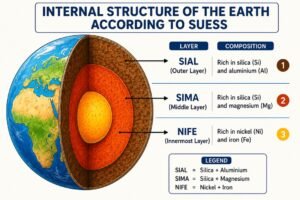
      स्वेस महोदय ने पहली बार पृथ्वी की रासायनिक संरचना का अध्ययन किया। उन्होंने बताया कि रासायनिक संरचना के आधार पर पृथ्वी की आंतरिक भागों को तीन परतों में बाँटा जा  सकता है। Suess was the first scholar to study the chemical composition of the Earth. He stated that, based on chemical composition, the interior of the Earth can be divided into three layers.

Internal Structure of the Earth


(1) सियाल (SIAL) 

       पृथ्वी का सबसे ऊपरी परत सिलिकन & अलुमिनियम से निर्मित है। The Earth’s uppermost layer is made of silicon and aluminium.

(2) सिमा (SIMA)

    स्वेस ने मध्यवर्ती परत को सिमा से संबोधित किया है और उन्होंने बताया कि सिमा सिलिकन & मैग्नेशियम से बना है। Suess called the intermediate layer Sima and stated that it is made up of silicon and magnesium.

(3) निफे (NIFE)

      पृथ्वी के सबसे आंतरिक भाग को निफे से संबोधित किया है और बताया कि यह निकेल & लोहा से बना है। The innermost part of the Earth is called the Nife, and it is made up of nickel and iron.

भूकम्पीय साक्ष्यों के आधार पर पृथ्वी की आंतरिक संरचना

(Internal Structure of the Earth Based on Seismic Evidence):-

     भूकम्पीय साक्ष्यों के आधार पर पृथ्वी की आंतरिक संरचना का सबसे अधिक वैज्ञानिक अध्ययन प्रस्तुत किया जाता है। जिसके अनुसार पृथ्वी को तीन परतों में बाँटा गया है-

      Based on seismic evidence, the most scientific study of the Earth’s internal structure is presented. According to this, the Earth is divided into three layers.

1. भूपर्पटी (Crust)

2. भू-प्रावर (Mantle)

3. क्रोड (Core)

(1) भूपर्पटी (Crust):-

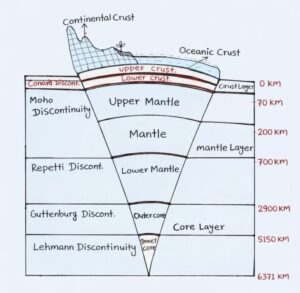
      यह पृथ्वी का सबसे ऊपरी एवं पतली परत है। पृथ्वी के कुल आयतन का 0.5% और कुल द्रव्यमान का 0.2% Crust में शामिल है। इसकी औसत मोटाई 33 किमी० है। महाद्वीपों पर इसकी अधिकतम मोटाई 70 किमी० तक और महासागरीय क्षेत्र में औसत मोटाई 5 किमी० है।

     The Crust is the uppermost and thinnest layer of the Earth. It accounts for about 0.5% of the Earth’s total volume and 0.2% of its total mass. Its average thickness is about 33 km. Its maximum thickness is about 70 km beneath continents, while its average thickness in oceanic areas is about 5 km.

       इसमें परतदार चट्टानों की प्रधानता होती है। लेकिन महाद्वीपीय भागों में परतदार चट्टानों के नीचे ग्रेनाइट चट्टान की परत मिलती है जबकि महासागरीय भूपटल पर बैसाल्ट चट्टाने मिलती है।

      Layered (sedimentary) rocks are dominant in the crust. However, beneath the sedimentary rocks in continental areas, a layer of granite is found, while basaltic rocks are found in the oceanic crust.

★ भूपर्पटी की रासायनिक संरचना से स्पष्ट होता है कि इसमें सर्वाधिक ऑक्सीजन (46.80%), सिलिकन (27.72%) अल्युमीनियम (8.13%) पायी जाती है। यह पृथ्वी का वह मण्डल है जिसमें प्राथमिक तरंग, द्वितीयक तरंग, सतही तरंग, P*, S*, Pg & Sg जैसे भूकम्पीय तरंग चला करते है।

     The chemical composition of the crust shows that oxygen (46.80%), silicon (27.72%), and aluminium (8.13%) are the most abundant elements. It is the Earth’s layer through which seismic waves such as Primary (P), Secondary (S), Surface, P*, S*, Pg and Sg waves travel.

         भूपर्पटी भी दो भागों में विभक्त है (The crust is further divided into two parts):- 

1. महासागरीय भूपटल /Oceanic Crust

2. महाद्वीपीय भूपटल /Continental Crust

       महाद्वीपीय भूपटल का घनत्व कम (2.75) है जबकि महासागरीय भूपटल का घनत्व अधिक (3.75) है। यही कारण है कि महाद्वीपीय भूपटल फुला/खुला हुआ है जबकि महासागरीय भूपटल धँसा हुआ है। महाद्वीपीय भूपटल में भी अलग-अलग घनत्व की चट्टाने पायी जाती है। जैसे:- पर्वतीय चट्टानों के घनत्व सबसे कम होता है। इससे अधिक घनत्व पठारों का और पठारों से ज्यादा घनत्व मैदानी चट्टानों में होता है।

     The density of the continental crust is low (2.75), while the density of the oceanic crust is high (3.75). This is why the continental crust is uplifted, whereas the oceanic crust is depressed. The continental crust also contains rocks with different densities. Mountain rocks have the lowest density, followed by plateau rocks, while plain rocks have a higher density.

(2) भू-प्रावार (Mantle):-

       भू-प्रावार की मोटाई मोहो असम्बद्धता से 2900 KM तक है। पृथ्वी के कुल आयतन का 83% और कुल द्रव्यमान का 68% भाग भूप्रावार में शामिल है। यह अधिक तापमान के कारण पिघली हुई अवस्था (द्रव) के समान है। भूप्रावार पृथ्वी का वह मण्डल है जिसमें प्राथमिक तरंग  तो संचरित होती है लेकिन द्वितीयक तरंग विलुप्त हो जाती है। इसका निर्माण सिलिकन & मैग्नेशियम जैसे तत्वों से हुआ है। भूप्रावार का घनत्व 3 से 5.5 तक मानी जाती है।

     The thickness of the mantle extends from the Mohorovičić Discontinuity (Moho) to a depth of about 2,900 km. It accounts for about 83% of the Earth’s total volume and about 68% of its total mass. Due to its high temperature, it is considered to be in a molten or fluid-like state. In the mantle, primary (P) waves can travel, while secondary (S) waves disappear. The mantle is mainly composed of elements such as silicon and magnesium. Its density is considered to range from about 3 to 5.5.

★ भूपर्पटी और भूप्रावार के बीच एक संक्रमण पेटी पायी जाती है जिसे मोहोअसम्बद्धता (Moho Discontinuty) कहते है। A transition zone is found between the crust and mantle, which is called the Moho Discontinuity.

★ क्रस्ट और मेंटल के ऊपरी भाग को मिलाकर स्थलमण्डल/लिथोस्फेयर कहा जाता है। The crust and the upper part of the mantle together are called the lithosphere.

★ स्थलमण्डल के नीचे वाले मण्डल को दुर्बलमण्डल (Aestheno Sphere) कहते है। होम्स ने बताया कि दुर्बलमण्डल में ही संवहन तरंगे चलती है। ये तरंगे इतनी शक्तिशाली होती है जो स्थलमण्डल को तोड़ने एवं मोड़ने की क्षमता रखती है। The layer below the lithosphere is called the Asthenosphere. Holmes stated that convection currents move within the asthenosphere. These currents are so powerful that they can break and bend the lithosphere.

(3) क्रोड(Core)/अंतरतम:-   

       यह पृथ्वी का केंद्रीय भाग है। इसका घनत्व -10 से 13.6 g/cm3 है। पृथ्वी के कुल आयतन का 16% एवं द्रव्यमान का 32% भाग क्रोड में शामिल है। क्रोड पृथ्वी का वह मण्डल है जसमें केवल प्राथमिक तरंगे गुजरती है। यह मण्डल निकेल & लोहा से निर्मित है। इसी कारण से पृथ्वी में चुम्बकीय गुण है। 

     This is the central part of the Earth. Its density is 10 to 13.6 g/cm³. The core accounts for about 16% of the total volume and 32% of the total mass of the Earth. The core is the layer of the Earth through which only primary waves (P-waves) pass. It is mainly made up of nickel and iron. Therefore, it is associated with the magnetic properties of the Earth.

      क्रोड अत्याधिक दबाव के कारण ठोस भाग के रूप में परिणत हो चुका है। क्रोड की औसत मोटाई 3471 KM है। Mantle और Core के बीच में एक संक्रमण पेटी पायी जाती है जिसे गुटेनबर्ग असम्बद्धता कहते हैं। पृथ्वी की आंतरिक संरचना को नीचे के चित्रों में भी देखा जा सकता है।

     Due to extremely high pressure, the core has become solid in nature. The average thickness of the core is about 3,471 km. A transition zone is found between the mantle and the core, known as the Gutenberg Discontinuity. The internal structure of the Earth can also be seen in the figures given below.

निष्कर्ष (Conclusion):- 

        इस तरह उपर्युक्त तथ्यों से स्पष्ट है कि पृथ्वी की आंतरिक संरचना के संबंध में भूकम्पीय तरंग सबसे अधिक वैज्ञानिक साक्ष्य प्रस्तुत करते हैं। Thus, it is clear from the above facts that seismic waves provide the most scientific evidence about the internal structure of the Earth.

Data Collection and Classification (आँकड़ों का संकलन एवं वर्गीकरण) Complete Notes | Easy Explanation 2026

Data Collection and Classification

(आँकड़ों का संकलन एवं वर्गीकरण)

आँकड़ों का अर्थ (Meaning of Data):

     आँकड़े (Data) किसी विषय, घटना, क्षेत्र या जनसंख्या से संबंधित तथ्यों, सूचनाओं एवं मापों का व्यवस्थित अथवा अव्यवस्थित संकलन हैं, जिनका उपयोग किसी समस्या के अध्ययन, विश्लेषण एवं निष्कर्ष निकालने के लिए किया जाता है।

     भूगोल में जनसंख्या, वर्षा, तापमान, कृषि, उद्योग, परिवहन, भूमि उपयोग, आय, साक्षरता आदि से संबंधित सूचनाएँ आँकड़ों के रूप में प्राप्त की जाती हैं।

सरल शब्दों में:

   किसी भौगोलिक घटना से संबंधित संख्यात्मक या गुणात्मक तथ्यों के संग्रह को आँकड़े कहा जाता है। अर्थात् The collection of numerical or qualitative facts related to a geographical phenomenon is called data.

आँकड़ों का संकलन (Data Collection):

    किसी शोध या भौगोलिक अध्ययन के लिए आवश्यक सूचनाओं को विभिन्न स्रोतों से एकत्र करने की प्रक्रिया को आँकड़ों का संकलन (Data Collection) कहते हैं।

    आँकड़ों के संकलन को मुख्यतः दो भागों में बाँटा जाता है-

(1) प्राथमिक आँकड़े (Primary Data)

(2) द्वितीयक आँकड़े (Secondary Data)

(1) प्राथमिक आँकड़े (Primary Data):

    शोधकर्ता द्वारा स्वयं पहली बार किसी निर्धारित उद्देश्य के लिए प्रत्यक्ष रूप से एकत्र किए गए आँकड़े प्राथमिक आँकड़े कहलाते हैं।

जैसे- यदि कोई शोधकर्ता किसी गाँव में जाकर परिवारों से उनकी आय, शिक्षा, व्यवसाय एवं परिवार के आकार की जानकारी स्वयं प्राप्त करता है, तो ये प्राथमिक आँकड़े होंगे।

प्राथमिक आँकड़ों के प्रमुख स्रोत:

1. प्रत्यक्ष अवलोकन (Direct Observation):-

    प्रत्यक्ष अवलोकन में शोधकर्ता स्वयं अध्ययन क्षेत्र में जाकर विभिन्न घटनाओं, परिस्थितियों और प्रक्रियाओं का निरीक्षण करता है। इसके माध्यम से वास्तविक एवं प्रत्यक्ष सूचनाएँ प्राप्त होती हैं। यह विधि सामाजिक, आर्थिक तथा भौगोलिक परिस्थितियों के क्षेत्रीय अध्ययन में विशेष रूप से उपयोगी होती है।

2. साक्षात्कार (Interview):-

    साक्षात्कार प्राथमिक आँकड़े एकत्र करने की महत्वपूर्ण विधि है, जिसमें शोधकर्ता उत्तरदाताओं से प्रत्यक्ष बातचीत करके आवश्यक सूचनाएँ प्राप्त करता है। इसमें पूर्व निर्धारित या खुले प्रश्न पूछे जा सकते हैं। साक्षात्कार व्यक्तिगत, समूह आधारित, संरचित अथवा असंरचित प्रकृति का हो सकता है।

3. अनुसूची (Schedule):-

   अनुसूची प्रश्नों की एक पूर्व निर्धारित एवं व्यवस्थित सूची होती है, जिसके आधार पर enumerator (गणनाकर्ता/अन्वेषक) उत्तरदाताओं से प्रश्न पूछता है और उनके उत्तर स्वयं अनुसूची में दर्ज करता है। यह विधि उन परिस्थितियों में उपयोगी है जहाँ उत्तरदाता स्वयं प्रश्नावली भरने में सक्षम नहीं होते हैं।

4. प्रश्नावली (Questionnaire):-

    प्रश्नावली प्रश्नों की एक व्यवस्थित सूची होती है, जिसे उत्तरदाताओं को उपलब्ध कराया जाता है। उत्तरदाता प्रश्नों को समझकर उनके उत्तर स्वयं दर्ज करता है। यह विधि बड़े क्षेत्र में कम समय में जानकारी एकत्र करने के लिए उपयोगी है तथा डाक, ऑनलाइन या अन्य माध्यमों से भी संचालित की जा सकती है।

5. क्षेत्र सर्वेक्षण (Field Survey):-

    क्षेत्र सर्वेक्षण में शोधकर्ता अध्ययन क्षेत्र में जाकर सामाजिक, आर्थिक, सांस्कृतिक तथा भौगोलिक परिस्थितियों से संबंधित प्राथमिक सूचनाएँ प्रत्यक्ष रूप से एकत्र करता है। इसमें अवलोकन, साक्षात्कार, मापन तथा प्रश्नावली जैसी विभिन्न विधियों का उपयोग किया जा सकता है। भूगोल में इसका विशेष महत्व है।

6. मापन (Measurement):-

    मापन के अंतर्गत अध्ययन से संबंधित भौगोलिक विशेषताओं और घटनाओं का उपकरणों अथवा निर्धारित तकनीकों की सहायता से प्रत्यक्ष मापन किया जाता है। इसके द्वारा तापमान, वर्षा, दूरी, ऊँचाई, ढाल आदि का मात्रात्मक आँकड़ा प्राप्त किया जाता है। यह वैज्ञानिक एवं वस्तुनिष्ठ अध्ययन में अत्यंत उपयोगी है।

2. द्वितीयक आँकड़े (Secondary Data):

    ऐसे आँकड़े जो पहले से किसी अन्य व्यक्ति, संस्था या संगठन द्वारा किसी उद्देश्य से एकत्र किए जा चुके हों और बाद में शोधकर्ता द्वारा अपने अध्ययन में उपयोग किए जाएँ, द्वितीयक आँकड़े कहलाते हैं।

उदाहरण- Census Reports, Statistical Abstracts, Government Reports, Economic Survey, Research Papers, Books, Journals, ewspapers, Websites, Institutional Reports।

द्वितीयक आँकड़ों के प्रमुख स्रोत:

(A) प्रकाशित स्रोत (Published Sources):-

      प्रकाशित स्रोत (Published Sources) वे स्रोत हैं जिनमें आँकड़े या सूचनाएँ किसी सरकार, संस्था, संगठन, शोधकर्ता या प्रकाशक द्वारा औपचारिक रूप से प्रकाशित की जाती हैं और जिन्हें शोधकर्ता अपने अध्ययन में उपयोग कर सकता है। ये द्वितीयक आँकड़ों (Secondary Data) के प्रमुख स्रोत हैं।

जैसे-  जनगणना रिपोर्ट, सरकारी प्रकाशन, शोध पत्र एवं शोध प्रबंध, पुस्तकें एवं पत्रिकाएँ, आर्थिक सर्वेक्षण, Statistical Reports, अंतरराष्ट्रीय संस्थाओं की रिपोर्ट आदि।

(B) अप्रकाशित स्रोत (Unpublished Sources):-

      अप्रकाशित स्रोत (Unpublished Sources) का मतलब है ऐसे आँकड़े या रिकॉर्ड जो सार्वजनिक रूप से प्रकाशित नहीं किए गए हैं, लेकिन किसी व्यक्ति, संस्था, कार्यालय या संगठन के पास उपलब्ध हैं और शोध में उपयोग किए जा सकते हैं। ये सामान्यतः द्वितीयक आँकड़ों (Secondary Data) के स्रोत माने जाते हैं।

जैसे- कार्यालयीय अभिलेख, संस्थागत रिकॉर्ड, निजी दस्तावेज, शोधकर्ता के अप्रकाशित सर्वेक्षण रिकॉर्ड, आंतरिक रिपोर्ट एवं Memorandum आदि।

प्राथमिक एवं द्वितीयक आँकड़ों में अंतर

आधार प्राथमिक आँकड़े द्वितीयक आँकड़े
संकलन स्वयं शोधकर्ता द्वारा पहले से किसी अन्य द्वारा संकलित
उद्देश्य वर्तमान शोध के उद्देश्य के अनुसार किसी पूर्व उद्देश्य के लिए
प्रकृति Original Already available
लागत अपेक्षाकृत अधिक अपेक्षाकृत कम
समय अधिक लगता है कम समय लगता है
नियंत्रण शोधकर्ता का अधिक नियंत्रण सीमित नियंत्रण
उदाहरण Field Survey Census Report

आँकड़ों का वर्गीकरण (Classification of Data):

    एकत्रित आँकड़ों को उनकी समानता, प्रकृति, विशेषताओं अथवा उद्देश्य के आधार पर विभिन्न समूहों में व्यवस्थित करने की प्रक्रिया को आँकड़ों का वर्गीकरण कहते हैं।

    वर्गीकरण का मुख्य उद्देश्य विशाल मात्रा में उपलब्ध आँकड़ों को सरल, व्यवस्थित एवं विश्लेषण योग्य बनाना है।

आँकड़ों का प्रमुख वर्गीकरण

1. गुणात्मक आँकड़े (Qualitative Data)

2. मात्रात्मक आँकड़े (Quantitative Data)

3. कालानुक्रमिक आँकड़े (Chronological Data)

4. स्थानिक/भौगोलिक आँकड़े (Spatial Data)

1. गुणात्मक आँकड़े (Qualitative Data):-

      गुणात्मक आँकड़े किसी व्यक्ति, वस्तु, घटना या क्षेत्र के गुण, विशेषताओं अथवा श्रेणीगत स्वरूप को प्रदर्शित करते हैं। इनमें संख्यात्मक मापन की अपेक्षा विशेषताओं का वर्णन किया जाता है। उदाहरण के लिए लिंग, धर्म, व्यवसाय, वैवाहिक स्थिति, मिट्टी का प्रकार तथा भूमि उपयोग आदि गुणात्मक आँकड़ों के प्रमुख उदाहरण हैं।

2. मात्रात्मक आँकड़े (Quantitative Data):-

      मात्रात्मक आँकड़े वे आँकड़े हैं जिन्हें संख्या के रूप में व्यक्त, मापा और सांख्यिकीय रूप से विश्लेषित किया जा सकता है। ये किसी घटना की मात्रा, संख्या, आकार, दर या परिमाण को दर्शाते हैं। भूगोल में जनसंख्या, वर्षा, तापमान, क्षेत्रफल, दूरी, ऊँचाई, उत्पादन, आय तथा साक्षरता दर आदि मात्रात्मक आँकड़ों के प्रमुख उदाहरण हैं।

     इन आँकड़ों का उपयोग तालिका, ग्राफ, चार्ट एवं सांख्यिकीय विधियों के माध्यम से तुलना और विश्लेषण करने में किया जाता है। मात्रात्मक आँकड़े मुख्यतः विच्छिन्न (Discrete) और सतत (Continuous) प्रकार के होते हैं।

उदाहरण-

जनसंख्या = 50,000

वर्षा = 1,200 mm

तापमान = 25°C

साक्षरता = 72%

क्षेत्रफल = 500 km²

    मात्रात्मक आँकड़ों का उपयोग सांख्यिकीय विश्लेषण में व्यापक रूप से किया जाता है।

3. कालानुक्रमिक आँकड़े (Chronological Data):-

      जब आँकड़ों को समय के क्रम में व्यवस्थित किया जाता है, तो उन्हें कालानुक्रमिक आँकड़े कहते हैं।

उदाहरण-

वर्ष बिहार की जनसंख्या
1991 6,45,30,554
2001 8,29,98,509
2011 10,40,99,452
2021 जनगणना उपलब्ध नहीं

     इस प्रकार के आँकड़े समय के साथ होने वाले परिवर्तन और प्रवृत्ति (Trend) के अध्ययन में उपयोगी होते हैं।

4. स्थानिक आँकड़े (Spatial Data):-

      किसी घटना या विशेषता के स्थानिक वितरण और अवस्थिति से संबंधित आँकड़ों को स्थानिक आँकड़े कहते हैं।

उदाहरण- जिलावार जनसंख्या, राज्यवार साक्षरता, पंचायतवार कृषि उत्पादन, नदी का स्थान, सड़क नेटवर्क, भूमि उपयोग

    Geography में Spatial Data का विशेष महत्व है क्योंकि भूगोल का मुख्य संबंध स्थान और क्षेत्रीय वितरण से है।

आँकड़ों के संकलन में सावधानियाँ:

    अच्छे आँकड़े प्राप्त करने के लिए निम्न बातों का ध्यान रखना चाहिए-

✍️ आँकड़े अध्ययन के उद्देश्य से संबंधित होने चाहिए।

✍️ स्रोत विश्वसनीय होना चाहिए।

✍️ आँकड़े पर्याप्त मात्रा में होने चाहिए।

✍️ Data collection method उपयुक्त होना चाहिए।

✍️ Sampling में उचित पद्धति अपनानी चाहिए।

✍️ Data में errors को न्यूनतम रखना चाहिए।

✍️ Secondary data का उपयोग करते समय source, year और methodology की जाँच करनी चाहिए।

✍️ विभिन्न स्रोतों से प्राप्त आँकड़ों की comparability जाँची जानी चाहिए।

याद रखने की Trick

“Q–Q–T–S”

Q → Qualitative
Q → Quantitative
T → Time (Chronological)
S → Space (Spatial)

ICT in Higher Education (उच्च शिक्षा में ICT) Complete Guide in Hindi | 50+ Twisted PYQ Pattern MCQs | UGC NET/JRF 2026

ICT in Higher Education

उच्च शिक्षा में ICT

UGC NET/JRF Paper-I | 2026

1. उच्च शिक्षा में ICT का सबसे व्यापक शैक्षिक उद्देश्य क्या है?

What is the most comprehensive educational purpose of ICT in higher education?

(A) केवल digital devices उपलब्ध कराना

(B) केवल online examinations आयोजित करना

(C) Teaching, learning, communication, collaboration और access को अधिक प्रभावी बनाना

(D) केवल traditional classrooms को समाप्त करना

Answer: (C)

2. निम्न में से कौन-सा ICT-enabled higher education का सबसे उपयुक्त उदाहरण है?

Which is the most appropriate example of ICT-enabled higher education?

(A) केवल printed notes वितरित करना

(B) LMS के माध्यम से course materials, assignments और feedback उपलब्ध कराना

(C) केवल classroom attendance लेना

(D) केवल physical library का उपयोग करना

Answer: (B)

3. Learning Management System (LMS) का प्रमुख उद्देश्य क्या है?

What is the primary purpose of a Learning Management System (LMS)?

(A) केवल university accounts manage करना

(B) केवल student admission करना

(C) केवल internet connectivity देना

(D) Learning content, activities, assessment और learner interaction को manage करना

Answer: (D)

4. निम्न में से कौन-सा LMS की प्रमुख functionality नहीं है?

Which is NOT a major functionality of an LMS?

(A) Course content management

(B) Assignment submission

(C) Learner assessment/tracking

(D) केवल physical classroom furniture management

Answer: (D)

5. Blended Learning का सबसे सही अर्थ क्या है?

What is the most appropriate meaning of blended learning?

(A) केवल online learning

(B) केवल face-to-face learning

(C) Face-to-face और online/digital learning का planned combination

(D) केवल recorded lectures

Answer: (C)

6. Flipped Classroom में सामान्यतः कौन-सा instructional sequence अपनाया जाता है?

Which instructional sequence is generally followed in a flipped classroom?

(A) Content पहले digital/home study और classroom में discussion/application

(B) केवल classroom lecture और कोई preparation नहीं

(C) केवल examination-based teaching

(D) पहले final examination और बाद में content

Answer: (A)

7. Higher education में ICT का उपयोग learner-centred pedagogy को कैसे support कर सकता है?

How can ICT support learner-centred pedagogy in higher education?

(A) सभी learners को एक ही pace पर सीखने के लिए बाध्य करके

(B) केवल teacher lecture को बढ़ाकर

(C) Learners को flexible resources, interaction और self-paced learning opportunities देकर

(D) Assessment को समाप्त करके

Answer: (C)

8. ICT-enabled education में synchronous learning का उदाहरण कौन-सा है?

Which is an example of synchronous learning?

(A) Recorded lecture

(B) Live video-conferencing class

(C) Downloaded PDF

(D) Discussion board पर asynchronous response

Answer: (B)

9. निम्न में से कौन asynchronous learning को सबसे अच्छी तरह दर्शाता है?

Which best represents asynchronous learning?

(A) Fixed-time live webinar

(B) Real-time virtual classroom

(C) Recorded lecture जिसे learner अपनी सुविधा से देखता है

(D) Live oral examination

Answer: (C)

10. Video Conferencing का higher education में प्रमुख pedagogical लाभ क्या है?

What is a major pedagogical benefit of video conferencing in higher education?

(A) Geographically separated learners और teachers के बीच real-time interaction

(B) केवल data storage

(C) केवल attendance automation

(D) केवल examination printing

Answer: (A)

11. ICT के माध्यम से Collaborative Learning का सबसे अच्छा उदाहरण कौन-सा है?

Which is the best example of collaborative learning through ICT?

(A) Student अकेले recorded lecture देखता है।

(B) Students shared online workspace में jointly project तैयार करते हैं।

(C) Teacher केवल lecture upload करता है।

(D) Student केवल MCQ download करता है।

Answer: (B)

12. Discussion Forum higher education में मुख्यतः किस pedagogical उद्देश्य को support करता है?

What pedagogical purpose does a discussion forum mainly support in higher education?

(A) केवल attendance

(B) केवल fee collection

(C) केवल certificate generation

(D) Peer interaction, reflection और academic discussion

Answer: (D)

13. Open Educational Resources (OER) की प्रमुख विशेषता क्या है?

What is a major characteristic of Open Educational Resources (OER)?

(A) Open licensing के अंतर्गत educational materials का access और, license के अनुसार, reuse/adaptation

(B) केवल paid resources

(C) केवल printed books

(D) केवल proprietary software

Answer: (A)

14. OER का उपयोग higher education में किस समस्या को कम करने में मदद कर सकता है?

OER can help reduce which problem in higher education?

(A) केवल classroom size

(B) Educational resource access और cost barriers

(C) केवल examination duration

(D) केवल campus transport

Answer: (B)

15. MOOCs higher education में ICT के किस aspect को सबसे स्पष्ट रूप से दर्शाते हैं?

MOOCs most clearly represent which aspect of ICT in higher education?

(A) Large-scale online learning

(B) केवल campus-based teaching

(C) केवल printed education

(D) केवल administrative automation

Answer: (A)

16. SWAYAM जैसे online platforms higher education में किस प्रकार योगदान कर सकते हैं?

How can online platforms such as SWAYAM contribute to higher education?

(A) केवल physical classrooms बढ़ाकर

(B) Online courses और flexible learning opportunities उपलब्ध कराकर

(C) केवल university admission करके

(D) केवल campus examination आयोजित करके

Answer: (B)

17. ICT-based Digital Library का सबसे महत्वपूर्ण लाभ क्या है?

What is a major advantage of an ICT-based digital library?

(A) केवल books की physical संख्या बढ़ाना

(B) केवल library furniture कम करना

(C) Electronic resources तक wider और flexible access

(D) केवल library staff की संख्या कम करना

Answer: (C)

18. Institutional Repository का मुख्य उद्देश्य क्या है?

What is the main purpose of an institutional repository?

(A) Institution के scholarly/digital outputs को collect, preserve और provide access करना

(B) केवल student attendance रखना

(C) केवल fee records रखना

(D) केवल classroom timetable बनाना

Answer: (A)

19. Higher education में ICT का उपयोग research को किस प्रकार support करता है?

How does ICT support research in higher education?

(A) केवल classroom teaching करके

(B) Data collection, analysis, communication और access to scholarly resources में सहायता करके

(C) केवल printed books के माध्यम से

(D) केवल administrative meetings के माध्यम से

Answer: (B)

20. E-learning में Learning Analytics का प्रमुख उद्देश्य क्या है?

What is the major purpose of learning analytics in e-learning?

(A) केवल website design

(B) Learner data का analysis करके engagement, progress और performance को समझना

(C) केवल password generation

(D) केवल video compression

Answer: (B)

21. Adaptive Learning system की विशेषता क्या है?

What is a characteristic of an adaptive learning system?

(A) सभी learners को identical content देना

(B) Learner performance/data के आधार पर content या learning path को adjust करना

(C) केवल printed content देना

(D) Assessment को पूरी तरह हटाना

Answer: (B)

22. ICT-enabled formative assessment का प्रमुख लाभ क्या है?

What is a major benefit of ICT-enabled formative assessment?

(A) Timely feedback और learner progress monitoring

(B) केवल final certification

(C) केवल attendance tracking

(D) केवल course advertising

Answer: (A)

23. E-assessment में automated feedback का सबसे महत्वपूर्ण लाभ क्या है?

What is a major benefit of automated feedback in e-assessment?

(A) Feedback को relatively जल्दी उपलब्ध कराया जा सकता है।

(B) सभी subjective responses की perfect evaluation सुनिश्चित होती है।

(C) Teacher की आवश्यकता हमेशा समाप्त हो जाती है।

(D) Learning objectives स्वतः निर्धारित हो जाते हैं।

Answer: (A)

24. Digital Literacy का higher education में सबसे उपयुक्त अर्थ क्या है?

What is the most appropriate meaning of digital literacy in higher education?

(A) केवल computer खरीदना

(B) Digital technologies का प्रभावी, critical और responsible उपयोग करने की क्षमता

(C) केवल typing करना

(D) केवल social media चलाना

Answer: (B)

25. Information Literacy और Digital Literacy में क्या संबंध है?

What is the relationship between information literacy and digital literacy?

(A) दोनों बिल्कुल unrelated हैं।

(B) Information literacy में information को identify, evaluate और use करने की क्षमता शामिल है, जबकि digital literacy digital environments में broader competencies को cover करती है।

(C) Digital literacy केवल hardware knowledge है।

(D) Information literacy केवल programming है।

Answer: (B)

26. Higher education में ICT से संबंधित Digital Divide मुख्यतः किस ओर संकेत करता है?

What does the digital divide mainly refer to in ICT-enabled higher education?

(A) Digital technologies और connectivity तक access और skills में असमानता

(B) केवल teachers और students के बीच age difference

(C) केवल rural-urban population difference

(D) केवल language difference

Answer: (A)

27. निम्न में से कौन Digital Divide को कम करने की दिशा में सबसे उपयुक्त कदम है?

Which is the most appropriate step toward reducing the digital divide?

(A) केवल expensive devices उपलब्ध कराना

(B) Affordable connectivity, devices, accessibility और digital skills training उपलब्ध कराना

(C) केवल online examinations बढ़ाना

(D) केवल advanced software खरीदना

Answer: (B)

28. Cloud Computing higher education institutions में किस प्रकार उपयोगी हो सकती है?

How can cloud computing be useful in higher education institutions?

(A) Scalable storage, computing और online services उपलब्ध कराने में

(B) केवल classroom furniture management में

(C) केवल printed books बनाने में

(D) केवल physical attendance में

Answer: (A)

29. Cyber Security higher education में क्यों महत्वपूर्ण है?

Why is cybersecurity important in higher education?

(A) Institutions में student records, research data और personal information जैसे sensitive digital assets होते हैं।

(B) केवल website colour बदलने के लिए

(C) केवल examination timetable बनाने के लिए

(D) केवल library furniture सुरक्षित करने के लिए

Answer: (A)

30. ICT-enabled higher education में Privacy का प्रमुख concern क्या है?

What is a major privacy concern in ICT-enabled higher education?

(A) Personal और academic data का unauthorized collection, use या disclosure

(B) केवल classroom size

(C) केवल textbook printing

(D) केवल campus landscaping

Answer: (A)

31. निम्नलिखित कथनों पर विचार कीजिए:

1. ICT flexible learning को support कर सकता है।

2. ICT collaborative learning को facilitate कर सकता है।

3. ICT का उपयोग करने से teacher की pedagogical role स्वतः समाप्त हो जाती है।

सही विकल्प चुनिए:

(A) केवल 1

(B) केवल 2

(C) 1 और 2

(D) 1, 2 और 3

Answer: (C)

32. निम्नलिखित में से कौन-से ICT-enabled higher education के components हो सकते हैं?

1. LMS

2. Digital Library

3. Video Conferencing

4. Online Assessment

(A) केवल 1 और 2

(B) 1, 2 और 3

(C) 2, 3 और 4

(D) 1, 2, 3 और 4

Answer: (D)

33. Assertion (A): ICT learner-centred education को facilitate कर सकता है।

Reason (R): Digital resources learners को flexible access, self-paced learning और विविध learning materials प्रदान कर सकते हैं।

(A) A और R दोनों सही हैं, लेकिन R सही व्याख्या नहीं है।

(B) A और R दोनों सही हैं तथा R, A की सही व्याख्या है।

(C) A सही है, R गलत है।

(D) A गलत है, R सही है।

Answer: (B)

34. Assertion (A): ICT का उपयोग अपने-आप teaching quality सुनिश्चित करता है।

Reason (R): Effective ICT integration के लिए pedagogical planning, teacher competence और appropriate instructional design भी आवश्यक हैं।

(A) A और R दोनों सही हैं।

(B) A सही, R गलत।

(C) A गलत, R सही।

(D) A और R दोनों गलत।

Answer: (C)

35. Assertion (A): Blended Learning traditional और digital learning environments की strengths को combine कर सकता है।

Reason (R): Blended learning में face-to-face और technology-mediated learning activities का planned integration हो सकता है।

(A) A और R दोनों सही हैं तथा R, A की सही व्याख्या है।

(B) A और R दोनों सही हैं, लेकिन R सही व्याख्या नहीं है।

(C) A सही है, R गलत है।

(D) A गलत है, R सही है।

Answer: (A)

36. निम्नलिखित का सही मिलान कीजिए:

सूची-I सूची-II
A. LMS 1. Course/Learning Management
B. OER 2. Open Educational Resources
C. MOOCs 3. Massive Online Courses
D. Digital Library 4. Electronic Scholarly Resources

(A) A-2, B-1, C-4, D-3

(B) A-1, B-2, C-3, D-4

(C) A-3, B-4, C-2, D-1

(D) A-4, B-3, C-1, D-2

Answer: (B)

37. निम्नलिखित का सही मिलान कीजिए:

सूची-I सूची-II
A. Synchronous 1. Real-time interaction
B. Asynchronous 2. Flexible-time participation
C. Flipped Classroom 3. Pre-class digital learning + in-class application
D. Adaptive Learning 4. Data-based personalization

(A) A-1, B-2, C-3, D-4

(B) A-2, B-1, C-4, D-3

(C) A-3, B-2, C-1, D-4

(D) A-4, B-3, C-2, D-1

Answer: (A)

38. एक university LMS का उपयोग करती है जिसमें students course material देखते हैं, assignments submit करते हैं, quizzes देते हैं और teacher feedback देता है। यह ICT के किस integrated use को दर्शाता है?

A university uses an LMS where students access course material, submit assignments, take quizzes and receive teacher feedback. What does this represent?

(A) केवल content delivery

(B) केवल online assessment

(C) केवल communication

(D) Integrated teaching-learning-assessment environment

Answer: (D)

39. यदि teacher students को lecture से पहले short videos देखने को देता है और classroom time में problem-solving करवाता है, तो यह किस approach का उदाहरण है?

If a teacher asks students to watch short videos before class and uses classroom time for problem-solving, which approach is this?

(A) Flipped Classroom

(B) Purely traditional lecture

(C) Distance correspondence only

(D) Drill-based learning

Answer: (A)

40. एक learner recorded lectures को अपनी सुविधा से देखता है लेकिन weekly live discussion में निर्धारित समय पर शामिल होता है। यह किस प्रकार का environment है?

A learner watches recorded lectures at convenience but attends a scheduled weekly live discussion. What type of environment is this?

(A) Purely asynchronous

(B) Purely synchronous

(C) Blended synchronous-asynchronous online environment

(D) Completely offline

Answer: (C)

41. यदि university student performance data का analysis करके उन students को additional learning resources recommend करती है जिन्हें किसी topic में difficulty है, तो यह किसका उदाहरण है?

If a university analyses student performance data and recommends additional resources to students struggling with a topic, this is an example of:

(A) Learning analytics-based intervention

(B) केवल digital library

(C) केवल video conferencing

(D) केवल e-mail communication

Answer: (A)

42. Higher education में ICT integration की सफलता को केवल number of devices से measure करना क्यों उचित नहीं है?

Why is measuring ICT integration success merely by the number of devices inappropriate?

(A) Devices का होना learning outcomes या pedagogical effectiveness को स्वतः सुनिश्चित नहीं करता।

(B) Devices का education में कोई उपयोग नहीं है।

(C) ICT में devices की आवश्यकता नहीं होती।

(D) केवल hardware ही learning quality निर्धारित करता है।

Answer: (A)

43. यदि online course में students को विभिन्न formats—video, text, audio और interactive activities—में content मिलता है, तो यह किस principle को support करता है?

If an online course provides content in multiple formats such as video, text, audio and interactive activities, which principle does this support?

(A) Uniformity only

(B) Multimodal learning and accessibility

(C) Digital exclusion

(D) Single-mode instruction

Answer: (B)

44. ICT-enabled education में accessibility का सबसे उपयुक्त उदाहरण कौन-सा है?

Which is the best example of accessibility in ICT-enabled education?

(A) केवल high-bandwidth video देना

(B) Captions, transcripts, keyboard navigation और accessible formats उपलब्ध कराना

(C) केवल complex interface रखना

(D) केवल एक language में inaccessible content देना

Answer: (B)

45. Higher education में Artificial Intelligence का ICT-based learning में संभावित उपयोग क्या है?

What is a potential use of Artificial Intelligence in ICT-based higher education?

(A) Personalized feedback, recommendation और learning support

(B) सभी teachers को automatically replace करना

(C) सभी assessments को बिना human oversight के perfect बनाना

(D) केवल hardware repair करना

Answer: (A)

46. ICT-enabled higher education में Open Access का मुख्य उद्देश्य क्या है?

What is the main purpose of Open Access in higher education?

(A) Scholarly information तक wider access उपलब्ध कराना

(B) Research publications को केवल institutions तक सीमित करना

(C) सभी academic content को confidential रखना

(D) केवल printed journals की संख्या बढ़ाना

Answer: (A)

47. निम्न में से कौन ICT integration की pedagogically sound approach को सबसे बेहतर दर्शाता है?

Which best represents a pedagogically sound approach to ICT integration?

(A) Technology को केवल इसलिए उपयोग करना क्योंकि वह नया है।

(B) Learning objectives के अनुरूप appropriate technology का चयन करना।

(C) हर course में maximum number of apps का उपयोग करना।

(D) Teacher interaction को पूरी तरह हटाना।

Answer: (B)

48. Higher education में ICT के अत्यधिक उपयोग की एक संभावित चुनौती क्या है?

What is a potential challenge of excessive ICT use in higher education?

(A) Digital fatigue, distraction, privacy concerns और unequal access

(B) Learning resources की उपलब्धता

(C) Flexible learning

(D) Wider communication

Answer: (A)

49. ICT-enabled higher education में Human–Technology Balance का सबसे उपयुक्त अर्थ क्या है?

What is the most appropriate meaning of human–technology balance in ICT-enabled higher education?

(A) Technology को teacher और pedagogy का पूर्ण replacement बनाना

(B) Human interaction को पूरी तरह समाप्त करना

(C) Technology का उपयोग pedagogical goals और human interaction को support करने के लिए करना

(D) Technology का बिल्कुल उपयोग न करना

Answer: (C)

50. ICT in Higher Education की सबसे व्यापक और संतुलित व्याख्या कौन-सी है?

Which is the most comprehensive and balanced interpretation of ICT in higher education?

(A) ICT केवल online classes का दूसरा नाम है।

(B) ICT केवल administrative software तक सीमित है।

(C) ICT का उद्देश्य traditional education को पूरी तरह समाप्त करना है।

(D) ICT teaching, learning, research, assessment, communication और administration को enhance कर सकता है, लेकिन इसकी effectiveness pedagogy, accessibility, digital literacy और institutional support पर निर्भर करती है।

Answer: (D)

UGC NET/JRF Quick Revision

Concept Key Point
ICT Information and Communication Technology
LMS Learning Management System
Blended Learning Face-to-face + Online
Flipped Classroom Pre-class digital learning + In-class application
Synchronous Real-time learning
Asynchronous Flexible-time learning
OER Open Educational Resources
MOOCs Massive Open Online Courses
Digital Library Electronic information resources
Institutional Repository Institutional scholarly outputs
Learning Analytics Learner data analysis
Adaptive Learning Data-based personalization
E-Assessment Technology-mediated assessment
Digital Literacy Effective + critical + responsible digital use
Digital Divide Unequal access/skills
Cloud Computing Scalable online storage/services
Cyber Security Digital data/system protection
Open Access Wider access to scholarly information
AI in Education Personalization + feedback + support

 UGC NET/JRF Super Revision Tricks

ICT → Teaching + Learning + Research + Assessment + Communication

LMS → Manage Learning

Blended → Face-to-Face + Online

Flipped → Learn Before Class + Apply in Class

Synchronous → Same Time

Asynchronous → Different/Flexible Time

OER → Openly Licensed Educational Resources

MOOC → Massive Online Learning

Learning Analytics → Data → Insight → Intervention

Adaptive Learning → Personalization

Digital Divide → Access + Connectivity + Skills Gap

ICT ≠ Technology Alone → Pedagogy + People + Technology

Best ICT Integration → Learning Objective First, Technology Second

Cyber Security: Complete Concepts, Threats, Malware & 50+Difficult MCQs | UGC NET/JRF 2026

Cyber Security

साइबर सुरक्षा 

UGC NET/JRF Paper-I | 2026

1. Cyber Security का सबसे व्यापक अर्थ क्या है?

What is the most comprehensive meaning of Cyber Security?

(A) केवल computer viruses को हटाना / Removing computer viruses only

(B) केवल passwords को सुरक्षित रखना / Protecting passwords only

(C) Digital systems, networks, devices और data को unauthorized access, attacks और damage से सुरक्षित रखना / Protecting digital systems, networks, devices and data from unauthorized access, attacks and damage

(D) केवल internet speed बढ़ाना / Increasing internet speed only

Answer: (C)

2. CIA Triad में निम्न में से कौन-से तीन प्रमुख security principles शामिल हैं?

Which three major security principles are included in the CIA Triad?

(A) Confidentiality, Integrity and Availability

(B) Control, Internet and Authentication

(C) Confidentiality, Internet and Authorization

(D) Control, Integrity and Access

Answer: (A)

3. यदि sensitive information केवल authorized users को उपलब्ध हो, तो यह किस security principle को दर्शाता है?

If sensitive information is accessible only to authorized users, which security principle does this represent?

(A) Availability

(B) Confidentiality

(C) Integrity

(D) Non-repudiation

Answer: (B)

4. किसी database में stored information को unauthorized तरीके से बदल दिया गया। CIA Triad के किस component का मुख्यतः उल्लंघन हुआ?

Information in a database is modified without authorization. Which component of the CIA Triad is primarily violated?

(A) Availability

(B) Confidentiality

(C) Authentication

(D) Integrity

Answer: (D)

5. किसी online service को legitimate users के लिए unavailable बनाने के लिए अत्यधिक traffic भेजा जाता है। यह किस प्रकार के attack से संबंधित है?

Excessive traffic is sent to make an online service unavailable to legitimate users. This is associated with which type of attack?

(A) Phishing

(B) Data masking

(C) Denial-of-Service attack

(D) Encryption

Answer: (C)

6. DDoS attack में “Distributed” शब्द किस ओर संकेत करता है?

What does “Distributed” in a DDoS attack indicate?

(A) Attack traffic multiple compromised sources से आ सकता है।

(B) केवल एक computer attack करता है।

(C) Data multiple formats में stored होता है।

(D) केवल server के अंदर attack होता है।

Answer: (A)

7. Malware का सबसे उपयुक्त अर्थ क्या है?

What is the most appropriate meaning of malware?

(A) केवल malicious website

(B) ऐसा software जो system या data को नुकसान पहुँचाने या unauthorized activity करने के लिए designed हो

(C) केवल antivirus software

(D) केवल encrypted file

Answer: (B)

8. निम्न में से कौन-सा Malware का उदाहरण है?

Which is an example of malware?

(A) Firewall

(B) Digital certificate

(C) Antivirus

(D) Ransomware

Answer: (D)

9. Ransomware की प्रमुख विशेषता क्या है?

What is a major characteristic of ransomware?

(A) Files/data को encrypt या lock करके payment की मांग करना

(B) केवल browser history delete करना

(C) Internet speed बढ़ाना

(D) केवल spam messages भेजना

Answer: (A)

10. Spyware का मुख्य उद्देश्य सामान्यतः क्या होता है?

What is the usual purpose of spyware?

(A) System को physically repair करना

(B) User की activity या information को secretly monitor/collect करना

(C) Network bandwidth बढ़ाना

(D) Files को automatically backup करना

Answer: (B)

11. Trojan Horse की प्रमुख विशेषता क्या है?

What is a major characteristic of a Trojan Horse?

(A) यह केवल network hardware है।

(B) यह स्वयं को legitimate software/file के रूप में प्रस्तुत करके user को deceive कर सकता है।

(C) यह हमेशा केवल encrypted data बनाता है।

(D) यह केवल firewall का दूसरा नाम है।

Answer: (B)

12. Computer Worm और Virus में एक महत्वपूर्ण अंतर क्या है?

What is an important difference between a computer worm and a virus?

(A) Worm को कभी network की आवश्यकता नहीं होती।

(B) Virus हमेशा harmless होता है।

(C) Worm स्वयं फैलने की क्षमता रख सकता है, जबकि virus को सामान्यतः host file/program से जुड़ने की आवश्यकता होती है।

(D) दोनों हमेशा बिल्कुल समान होते हैं।

Answer: (C)

13. Phishing attack मुख्यतः किस प्रकार की technique पर आधारित होता है?

Phishing attacks are primarily based on which technique?

(A) Social engineering और deception

(B) Hardware replacement

(C) Data compression

(D) Network cabling

Answer: (A)

14. एक व्यक्ति को बैंक के नाम से suspicious link वाला e-mail मिलता है और उससे password तथा OTP माँगा जाता है। यह किसका संभावित उदाहरण है?

A person receives an e-mail apparently from a bank containing a suspicious link and asking for a password and OTP. This is potentially an example of:

(A) Encryption

(B) Phishing

(C) Backup

(D) Firewall filtering

Answer: (B)

15. Spear Phishing सामान्य Phishing से किस प्रकार अलग है?

How does spear phishing differ from ordinary phishing?

(A) यह केवल government websites पर होता है।

(B) यह केवल malware से संबंधित है।

(C) यह किसी विशेष व्यक्ति या organization को target करके अधिक customized deception कर सकता है।

(D) इसमें Internet का उपयोग नहीं होता।

Answer: (C)

16. Social Engineering का सबसे उपयुक्त अर्थ क्या है?

What is the most appropriate meaning of social engineering?

(A) Social media website बनाना

(B) Human psychology/manipulation का उपयोग करके sensitive information या unauthorized access प्राप्त करना

(C) Computer network design करना

(D) Software programming करना

Answer: (B)

17. निम्न में से कौन-सा Social Engineering का उदाहरण है?

Which is an example of social engineering?

(A) किसी employee को phone करके IT administrator बनकर password पूछना

(B) Antivirus update करना

(C) Firewall install करना

(D) Data backup लेना

Answer: (A)

18. Password Security के संदर्भ में निम्न में से कौन-सा सबसे सुरक्षित practice है?

Which is the safest practice regarding password security?

(A) सभी accounts में एक ही password रखना

(B) Password को publicly share करना

(C) Strong, unique passwords और multi-factor authentication का उपयोग करना

(D) Password को browser में plain text में लिखना

Answer: (C)

19. Multi-Factor Authentication (MFA) का मूल उद्देश्य क्या है?

What is the basic purpose of Multi-Factor Authentication?

(A) केवल password की length बढ़ाना

(B) Authentication के लिए एक से अधिक independent factors का उपयोग करना

(C) केवल username हटाना

(D) केवल Internet speed बढ़ाना

Answer: (B)

20. निम्न में से कौन-सा Authentication Factor का उदाहरण है?

Which is an example of an authentication factor?

(A) Something you know – password

(B) Something you download – PDF

(C) Something you browse – website

(D) Something you print – document

Answer: (A)

21. Fingerprint authentication किस प्रकार के factor का उदाहरण है?

Fingerprint authentication is an example of which factor?

(A) Something you know

(B) Something you have

(C) Something you are

(D) Somewhere you are

Answer: (C)

22. OTP सामान्यतः किस category से संबंधित authentication factor के रूप में उपयोग किया जाता है?

OTP is generally used as which type of authentication factor?

(A) Something you have

(B) Something you are

(C) Something you know only

(D) Something you see

Answer: (A)

23. Encryption का प्रमुख उद्देश्य क्या है?

What is the primary purpose of encryption?

(A) Data को unauthorized parties के लिए unreadable रूप में बदलना

(B) Data को permanently delete करना

(C) Internet speed बढ़ाना

(D) Computer की RAM बढ़ाना

Answer: (A)

24. Encryption में plaintext का क्या होता है?

What happens to plaintext during encryption?

(A) वह हमेशा delete हो जाता है।

(B) वह ciphertext में transform होता है।

(C) वह automatically print हो जाता है।

(D) वह केवल backup file बन जाता है।

Answer: (B)

25. Decryption का अर्थ क्या है?

What does decryption mean?

(A) Ciphertext को appropriate key/process की सहायता से readable plaintext में बदलना

(B) Data को compress करना

(C) Password को delete करना

(D) Network को disconnect करना

Answer: (A)

26. Symmetric Encryption की प्रमुख विशेषता क्या है?

What is a major characteristic of symmetric encryption?

(A) Encryption और decryption के लिए एक ही secret key का उपयोग

(B) केवल public key का उपयोग

(C) किसी key की आवश्यकता नहीं

(D) केवल biometric authentication

Answer: (A)

27. Asymmetric Cryptography में सामान्यतः कितनी keys की जोड़ी उपयोग की जाती है?

How many keys are generally used in asymmetric cryptography?

(A) एक

(B) दो – public key और private key

(C) तीन

(D) कोई key नहीं

Answer: (B)

28. Digital Signature का प्रमुख उद्देश्य क्या है?

What is the primary purpose of a digital signature?

(A) केवल document का आकार कम करना

(B) केवल document को encrypt करना

(C) केवल password generate करना

(D) Authenticity/integrity सुनिश्चित करने और non-repudiation में सहायता करना

Answer: (D)

29. Digital Certificate मुख्यतः किससे संबंधित है?

A digital certificate is mainly associated with:

(A) Digital identity की verification/authentication

(B) केवल data compression

(C) केवल antivirus scanning

(D) केवल file storage

Answer: (A)

30. Firewall का प्रमुख कार्य क्या है?

What is the primary function of a firewall?

(A) सभी computer files को encrypt करना

(B) Network traffic को predefined security rules के आधार पर monitor/filter करना

(C) केवल password generate करना

(D) केवल backup लेना

Answer: (B)

31. निम्न में से कौन-सा Firewall की limitation हो सकती है?

Which can be a limitation of a firewall?

(A) यह हर प्रकार के social engineering attack को automatically रोक सकता है।

(B) यह सभी human errors को समाप्त कर सकता है।

(C) Properly configured firewall भी phishing जैसे human-targeted attacks को पूरी तरह नहीं रोक सकता।

(D) Firewall कभी network traffic inspect नहीं करता।

Answer: (C)

32. Antivirus software का मुख्य उद्देश्य क्या है?

What is the primary purpose of antivirus software?

(A) Malware को detect, prevent और/or remove करने में सहायता करना

(B) Internet bandwidth को double करना

(C) Password को publicly share करना

(D) केवल website design करना

Answer: (A)

33. Antivirus software को regularly update करने का मुख्य कारण क्या है?

Why should antivirus software be updated regularly?

(A) नए malware signatures/threat intelligence और security improvements प्राप्त करने के लिए

(B) Computer की screen size बढ़ाने के लिए

(C) Keyboard की speed बढ़ाने के लिए

(D) केवल files rename करने के लिए

Answer: (A)

34. निम्नलिखित कथनों पर विचार कीजिए:

1. Strong passwords cyber security को improve कर सकते हैं।

2. Multi-factor authentication अतिरिक्त security layer प्रदान कर सकता है।

3. सभी accounts के लिए एक ही password रखना recommended practice है।

सही विकल्प चुनिए:

(A) केवल 1

(B) केवल 3

(C) 1 और 2

(D) 1, 2 और 3

Answer: (C)

35. निम्नलिखित में से कौन-से Cyber Security threats हैं?

1. Phishing

2. Ransomware

3. Spyware

4. Social Engineering

(A) केवल 1 और 2

(B) 1, 2 और 3

(C) 2, 3 और 4

(D) 1, 2, 3 और 4

Answer: (D)

36. Assertion (A): Multi-Factor Authentication account security को मजबूत कर सकता है।

Reason (R): MFA authentication के लिए एक से अधिक प्रकार के factors का उपयोग कर सकता है।

(A) A और R दोनों सही हैं, लेकिन R सही व्याख्या नहीं है।

(B) A सही है, R गलत है।

(C) A गलत है, R सही है।

(D) A और R दोनों सही हैं तथा R, A की सही व्याख्या है।

Answer: (D)

37. Assertion (A): Encryption confidentiality को मजबूत करने में सहायक है।

Reason (R): Encryption plaintext को ऐसे रूप में बदलता है जिसे उचित decryption mechanism के बिना समझना कठिन होता है।

(A) A और R दोनों सही हैं तथा R, A की सही व्याख्या है।

(B) A और R दोनों सही हैं, लेकिन R सही व्याख्या नहीं है।

(C) A सही है, R गलत है।

(D) A गलत है, R सही है।

Answer: (A)

38. Assertion (A): Firewall सभी प्रकार के cyber attacks को रोक सकता है।

Reason (R): Firewall मुख्यतः network traffic को predefined rules के अनुसार filter/monitor करता है।

(A) A और R दोनों सही हैं।

(B) A सही है, R गलत है।

(C) A गलत है, R सही है।

(D) A और R दोनों गलत हैं।

Answer: (C)

39. निम्नलिखित का सही मिलान कीजिए:

सूची-I सूची-II
A. Phishing 1. Deceptive information harvesting
B. Ransomware 2. Data encryption/extortion
C. Spyware 3. Secret monitoring
D. Firewall 4. Traffic filtering

(A) A-1, B-2, C-3, D-4

(B) A-2, B-1, C-4, D-3

(C) A-3, B-2, C-1, D-4

(D) A-4, B-3, C-2, D-1

Answer: (A)

40. निम्नलिखित का सही मिलान कीजिए:

सूची-I सूची-II
A. Confidentiality 1. Unauthorized disclosure से protection
B. Integrity 2. Unauthorized modification से protection
C. Availability 3. Authorized users के लिए access
D. Authentication 4. Identity verification

(A) A-2, B-1, C-4, D-3

(B) A-1, B-2, C-3, D-4

(C) A-3, B-2, C-1, D-4

(D) A-4, B-3, C-2, D-1

Answer: (B)

41. एक organization के employees को suspicious e-mails की पहचान करने और sensitive information share न करने की training दी जाती है। यह मुख्यतः किस security approach का हिस्सा है?

Employees are trained to identify suspicious e-mails and avoid sharing sensitive information. This is mainly part of which security approach?

(A) Human awareness and security education

(B) Data compression

(C) Hardware virtualization

(D) Network topology design

Answer: (A)

42. यदि attacker किसी legitimate website जैसा दिखने वाला fake website बनाकर users से login credentials प्राप्त करता है, तो इसे किससे सबसे अधिक जोड़ा जाएगा?

If an attacker creates a fake website resembling a legitimate website to obtain login credentials, this is most closely associated with:

(A) Backup

(B) Phishing

(C) Encryption

(D) Load balancing

Answer: (B)

43. Zero-Day Vulnerability का सबसे उपयुक्त अर्थ क्या है?

What is the most appropriate meaning of a Zero-Day Vulnerability?

(A) ऐसी vulnerability जिसके exploitation से पहले या उसके शुरुआती समय में effective patch उपलब्ध नहीं हो सकता

(B) ऐसी vulnerability जो केवल पुराने computers में होती है

(C) ऐसी vulnerability जो हमेशा harmless होती है

(D) ऐसी vulnerability जिसका कोई security relevance नहीं है

Answer: (A)

44. Software updates और security patches cyber security के लिए क्यों महत्वपूर्ण हैं?

Why are software updates and security patches important for cybersecurity?

(A) वे केवल software का appearance बदलते हैं।

(B) वे केवल storage capacity बढ़ाते हैं।

(C) वे ज्ञात vulnerabilities को address कर सकते हैं और security improvements प्रदान कर सकते हैं।

(D) वे हमेशा सभी cyber attacks को समाप्त कर देते हैं।

Answer: (C)

45. Data Backup ransomware attack के संदर्भ में क्यों महत्वपूर्ण है?

Why is data backup important in the context of ransomware attacks?

(A) Backup से compromised/encrypted data को सुरक्षित copy से restore करने में सहायता मिल सकती है।

(B) Backup ransomware को automatically attack करने से रोकता है।

(C) Backup Internet speed बढ़ाता है।

(D) Backup phishing e-mails को delete करता है।

Answer: (A)

46. Public Wi-Fi का उपयोग करते समय sensitive transactions के लिए सबसे उपयुक्त practice क्या है?

What is an appropriate practice when performing sensitive transactions over public Wi-Fi?

(A) किसी भी suspicious network पर बिना verification connect होना

(B) Security protections का उपयोग करना और sensitive activity के लिए trusted/secure connection को प्राथमिकता देना

(C) Password को खुले रूप में share करना

(D) सभी security warnings को ignore करना

Answer: (B)

47. निम्न में से कौन-सा least privilege principle को सबसे अच्छी तरह दर्शाता है?

Which best represents the principle of least privilege?

(A) प्रत्येक user को administrator-level access देना

(B) सभी employees को सभी databases तक access देना

(C) Users को उनके कार्य के लिए आवश्यक न्यूनतम permissions देना

(D) किसी भी user से authentication न माँगना

Answer: (C)

48. Cyber Security में Defense in Depth का अर्थ क्या है?

What does Defense in Depth mean in cybersecurity?

(A) केवल एक मजबूत password पर निर्भर रहना

(B) केवल firewall install करना

(C) केवल antivirus का उपयोग करना

(D) Multiple security layers और controls का उपयोग करना

Answer: (D)

49. निम्न में से कौन-सा cyber incident के बाद सबसे उपयुक्त response sequence को दर्शाता है?

Which represents an appropriate broad response sequence after a cyber incident?

(A) Detect/identify → Contain → Eradicate/Remediate → Recover → Learn/Improve

(B) Ignore → Delete → Restart → Forget

(C) Publish → Share → Ignore → Recover

(D) Shutdown permanently → Destroy all data → Reinstall without investigation

Answer: (A)

50. Cyber Security की सबसे प्रभावी समग्र रणनीति कौन-सी है?

Which is the most effective comprehensive cybersecurity strategy?

(A) केवल antivirus install करना

(B) केवल strong password रखना

(C) केवल firewall लगाना

(D) People + Process + Technology के साथ layered security, awareness, updates, authentication, backup और continuous monitoring का संयोजन

Answer: (D)

UGC NET/JRF Quick Revision

Concept Key Point
Cyber Security Digital systems, networks और data की सुरक्षा
CIA Triad Confidentiality + Integrity + Availability
Confidentiality Unauthorized disclosure से protection
Integrity Unauthorized modification से protection
Availability Authorized users के लिए access
Authentication Identity verification
Authorization Permissions/access rights
Malware Malicious software
Virus Host file/program से जुड़कर फैल सकता है
Worm स्वयं network पर फैल सकता है
Trojan Legitimate software के रूप में deception
Ransomware Data lock/encrypt + extortion
Spyware Secret monitoring/information collection
Phishing Deceptive information theft
Spear Phishing Targeted phishing
Social Engineering Human manipulation
Encryption Plaintext → Ciphertext
Decryption Ciphertext → Plaintext
Symmetric Encryption Same secret key
Asymmetric Encryption Public + Private key
Digital Signature Authenticity + Integrity + Non-repudiation
Firewall Network traffic filtering
Antivirus Malware detection/removal
MFA Multiple authentication factors
Zero-Day Unpatched/unknown vulnerability exploitation
Backup Recovery में सहायता
Least Privilege Minimum necessary access
Defense in Depth Multiple security layers

UGC NET/JRF Super Revision Tricks

CIA → Confidentiality + Integrity + Availability

Confidentiality → Secret रखना

Integrity → Data को सही/unchanged रखना

Availability → जरूरत पर उपलब्ध रखना

Phishing → Fake message/link

Spear Phishing → Targeted Phishing

Ransomware → Encrypt/Lock + Demand

Spyware → Secretly Monitor

Trojan → Disguise

Worm → Self-spreading

Symmetric → One Secret Key

Asymmetric → Public + Private Key

MFA → Multiple Factors

Firewall → Traffic Filter

Digital Signature → Authenticity + Integrity

Least Privilege → Minimum Required Access

Defense in Depth → Multiple Security Layers

SWAYAM (स्वयं) Complete Notes in Hindi | 50+ PYQ Pattern MCQs | UGC NET/JRF 2026

SWAYAM (स्वयं)

UGC NET/JRF Paper-I | 2026

1. SWAYAM का पूर्ण रूप क्या है?

What is the full form of SWAYAM?

(A) Study Webs of Active-learning for Young Aspiring Minds

(B) Studies Webs for Advanced Young Academic Minds

(C) Scientific Web Application for Young Academic Management

(D) Study World for Active Young Academic Modules

Answer: (A)

2. SWAYAM मुख्यतः किस उद्देश्य से विकसित किया गया है?

SWAYAM was primarily developed with which objective?

(A) केवल commercial online education उपलब्ध कराना

(B) Access, Equity और Quality के सिद्धांतों के अनुरूप व्यापक online learning opportunities उपलब्ध कराना

(C) केवल technical education प्रदान करना

(D) केवल competitive examinations की तैयारी कराना

Answer: (B)

3. SWAYAM को किसके द्वारा प्रारंभ किया गया?

SWAYAM was initiated by:

(A) Government of India

(B) केवल private universities

(C) केवल UGC

(D) केवल NPTEL

Answer: (A)

4. SWAYAM पर courses किस स्तर तक उपलब्ध कराए जाते हैं?

Courses on SWAYAM are available from which level?

(A) केवल Undergraduate

(B) केवल Postgraduate

(C) Class 9 से Postgraduate level तक

(D) केवल Research level

Answer: (C)

5. SWAYAM की courses की उपलब्धता के संदर्भ में कौन-सा कथन अधिक उपयुक्त है?

Which statement is most appropriate regarding SWAYAM course availability?

(A) Courses केवल classroom students के लिए हैं।

(B) Courses व्यापक learners के लिए online access हेतु उपलब्ध कराए जाते हैं।

(C) Courses केवल government employees के लिए हैं।

(D) Courses केवल university teachers के लिए हैं।

Answer: (B)

6. SWAYAM courses के संदर्भ में “free of cost” का सबसे उपयुक्त अर्थ क्या है?

What is the most appropriate meaning of “free of cost” for SWAYAM courses?

(A) Course learning access सामान्यतः free है, जबकि certificate के लिए निर्धारित proctored examination fee हो सकती है।

(B) Certificate हमेशा free होता है।

(C) हर examination automatically free होता है।

(D) सभी services lifetime free होती हैं।

Answer: (A)

7. SWAYAM में certificate प्राप्त करने के लिए सामान्यतः कौन-सी प्रक्रिया महत्वपूर्ण है?

Which process is generally important for obtaining a SWAYAM certificate?

(A) केवल course videos देखना

(B) Course requirements/assignments पूरा करना और निर्धारित proctored examination में शामिल होना

(C) केवल SWAYAM account बनाना

(D) केवल discussion forum में एक प्रश्न पूछना

Answer: (B)

8. SWAYAM courses में निम्न में से कौन-सा चार-quadrant approach का हिस्सा है?

Which is part of the four-quadrant approach of SWAYAM courses?

(A) Video lectures

(B) Specially prepared reading material

(C) Self-assessment tests/quizzes

(D) उपर्युक्त सभी

Answer: (D)

9. SWAYAM के चार quadrants में कौन-सा शामिल नहीं है?

Which is NOT one of the four quadrants of SWAYAM?

(A) Video lecture

(B) Reading material

(C) Self-assessment tests/quizzes

(D) Physical laboratory attendance as a universal requirement

Answer: (D)

10. SWAYAM में Online Discussion Forum का प्रमुख उद्देश्य क्या है?

What is the primary purpose of the Online Discussion Forum in SWAYAM?

(A) Doubts और course-related queries को discuss करना

(B) केवल certificate download करना

(C) केवल fee payment करना

(D) केवल attendance लगाना

Answer: (A)

11. SWAYAM में learner faculty से course-related question कहाँ पूछ सकता है?

Where can a learner ask course-related questions to faculty on SWAYAM?

(A) Q&A option

(B) केवल certificate section

(C) केवल examination hall

(D) केवल payment gateway

Answer: (A)

12. SWAYAM में Q&A forum की प्रकृति क्या हो सकती है?

What is the nature of the Q&A forum in SWAYAM?

(A) Open forum जहाँ enrolled students course-related questions देख सकते हैं

(B) केवल faculty के लिए private mailbox

(C) केवल payment-related portal

(D) केवल examination result system

Answer: (A)

13. SWAYAM के Credit Course की सबसे उपयुक्त पहचान क्या है?

What best describes a Credit Course on SWAYAM?

(A) ऐसा course जो academic curriculum का हिस्सा हो सकता है और जिसके credits transfer किए जा सकते हैं, subject to applicable regulations

(B) केवल awareness programme

(C) केवल personal hobby course

(D) ऐसा course जिसमें assessment नहीं होता

Answer: (A)

14. SWAYAM के No-Credit/Self-paced Course के संदर्भ में कौन-सा कथन सही है?

Which statement is correct regarding No-Credit/Self-paced Courses?

(A) ये curriculum का credit-bearing component होना आवश्यक नहीं है।

(B) ये सभी university degrees के बराबर होते हैं।

(C) इनमें हमेशा compulsory university credits मिलते हैं।

(D) इनमें हमेशा proctored examination अनिवार्य है।

Answer: (A)

15. SWAYAM के credit transfer के संदर्भ में कौन-सा कथन सबसे उपयुक्त है?

Which is most appropriate regarding credit transfer through SWAYAM?

(A) प्रत्येक certificate स्वतः सभी universities में समान credits देता है।

(B) Credit transfer applicable regulations और adopting institution/university की व्यवस्था पर निर्भर करता है।

(C) SWAYAM certificate का कभी credit नहीं हो सकता।

(D) केवल foreign universities credits transfer करती हैं।

Answer: (B)

16. UGC की SWAYAM में क्या प्रमुख भूमिका है?

What is the major role of UGC in SWAYAM?

(A) Non-technical Post-Graduation education के लिए National Coordinator की भूमिका

(B) केवल school education

(C) केवल engineering courses

(D) केवल management courses

Answer: (A)

17. NPTEL को SWAYAM में मुख्यतः किस क्षेत्र के courses से जोड़ा गया है?

NPTEL is primarily associated with which area of SWAYAM courses?

(A) Engineering

(B) School education

(C) Non-technical PG education

(D) Management studies

Answer: (A)

18. CEC की SWAYAM में प्रमुख भूमिका क्या है?

What is the major role of CEC in SWAYAM?

(A) Undergraduate education

(B) Engineering education

(C) Management studies

(D) Teacher training only

Answer: (A)

19. NCERT को SWAYAM में मुख्यतः किससे संबंधित किया गया है?

NCERT is primarily associated with:

(A) School education

(B) Management studies

(C) Engineering

(D) Non-technical PG education

Answer: (A)

20. IGNOU की SWAYAM में प्रमुख भूमिका किससे संबंधित है?

IGNOU’s major role in SWAYAM is associated with:

(A) Out-of-school students

(B) केवल engineering students

(C) केवल school textbooks

(D) केवल teacher training

Answer: (A)

21. IIMB को SWAYAM में किस क्षेत्र के लिए National Coordinator बनाया गया है?

IIMB is a National Coordinator for which area?

(A) Management studies

(B) Engineering

(C) School education

(D) Undergraduate education

Answer: (A)

22. NITTTR का SWAYAM में प्रमुख क्षेत्र क्या है?

What is the major area of NITTTR in SWAYAM?

(A) Teacher Training Programme

(B) Engineering degree courses

(C) School education

(D) Management studies

Answer: (A)

23. निम्न में से कौन-सा सही सुमेलित है?

सूची-I सूची-II
A. UGC 1. Non-technical PG
B. NPTEL 2. Engineering
C. CEC 3. Undergraduate
D. IIMB 4. Management

(A) A-1, B-2, C-3, D-4

(B) A-2, B-1, C-4, D-3

(C) A-3, B-2, C-1, D-4

(D) A-4, B-3, C-2, D-1

Answer: (A)

24. निम्न में से कौन-सा गलत सुमेलित है?

Which is incorrectly matched?

(A) NPTEL – Engineering

(B) UGC – Non-technical PG

(C) IIMB – Management

(D) NITTTR – School education

Answer: (D)

25. SWAYAM पर course खोजने के लिए learner क्या कर सकता है?

How can a learner search for a course on SWAYAM?

(A) Keywords या categories का उपयोग

(B) केवल course code जानना आवश्यक है।

(C) केवल university administrator से अनुमति लेना

(D) केवल offline catalogue देखना

Answer: (A)

26. SWAYAM पर course की eligibility कहाँ देखी जा सकती है?

Where can course eligibility be checked on SWAYAM?

(A) Course page

(B) केवल certificate पर

(C) केवल examination centre पर

(D) केवल payment receipt में

Answer: (A)

27. SWAYAM learner एक registration के बाद कितने MOOCs में enroll कर सकता है?

How many MOOCs can a learner enroll in after registration?

(A) केवल एक

(B) एक semester में केवल दो

(C) Multiple courses

(D) केवल एक university का course

Answer: (C)

28. Scheduled SWAYAM course और Self-paced course में मुख्य अंतर क्या है?

What is a key difference between scheduled and self-paced SWAYAM courses?

(A) Scheduled courses में enrollment/course timeline निर्धारित हो सकती है; self-paced courses में fixed deadline नहीं हो सकती।

(B) Self-paced course में internet की आवश्यकता नहीं होती।

(C) Scheduled course में content नहीं होता।

(D) दोनों हमेशा बिल्कुल समान होते हैं।

Answer: (A)

29. SWAYAM course में assignment deadline कहाँ उपलब्ध होती है?

Where can assignment deadlines be found?

(A) Assignment page

(B) केवल certificate page

(C) केवल homepage banner

(D) केवल payment receipt

Answer: (A)

30. SWAYAM पर submitted assignment का score सामान्यतः कहाँ देखा जा सकता है?

Where can a learner generally see the score of a submitted assignment?

(A) Progress page

(B) केवल homepage

(C) केवल discussion forum

(D) केवल certificate

Answer: (A)

31. निम्नलिखित कथनों पर विचार कीजिए:

1. SWAYAM Government of India की initiative है।

2. SWAYAM पर courses Class 9 से PG level तक उपलब्ध हो सकते हैं।

3. SWAYAM courses में video lectures, reading material, self-assessment और discussion forum शामिल हैं।

सही विकल्प चुनिए:

(A) केवल 1

(B) 1 और 2

(C) 2 और 3

(D) 1, 2 और 3

Answer: (D)

32. निम्नलिखित में से कौन-से SWAYAM की प्रमुख विशेषताएँ हैं?

1. Self-paced learning

2. Certifications

3. University credits

4. Online courses

(A) केवल 1 और 2

(B) 1, 2 और 3

(C) 2, 3 और 4

(D) 1, 2, 3 और 4

Answer: (D)

33. Assertion (A): SWAYAM lifelong learning को support करने की क्षमता रखता है।

Reason (R): SWAYAM विभिन्न स्तरों के learners के लिए online courses उपलब्ध कराता है और flexible access प्रदान करता है।

(A) A और R दोनों सही हैं तथा R, A की सही व्याख्या है।

(B) A और R दोनों सही हैं, लेकिन R सही व्याख्या नहीं है।

(C) A सही है, R गलत है।

(D) A गलत है, R सही है।

Answer: (A)

34. Assertion (A): SWAYAM पर उपलब्ध प्रत्येक course स्वतः credit course होता है।

Reason (R): SWAYAM पर no-credit/self-paced courses भी उपलब्ध हो सकते हैं।

(A) A और R दोनों सही हैं।

(B) A सही, R गलत।

(C) A गलत, R सही।

(D) A और R दोनों गलत।

Answer: (C)

35. Assertion (A): SWAYAM certificate के लिए केवल course videos देखना पर्याप्त नहीं माना जाना चाहिए।

Reason (R): Certification के लिए course-specific requirements और proctored examination जैसी शर्तें हो सकती हैं।

(A) A और R दोनों सही हैं तथा R, A की सही व्याख्या है।

(B) A और R दोनों सही हैं, लेकिन R सही व्याख्या नहीं है।

(C) A सही है, R गलत है।

(D) A गलत है, R सही है।

Answer: (A)

36. SWAYAM में learner को course content offline access करने की सुविधा कब मिल सकती है?

When may a learner be able to access SWAYAM content offline?

(A) जब संबंधित faculty/course download access प्रदान करे

(B) हर course में automatically

(C) केवल certificate प्राप्त करने के बाद

(D) केवल examination के दौरान

Answer: (A)

37. SWAYAM courses के लिए active internet connection के संदर्भ में कौन-सा कथन सही है?

Which statement is correct regarding an active internet connection for SWAYAM courses?

(A) Course content consume करने के लिए active internet connection की आवश्यकता हो सकती है।

(B) Internet की कभी आवश्यकता नहीं होती।

(C) केवल certificate के लिए internet चाहिए।

(D) केवल examination hall में internet चाहिए।

Answer: (A)

38. SWAYAM के credit courses में सफल completion के बाद क्या मिल सकता है?

What may be awarded after successful completion of a credit course on SWAYAM?

(A) Certificate with credits/grades as applicable

(B) Automatically a university degree

(C) केवल participation badge

(D) बिना किसी evaluation के doctorate

Answer: (A)

39. यदि किसी learner ने SWAYAM का credit course पूरा किया है, तो credits को academic record में transfer करने के संबंध में सबसे सही कथन क्या है?

If a learner completes a SWAYAM credit course, what is the correct statement regarding transfer of credits?

(A) Transfer applicable institutional/regulatory framework पर निर्भर करेगा।

(B) Credits हर university में स्वतः transfer होंगे।

(C) Credits कभी transfer नहीं हो सकते।

(D) केवल private institutions transfer कर सकते हैं।

Answer: (A)

40. SWAYAM में final certification examination के संदर्भ में कौन-सा कथन सही है?

Which statement is correct regarding the final certification examination on SWAYAM?

(A) Certification exam के लिए निर्धारित fee हो सकती है और proctored examination designated arrangements के अनुसार होता है।

(B) प्रत्येक exam हमेशा घर से किसी भी दिन दिया जा सकता है।

(C) Certificate के लिए examination की आवश्यकता कभी नहीं होती।

(D) Examination केवल foreign learners के लिए है।

Answer: (A)

41. वर्तमान SWAYAM framework में universities द्वारा SWAYAM examinations आयोजित करने की व्यवस्था का उद्देश्य क्या है?

What is the purpose of the framework allowing universities to conduct SWAYAM examinations?

(A) Students को अपने university में examination देने की अधिक flexibility देना

(B) SWAYAM courses समाप्त करना

(C) केवल online videos को बंद करना

(D) केवल course fees बढ़ाना

Answer: (A)

42. University द्वारा SWAYAM courses/examinations के coordination के लिए कौन-सी व्यवस्था महत्वपूर्ण है?

Which arrangement is important for university coordination of SWAYAM courses/examinations?

(A) University Nodal Officer

(B) केवल class monitor

(C) केवल external examiner

(D) केवल private tutor

Answer: (A)

43. SWAYAM की current institutional framework में re-examination provision का उद्देश्य क्या है?

What is the purpose of the re-examination provision in the current SWAYAM institutional framework?

(A) जो students pass नहीं कर पाए या exam में उपस्थित नहीं हो सके, उन्हें subsequent semesters में पुनः अवसर देना

(B) सभी students को बिना examination certificate देना

(C) Course content को हटाना

(D) केवल new courses launch करना

Answer: (A)

44. SWAYAM के संदर्भ में Access, Equity and Quality किससे संबंधित हैं?

Access, Equity and Quality in the context of SWAYAM are related to:

(A) इसके प्रमुख educational objectives

(B) केवल examination rules

(C) केवल payment system

(D) केवल course grading

Answer: (A)

45. SWAYAM का Digital Divide को कम करने में संभावित योगदान किस प्रकार समझा जा सकता है?

How can SWAYAM potentially contribute to reducing the digital divide?

(A) व्यापक learners तक quality educational resources पहुँचाकर

(B) केवल urban students को courses देकर

(C) केवल expensive courses उपलब्ध कराकर

(D) केवल physical classrooms बढ़ाकर

Answer: (A)

46. निम्न में से कौन-सा SWAYAM और SWAYAM Prabha के बीच सही अंतर बताता है?

Which correctly distinguishes SWAYAM and SWAYAM Prabha?

(A) SWAYAM online course platform है, जबकि SWAYAM Prabha educational DTH television channels का समूह है।

(B) दोनों केवल e-mail platforms हैं।

(C) SWAYAM केवल DTH platform है।

(D) SWAYAM Prabha केवल online examination platform है।

Answer: (A)

47. SWAYAM Prabha के संदर्भ में कौन-सा कथन सही है?

Which statement is correct regarding SWAYAM Prabha?

(A) यह educational programmes के लिए DTH channels का समूह है।

(B) यह केवल university admission portal है।

(C) यह केवल e-mail service है।

(D) यह केवल online quiz platform है।

Answer: (A)

48. एक student SWAYAM course में enroll करता है, weekly assignments submit करता है, Q&A forum में doubts पूछता है और final proctored examination देता है। यह SWAYAM की किस प्रकृति को सबसे अच्छी तरह दर्शाता है?

A student enrolls in a SWAYAM course, submits weekly assignments, asks doubts in Q&A and takes a final proctored exam. What does this best represent?

(A) Structured online learning with assessment and certification pathway

(B) केवल passive video watching

(C) केवल self-reading without assessment

(D) केवल offline education

Answer: (A)

49. निम्न में से कौन-सा SWAYAM की educational philosophy को सबसे बेहतर दर्शाता है?

Which best represents the educational philosophy of SWAYAM?

(A) Technology के माध्यम से quality education को व्यापक learners तक पहुँचाना

(B) केवल elite learners तक education सीमित करना

(C) केवल commercial certification प्रदान करना

(D) केवल physical classroom education को replace करना

Answer: (A)

50. SWAYAM का सबसे व्यापक और संतुलित मूल्यांकन कौन-सा है?

Which is the most comprehensive and balanced assessment of SWAYAM?

(A) यह केवल video-sharing platform है।

(B) यह Government of India की online learning initiative है जो विभिन्न स्तरों के courses, assessment, discussion, certification और applicable credit-transfer opportunities को support करती है।

(C) यह केवल competitive examination portal है।

(D) यह केवल university admission system है।

Answer: (B)

UGC NET/JRF Quick Revision

Concept Key Point
SWAYAM Study Webs of Active-learning for Young Aspiring Minds
Initiative Government of India
Main Objectives Access, Equity & Quality
Course Level Class 9 से PG
Four Quadrants Video, Reading Material, Self-Assessment, Discussion Forum
UGC Non-technical PG
NPTEL Engineering
CEC Undergraduate
NCERT School Education
IGNOU Out-of-school Students
IIMB Management
NITTTR Teacher Training
Credit Course Academic curriculum + applicable credit transfer
No-Credit Course Self-paced/independent learning
Certificate Course requirements + applicable proctored exam
Q&A Faculty/course-related queries
Learning Access Courses generally free
Certification Exam Nominal/ prescribed fee may apply
Credit Transfer Applicable regulations/institutional framework
Nodal Officer University-level coordination
SWAYAM Prabha Educational DTH channels

सबसे महत्वपूर्ण NET Tricks

SWAYAM → Study Webs of Active-learning for Young Aspiring Minds

SWAYAM → Access + Equity + Quality

Four Quadrants → Video + Reading + Assessment + Discussion

UGC → Non-Technical PG

NPTEL → Engineering

CEC → Undergraduate

NCERT → School

IIMB → Management

NITTTR → Teacher Training

Credit Course ≠ No-Credit Course

SWAYAM Course → Generally Free

Certificate → Course requirements + Proctored Examination

SWAYAM ≠ SWAYAM Prabha

SWAYAM → Online courses

SWAYAM Prabha → Educational DTH channels

MOOCs (Massive Open Online Courses) Complete Notes in Hindi | 50+PYQ Pattern MCQs | UGC NET/JRF 2026

MOOCs (Massive Open Online Courses) 

UGC NET/JRF Paper-I | 2026

1. MOOC का पूर्ण रूप क्या है?

What is the full form of MOOC?

(A) Massive Open Online Course

(B) Multiple Open Online Curriculum

(C) Massive Offline Online Course

(D) Modern Open Organized Course

Answer: (A)

2. MOOC की सबसे प्रमुख विशेषता क्या है?

What is the most significant characteristic of a MOOC?

(A) सीमित संख्या में learners के लिए classroom-based instruction

(B) बड़े पैमाने पर learners के लिए online course access

(C) केवल printed study material

(D) केवल face-to-face teaching

Answer: (B)

3. MOOC में “Massive” शब्द मुख्यतः किस ओर संकेत करता है?

The term “Massive” in MOOC primarily refers to:

(A) Course content की विशाल मात्रा

(B) बड़ी संख्या में learners को accommodate करने की क्षमता

(C) केवल बड़े video files

(D) बड़े physical classrooms

Answer: (B)

4. MOOC में “Open” शब्द को सबसे उचित रूप से कैसे समझा जाना चाहिए?

How should the term “Open” in MOOC be most appropriately understood?

(A) हर course पूरी तरह free और बिना किसी condition के होता है।

(B) Course तक व्यापक access/enrollment की openness को दर्शाता है; specific course में conditions या fees हो सकती हैं।

(C) केवल open-source software का उपयोग होता है।

(D) केवल government institutions courses प्रदान करते हैं।

Answer: (B)

5. MOOC की “Online” प्रकृति का सबसे सीधा अर्थ क्या है?

What does the “Online” nature of a MOOC most directly imply?

(A) Course delivery और learning activities digital/networked environment में होती हैं।

(B) Learners को physical classroom में उपस्थित होना अनिवार्य है।

(C) केवल printed notes उपलब्ध होते हैं।

(D) Internet की आवश्यकता नहीं होती।

Answer: (A)

6. निम्न में से कौन-सा MOOC का आवश्यक तत्व नहीं है?

Which is NOT an essential characteristic of a MOOC?

(A) Online delivery

(B) Large-scale participation

(C) Open access/orientation

(D) अनिवार्य physical classroom attendance

Answer: (D)

7. MOOC और पारंपरिक online course के बीच एक महत्वपूर्ण अंतर क्या हो सकता है?

What can be an important difference between a MOOC and a conventional online course?

(A) MOOC सामान्यतः large-scale participation के लिए designed होता है।

(B) MOOC में digital content नहीं होता।

(C) Conventional online course हमेशा face-to-face होता है।

(D) दोनों में कोई conceptual difference नहीं है।

Answer: (A)

8. निम्न में से कौन-सा MOOC की scalability को सबसे बेहतर दर्शाता है?

Which best represents the scalability of MOOCs?

(A) एक शिक्षक द्वारा केवल 20 learners को पढ़ाना

(B) Digital platform के माध्यम से हजारों learners को course access देना

(C) केवल local classroom में teaching

(D) केवल printed assignments distribute करना

Answer: (B)

9. MOOC में Discussion Forum का प्रमुख pedagogical purpose क्या है?

What is the major pedagogical purpose of a discussion forum in a MOOC?

(A) Peer interaction, discussion और collaborative learning को support करना

(B) केवल attendance record करना

(C) केवल course fee collect करना

(D) केवल video storage करना

Answer: (A)

10. MOOC में Peer Assessment का प्रमुख लाभ क्या हो सकता है?

What can be a major benefit of peer assessment in MOOCs?

(A) Large learner population में feedback और evaluative participation को support करना

(B) Teacher की हर भूमिका को समाप्त करना

(C) केवल attendance बढ़ाना

(D) केवल course content download करना

Answer: (A)

11. MOOC में Automated Assessment का प्रमुख लाभ क्या है?

What is a major advantage of automated assessment in MOOCs?

(A) Large number of learners को relatively rapid feedback देना

(B) सभी subjective answers की perfect evaluation करना

(C) Teacher की आवश्यकता हमेशा समाप्त करना

(D) केवल video lectures बनाना

Answer: (A)

12. निम्न में से कौन-सा MOOC में सामान्य assessment method हो सकता है?

Which can be a common assessment method in MOOCs?

(A) Online quizzes

(B) केवल oral viva in physical classroom

(C) केवल handwritten attendance

(D) केवल classroom observation

Answer: (A)

13. MOOC में Self-paced Learning का अर्थ क्या है?

What does self-paced learning mean in a MOOC?

(A) Learner उपलब्ध समय के अनुसार course content को अपनी गति से पूरा कर सकता है।

(B) सभी learners को बिल्कुल समान समय पर content करना होता है।

(C) Teacher प्रत्येक learner की गति manually निर्धारित करता है।

(D) Course केवल live lecture पर आधारित होता है।

Answer: (A)

14. यदि किसी MOOC में सभी learners को निर्धारित समय पर live session में उपस्थित होना आवश्यक है, तो यह किस प्रकार की learning से अधिक संबंधित होगा?

If a MOOC requires all learners to attend a live session at a fixed time, it is more closely associated with:

(A) Synchronous learning

(B) Asynchronous learning

(C) Self-paced learning only

(D) Offline learning

Answer: (A)

15. Recorded lectures और discussion forums वाला MOOC मुख्यतः किस learning mode को support कर सकता है?

A MOOC with recorded lectures and discussion forums can primarily support:

(A) Asynchronous learning

(B) केवल synchronous learning

(C) केवल classroom learning

(D) केवल correspondence learning

Answer: (A)

16. MOOC में Microlearning approach का अर्थ क्या है?

What does the microlearning approach mean in a MOOC?

(A) Learning content को छोटे, focused units में प्रस्तुत करना

(B) केवल छोटे learners को पढ़ाना

(C) केवल mobile phone पर teaching करना

(D) केवल short-duration degree programmes देना

Answer: (A)

17. MOOC में Learning Analytics का प्रमुख उपयोग क्या है?

What is a major use of learning analytics in MOOCs?

(A) Learner engagement, progress और performance का analysis

(B) केवल website colour बदलना

(C) केवल course logo design करना

(D) केवल internet speed बढ़ाना

Answer: (A)

18. यदि MOOC platform किसी learner के repeated incorrect responses के आधार पर additional resources recommend करता है, तो यह किसका उदाहरण है?

If a MOOC platform recommends additional resources based on repeated incorrect responses, this is an example of:

(A) Data-informed/adaptive learning support

(B) केवल traditional teaching

(C) केवल peer assessment

(D) केवल content delivery

Answer: (A)

19. MOOC में Dropout को प्रभावित करने वाला संभावित factor कौन-सा है?

Which can be a factor affecting dropout in MOOCs?

(A) Low motivation, time constraints और weak learner support

(B) केवल high-quality content

(C) केवल strong learner engagement

(D) केवल effective feedback

Answer: (A)

20. MOOCs में completion rate अक्सर कम होने का एक संभावित कारण क्या है?

What can be a possible reason for low completion rates in MOOCs?

(A) Open enrollment के कारण learners के goals और commitment में विविधता

(B) सभी learners highly motivated होते हैं।

(C) सभी courses compulsory होते हैं।

(D) Learners को कोई flexibility नहीं मिलती।

Answer: (A)

21. MOOC में Credentialing का संबंध किससे है?

Credentialing in MOOCs is associated with:

(A) Course completion या achievement के recognition/certificate से

(B) केवल video compression से

(C) केवल discussion forums से

(D) केवल internet connectivity से

Answer: (A)

22. MOOC certificate और formal academic degree के संदर्भ में कौन-सा कथन सबसे उपयुक्त है?

Which statement is most appropriate regarding a MOOC certificate and a formal academic degree?

(A) प्रत्येक MOOC certificate स्वतः formal degree के बराबर होता है।

(B) MOOC certificate की recognition और academic equivalence institution/programme पर निर्भर कर सकती है।

(C) कोई MOOC certificate कभी उपयोगी नहीं होता।

(D) सभी MOOC certificates government degrees होते हैं।

Answer: (B)

23. निम्न में से कौन-सा MOOC में Peer Learning को सबसे अच्छी तरह दर्शाता है?

Which best represents peer learning in a MOOC?

(A) Learners का discussion forums में ideas share करना और एक-दूसरे को feedback देना

(B) केवल instructor का lecture देना

(C) केवल automated quiz attempt करना

(D) केवल certificate download करना

Answer: (A)

24. MOOC में Social Learning को मजबूत करने वाला सबसे उपयुक्त feature कौन-सा है?

Which feature most strongly supports social learning in MOOCs?

(A) Discussion forums और peer interaction

(B) केवल downloadable PDF

(C) केवल automated grading

(D) केवल recorded video

Answer: (A)

25. निम्न में से कौन-सा MOOC में Instructor’s Role का आधुनिक स्वरूप अधिक सही ढंग से बताता है?

Which best describes the modern role of an instructor in a MOOC?

(A) केवल lecture देने वाला व्यक्ति

(B) Content facilitator, moderator, feedback provider और learning designer

(C) केवल attendance checker

(D) केवल examination invigilator

Answer: (B)

26. MOOC में Instructional Design का महत्व क्यों है?

Why is instructional design important in MOOCs?

(A) Large-scale learners के लिए content, activities, interaction और assessment को pedagogically organize करने के लिए

(B) केवल course logo बनाने के लिए

(C) केवल platform की speed बढ़ाने के लिए

(D) केवल certificate design करने के लिए

Answer: (A)

27. निम्न में से कौन-सा MOOC की Accessibility बढ़ाने में सहायक है?

Which helps improve accessibility in MOOCs?

(A) Captions, transcripts और accessible digital materials

(B) केवल high-resolution videos

(C) बिना captions के audio-video

(D) केवल complex interface

Answer: (A)

28. MOOC में Digital Divide किस प्रकार barrier बन सकता है?

How can the digital divide become a barrier in MOOCs?

(A) Devices, connectivity और digital skills तक unequal access के कारण

(B) क्योंकि सभी learners को समान internet मिलता है।

(C) क्योंकि MOOCs केवल printed books पर आधारित हैं।

(D) क्योंकि MOOCs में technology का उपयोग नहीं होता।

Answer: (A)

29. निम्न में से कौन-सा MOOC में Universal Design for Learning के अनुरूप है?

Which aligns with Universal Design for Learning in MOOCs?

(A) Content को text, audio, video और accessible formats में विविध रूप से उपलब्ध कराना

(B) केवल एक format में content देना

(C) केवल high-bandwidth video देना

(D) केवल एक प्रकार का assessment रखना

Answer: (A)

30. MOOC में OER का उपयोग किस प्रकार लाभकारी हो सकता है?

How can the use of OER be beneficial in MOOCs?

(A) Openly licensed educational materials को reuse, adapt और share करने की संभावना

(B) केवल proprietary content पर निर्भरता बढ़ाना

(C) केवल course fees बढ़ाना

(D) केवल learner access सीमित करना

Answer: (A)

31. निम्नलिखित कथनों पर विचार कीजिए:

1. MOOCs large-scale participation को support कर सकते हैं।

2. सभी MOOCs पूरी तरह free होते हैं।

3. MOOCs में online learning activities और assessments शामिल हो सकते हैं।

सही विकल्प चुनिए:

(A) केवल 1

(B) 1 और 3

(C) 2 और 3

(D) 1, 2 और 3

Answer: (B)

32. निम्नलिखित में से कौन-से MOOCs के pedagogical features हो सकते हैं?

1. Peer discussion

2. Automated quizzes

3. Peer assessment

4. Learning analytics

(A) केवल 1 और 2

(B) 1, 2 और 3

(C) 2, 3 और 4

(D) 1, 2, 3 और 4

Answer: (D)

33. Assertion (A): MOOCs higher education को large-scale access प्रदान करने की क्षमता रखते हैं।

Reason (R): Digital platforms geographical constraints को काफी हद तक कम कर सकते हैं।

(A) A और R दोनों सही हैं तथा R, A की सही व्याख्या है।

(B) A और R दोनों सही हैं, लेकिन R सही व्याख्या नहीं है।

(C) A सही है, R गलत है।

(D) A गलत है, R सही है।

Answer: (A)

34. Assertion (A): सभी MOOCs की completion rate समान होती है।

Reason (R): Learner motivation, course design, time commitment और support completion को प्रभावित कर सकते हैं।

(A) A और R दोनों सही हैं।

(B) A सही, R गलत।

(C) A गलत, R सही।

(D) A और R दोनों गलत।

Answer: (C)

35. Assertion (A): MOOCs में peer assessment scalability को support कर सकता है।

Reason (R): Large learner population में instructor-only assessment workload को peer assessment कुछ हद तक distribute कर सकता है।

(A) A और R दोनों सही हैं तथा R, A की सही व्याख्या है।

(B) A और R दोनों सही हैं, लेकिन R सही व्याख्या नहीं है।

(C) A सही है, R गलत है।

(D) A गलत है, R सही है।

Answer: (A)

36. निम्नलिखित का सही मिलान कीजिए:

सूची-I सूची-II
A. MOOC 1. Massive Open Online Course
B. LMS 2. Learning Management System
C. OER 3. Open Educational Resources
D. UDL 4. Universal Design for Learning

(A) A-1, B-2, C-3, D-4

(B) A-2, B-1, C-4, D-3

(C) A-1, B-3, C-2, D-4

(D) A-4, B-2, C-3, D-1

Answer: (A)

37. निम्नलिखित का सही मिलान कीजिए:

सूची-I सूची-II
A. Peer Assessment 1. Learner-to-learner evaluation
B. Learning Analytics 2. Analysis of learner data
C. Discussion Forum 3. Online interaction
D. Automated Quiz 4. Computer-mediated assessment

(A) A-1, B-2, C-3, D-4

(B) A-2, B-1, C-4, D-3

(C) A-3, B-2, C-1, D-4

(D) A-4, B-3, C-2, D-1

Answer: (A)

38. एक MOOC में हजारों learners enrolled हैं। Instructor हर learner के essay को manually assess नहीं कर सकता। कौन-सा combination अधिक practical हो सकता है?

A MOOC has thousands of enrolled learners. The instructor cannot manually assess every essay. Which combination may be more practical?

(A) Automated assessment + peer assessment + sampling/moderation

(B) केवल manual assessment

(C) केवल attendance

(D) Assessment को पूरी तरह समाप्त करना

Answer: (A)

39. एक MOOC learner recorded lectures को अपनी सुविधा के अनुसार देखता है, discussion forum में भाग लेता है और weekly quiz पूरा करता है। यह किस प्रकार के learning environment को दर्शाता है?

A learner watches recorded lectures at their convenience, participates in discussion forums and completes weekly quizzes. What does this represent?

(A) Primarily asynchronous online learning

(B) केवल face-to-face learning

(C) केवल synchronous learning

(D) केवल traditional correspondence education

Answer: (A)

40. यदि MOOC में live weekly webinar के साथ recorded lectures और asynchronous discussion forum भी हो, तो इसे कैसे समझना अधिक उपयुक्त है?

If a MOOC includes live weekly webinars along with recorded lectures and asynchronous discussion forums, how is it best understood?

(A) Synchronous और asynchronous learning का combination

(B) केवल synchronous learning

(C) केवल asynchronous learning

(D) केवल offline learning

Answer: (A)

41. MOOC platform learner के login frequency, quiz attempts और discussion participation का data collect करता है। इसका सबसे उपयुक्त educational use क्या है?

A MOOC platform collects data on login frequency, quiz attempts and discussion participation. What is the most appropriate educational use?

(A) Learning analytics के माध्यम से learner engagement और progress को समझना

(B) केवल advertising करना

(C) केवल certificate printing

(D) केवल website colour बदलना

Answer: (A)

42. MOOCs में Self-regulated Learning क्यों महत्वपूर्ण है?

Why is self-regulated learning important in MOOCs?

(A) Learner को time management, goal setting और progress monitoring की अधिक आवश्यकता हो सकती है।

(B) Teacher प्रत्येक learner को लगातार physically supervise करता है।

(C) सभी learning activities compulsory classroom में होती हैं।

(D) MOOCs में learner autonomy नहीं होती।

Answer: (A)

43. निम्न में से कौन-सा MOOC में learner retention बढ़ाने के लिए अधिक प्रभावी हो सकता है?

Which can be more effective for improving learner retention in MOOCs?

(A) Timely feedback, clear milestones, interaction और learner support

(B) केवल course duration बढ़ाना

(C) केवल अधिक videos जोड़ना

(D) केवल difficult assessments देना

Answer: (A)

44. MOOC में Gamification का उपयोग करते समय सबसे महत्वपूर्ण pedagogical सावधानी क्या है?

What is an important pedagogical caution when using gamification in MOOCs?

(A) Game elements learning objectives को support करें, केवल superficial competition न बढ़ाएँ।

(B) अधिक से अधिक badges देना हमेशा बेहतर है।

(C) Learning objectives को हटाया जा सकता है।

(D) केवल leaderboard ही पर्याप्त है।

Answer: (A)

45. निम्न में से कौन-सा MOOC की सबसे बड़ी संभावित limitation में से एक है?

Which is one of the potential limitations of MOOCs?

(A) High learner dropout और limited individualized support

(B) Large-scale access

(C) Flexible learning

(D) Geographical reach

Answer: (A)

46. MOOC में Credential Inflation के संदर्भ में कौन-सा मुद्दा उठ सकता है?

What issue may arise in the context of credential inflation in MOOCs?

(A) बहुत अधिक certificates उपलब्ध होने पर उनकी signalling/recognition value में variation हो सकता है।

(B) सभी certificates automatically degrees बन जाते हैं।

(C) Certificates का कोई educational relevance नहीं होता।

(D) Credentials का employment से कोई संभावित संबंध नहीं है।

Answer: (A)

47. निम्न में से कौन-सा MOOCs के Equity perspective को सबसे बेहतर दर्शाता है?

Which best represents the equity perspective of MOOCs?

(A) Open access के बावजूद device, connectivity, language और digital skills की असमानता participation को प्रभावित कर सकती है।

(B) MOOCs automatically सभी learners के लिए समान outcomes सुनिश्चित करते हैं।

(C) Internet access की आवश्यकता नहीं होती।

(D) सभी learners की socio-economic conditions समान होती हैं।

Answer: (A)

48. एक MOOC में course content open है लेकिन final certificate के लिए fee देनी पड़ती है। क्या यह “Open” शब्द के साथ अनिवार्य रूप से contradiction है?

A MOOC offers open course content but charges a fee for the final certificate. Is this necessarily a contradiction with the term “Open”?

(A) हाँ, क्योंकि हर MOOC पूरी तरह free होना चाहिए।

(B) नहीं, access और credentialing अलग aspects हो सकते हैं।

(C) हाँ, क्योंकि certificate हमेशा free होना चाहिए।

(D) नहीं, क्योंकि MOOCs में कोई assessment नहीं होता।

Answer: (B)

49. निम्न में से कौन-सा MOOC की Quality Assurance के लिए सबसे व्यापक approach है?

Which is the most comprehensive approach for quality assurance in MOOCs?

(A) केवल video quality देखना

(B) Content quality + instructional design + assessment + accessibility + learner support + analytics

(C) केवल number of enrollments देखना

(D) केवल certificate design देखना

Answer: (B)

50. MOOCs की शैक्षिक भूमिका का सबसे व्यापक और संतुलित मूल्यांकन कौन-सा है?

Which is the most comprehensive and balanced assessment of the educational role of MOOCs?

(A) MOOCs traditional universities को पूरी तरह replace कर देंगे।

(B) MOOCs केवल entertainment platforms हैं।

(C) MOOCs large-scale, flexible और accessible learning opportunities प्रदान कर सकते हैं, लेकिन quality, retention, digital divide और learner support जैसी चुनौतियाँ भी रहती हैं।

(D) MOOCs का higher education से कोई संबंध नहीं है।

Answer: (C)

UGC NET/JRF Quick Revision

Concept Key Point
MOOC Massive Open Online Course
Massive Large-scale participation
Open Broad access/openness; हमेशा completely free होना जरूरी नहीं
Online Digital/network-based delivery
Peer Assessment Learner-to-learner evaluation
Automated Assessment Large-scale rapid feedback
Discussion Forum Peer interaction
Learning Analytics Learner data का analysis
Self-paced Learning Learner अपनी गति से सीखता है
Synchronous Real-time interaction
Asynchronous Flexible-time learning
OER Open Educational Resources
Digital Divide Access और skills में असमानता
Credentialing Learning achievement की recognition
Gamification Points, badges, leaderboard आदि
Self-regulated Learning Goal setting + time management + monitoring
Scalability बहुत बड़ी संख्या में learners तक पहुँच

सबसे महत्वपूर्ण NET Trick

MOOC → Massive + Open + Online + Course

Massive → Large number of learners

Open ≠ हमेशा Completely Free

Peer Assessment → Learner evaluates learner

Learning Analytics → Learner data का analysis

Synchronous → Same/Real Time

Asynchronous → Flexible Time

MOOC की बड़ी ताकत → Scale + Flexibility + Accessibility

MOOC की प्रमुख चुनौतियाँ → Dropout + Digital Divide + Learner Support + Quality Assurance

Digital Learning Complete Guide | LMS, MOOC, OER, Digital Literacy & 40+ MCQs | UGC NET/JRF 2026

Digital Learning

डिजिटल अधिगम

UGC NET/JRF Paper-I | 2026

1. Digital Learning की सबसे उपयुक्त अवधारणा क्या है?

What is the most appropriate concept of Digital Learning?

(A) केवल computer पर पढ़ना / Learning only on a computer

(B) Digital technologies और resources का उपयोग करके learning को support और facilitate करना / Using digital technologies and resources to support and facilitate learning

(C) केवल online examination देना / Taking online examinations only

(D) केवल electronic books पढ़ना / Reading e-books only

Answer: (B)

2. निम्न में से कौन-सा Digital Learning का प्रमुख घटक नहीं है?

Which is NOT a major component of digital learning?

(A) Digital content

(B) Learning Management System

(C) Online collaboration

(D) केवल face-to-face chalkboard teaching

Answer: (D)

3. Digital Learning का सबसे महत्वपूर्ण pedagogical advantage क्या हो सकता है?

What can be a major pedagogical advantage of digital learning?

(A) Flexible access और personalized learning opportunities

(B) Teacher की भूमिका पूरी तरह समाप्त करना

(C) सभी learners के लिए identical learning pace सुनिश्चित करना

(D) केवल memorization को बढ़ावा देना

Answer: (A)

4. निम्न में से कौन-सा Synchronous Learning का उदाहरण है?

Which is an example of synchronous learning?

(A) Recorded lecture को अपनी सुविधा से देखना

(B) Live online class में real-time interaction

(C) Downloaded PDF पढ़ना

(D) Discussion forum में अगले दिन response देना

Answer: (B)

5. Asynchronous Learning की प्रमुख विशेषता क्या है?

What is a major characteristic of asynchronous learning?

(A) सभी learners का एक ही समय पर उपस्थित होना

(B) Learners को content और activities तक flexible time पर access मिलना

(C) केवल physical classroom में learning होना

(D) Real-time interaction अनिवार्य होना

Answer: (B)

6. निम्न में से कौन-सा Synchronous और Asynchronous learning के बीच सही अंतर बताता है?

Which correctly distinguishes synchronous and asynchronous learning?

(A) Synchronous में real-time interaction सामान्यतः होता है; asynchronous में timing flexible होती है।

(B) दोनों में real-time interaction अनिवार्य है।

(C) Asynchronous केवल classroom learning है।

(D) Synchronous में teacher की आवश्यकता नहीं होती।

Answer: (A)

7. Learning Management System (LMS) का प्रमुख उद्देश्य क्या है?

What is the primary purpose of an LMS?

(A) Learning content, learners, assessment और course activities को manage करना

(B) केवल internet connection उपलब्ध कराना

(C) केवल video editing करना

(D) केवल computer hardware control करना

Answer: (A)

8. निम्न में से कौन-सा LMS का संभावित feature है?

Which can be a feature of an LMS?

(A) Course management, assessment और learner tracking

(B) केवल web browsing

(C) केवल antivirus scanning

(D) केवल image compression

Answer: (A)

9. MOOC का पूर्ण रूप क्या है?

What is the full form of MOOC?

(A) Massive Open Online Course

(B) Multiple Online Organized Course

(C) Modern Open Offline Course

(D) Massive Offline Organized Curriculum

Answer: (A)

10. MOOC की प्रमुख विशेषता क्या है?

What is a major characteristic of MOOCs?

(A) Large-scale access और online course delivery

(B) केवल एक classroom तक सीमित होना

(C) केवल printed material पर आधारित होना

(D) केवल face-to-face instruction

Answer: (A)

11. निम्न में से कौन-सा Digital Learning में Blended Learning का सबसे अच्छा उदाहरण है?

Which is the best example of blended learning?

(A) केवल classroom teaching

(B) केवल online recorded lectures

(C) Face-to-face teaching के साथ online learning activities का integration

(D) केवल textbook reading

Answer: (C)

12. Flipped Classroom Model में सामान्यतः क्या होता है?

What generally happens in a flipped classroom model?

(A) Basic instructional content पहले digital माध्यम से access किया जाता है और classroom time application/discussion के लिए उपयोग होता है।

(B) पूरा learning process केवल examination hall में होता है।

(C) Classroom teaching पूरी तरह समाप्त हो जाती है।

(D) Students को कोई digital material नहीं मिलता।

Answer: (A)

13. Digital Learning में Personalized Learning का अर्थ क्या है?

What does personalized learning mean in digital learning?

(A) सभी learners को exactly समान content और pace देना

(B) Learner की needs, pace और performance के अनुसार learning experience को adapt करना

(C) केवल individual examination लेना

(D) केवल teacher-centered instruction

Answer: (B)

14. Adaptive Learning Systems मुख्यतः किस पर आधारित होते हैं?

Adaptive learning systems are primarily based on:

(A) Learner performance और interaction data के आधार पर learning content/path को adapt करना

(B) सभी learners को एक ही sequence देना

(C) केवल printed books

(D) केवल attendance records

Answer: (A)

15. Digital Learning में Learning Analytics का प्रमुख उद्देश्य क्या है?

What is the primary purpose of learning analytics?

(A) Learner data का analysis करके learning processes और outcomes को समझना तथा improve करना

(B) केवल students की personal photographs store करना

(C) केवल internet speed मापना

(D) केवल hardware performance देखना

Answer: (A)

16. निम्न में से कौन-सा Learning Analytics का उपयोग है?

Which is a use of learning analytics?

(A) At-risk learners की पहचान करना

(B) केवल computer viruses detect करना

(C) केवल website traffic measure करना

(D) केवल e-mail भेजना

Answer: (A)

17. Digital Learning में Multimedia Learning किससे संबंधित है?

Multimedia learning is associated with:

(A) Text, images, audio और video जैसे multiple representations का उपयोग

(B) केवल printed text

(C) केवल oral lecture

(D) केवल numerical calculation

Answer: (A)

18. Multimedia learning में learner engagement बढ़ाने के लिए कौन-सा approach अधिक उपयुक्त है?

Which approach can better support learner engagement in multimedia learning?

(A) Relevant text, visuals और narration का thoughtfully integrated use

(B) अधिकतम संभव animations जोड़ना

(C) हर screen पर बहुत अधिक text डालना

(D) केवल decorative graphics का उपयोग

Answer: (A)

19. Digital Learning में Gamification का अर्थ क्या है?

What does gamification mean in digital learning?

(A) Learning context में game-like elements का उपयोग

(B) पूरे curriculum को केवल video game में बदल देना

(C) केवल gaming competition कराना

(D) केवल entertainment प्रदान करना

Answer: (A)

20. निम्न में से कौन-सा Gamification का उदाहरण है?

Which is an example of gamification?

(A) Badges, points और leaderboards का learning activities में उपयोग

(B) केवल textbook reading

(C) केवल lecture recording

(D) केवल attendance register

Answer: (A)

21. Digital Divide का सबसे उपयुक्त अर्थ क्या है?

What is the most appropriate meaning of digital divide?

(A) Digital technologies तक access और effective use में individuals/groups के बीच असमानता

(B) केवल computer और mobile के बीच अंतर

(C) केवल urban और rural population का अंतर

(D) केवल internet speed का अंतर

Answer: (A)

22. निम्न में से कौन-सा Digital Divide को बढ़ा सकता है?

Which can increase the digital divide?

(A) Unequal access to devices, connectivity और digital skills

(B) Universal broadband access

(C) Affordable devices

(D) Digital literacy programmes

Answer: (A)

23. Digital Literacy का सबसे व्यापक अर्थ क्या है?

What is the broadest meaning of digital literacy?

(A) Digital technologies को effectively, critically और responsibly use करने की क्षमता

(B) केवल typing करना

(C) केवल computer चालू करना

(D) केवल social media account बनाना

Answer: (A)

24. Digital Learning में Digital Citizenship किससे संबंधित है?

Digital citizenship is associated with:

(A) Digital environments में responsible, ethical और safe participation

(B) केवल online shopping

(C) केवल social media popularity

(D) केवल programming skills

Answer: (A)

25. निम्न में से कौन-सा Digital Citizenship का उदाहरण है?

Which is an example of digital citizenship?

(A) दूसरों की privacy और intellectual property का सम्मान करना

(B) बिना अनुमति किसी का data share करना

(C) Cyberbullying करना

(D) Fake information जानबूझकर फैलाना

Answer: (A)

26. Digital Learning में OER का पूर्ण रूप क्या है?

What is the full form of OER?

(A) Open Educational Resources

(B) Online Examination Repository

(C) Open Electronic Reading

(D) Organized Educational Research

Answer: (A)

27. Open Educational Resources की प्रमुख विशेषता क्या है?

What is a major characteristic of OER?

(A) Openly accessible educational materials जिन्हें defined permissions/licences के अनुसार reuse/adapt किया जा सकता है।

(B) केवल paid proprietary content

(C) केवल printed textbooks

(D) केवल government examination papers

Answer: (A)

28. Digital Learning में Creative Commons का संबंध मुख्यतः किससे है?

Creative Commons is mainly associated with:

(A) Copyrighted works के लिए standardized licensing permissions

(B) केवल antivirus software

(C) केवल cloud storage

(D) केवल search engine ranking

Answer: (A)

29. निम्न में से कौन-सा Digital Learning में Accessibility को बेहतर बनाता है?

Which improves accessibility in digital learning?

(A) Captions, transcripts और screen-reader compatible content

(B) केवल image-based text

(C) बिना captions के videos

(D) अत्यधिक complex navigation

Answer: (A)

30. Universal Design for Learning (UDL) का मूल उद्देश्य क्या है?

What is the basic objective of Universal Design for Learning (UDL)?

(A) विविध learners की needs को ध्यान में रखते हुए multiple means of engagement, representation और action/expression उपलब्ध कराना

(B) सभी learners को एक ही learning method देना

(C) केवल high-performing students पर ध्यान देना

(D) केवल examination performance बढ़ाना

Answer: (A)

31. निम्नलिखित कथनों पर विचार कीजिए:

1. Digital Learning केवल online classes तक सीमित नहीं है।

2. Digital Learning में synchronous और asynchronous दोनों approaches हो सकती हैं।

3. Blended Learning में online और face-to-face learning का integration हो सकता है।

सही विकल्प चुनिए:

(A) केवल 1

(B) 1 और 2

(C) 2 और 3

(D) 1, 2 और 3

Answer: (D)

32. निम्नलिखित में से कौन-से Digital Learning की गुणवत्ता को प्रभावित कर सकते हैं?

1. Digital infrastructure

2. Digital literacy

3. Instructional design

4. Learner engagement

(A) केवल 1 और 2

(B) 1, 2 और 3

(C) 2, 3 और 4

(D) 1, 2, 3 और 4

Answer: (D)

33. Assertion (A): Digital Learning learner autonomy को बढ़ा सकता है।

Reason (R): Learners कई digital resources को अपनी सुविधा और pace के अनुसार access कर सकते हैं।

(A) A और R दोनों सही हैं तथा R, A की सही व्याख्या है।

(B) A और R दोनों सही हैं, लेकिन R सही व्याख्या नहीं है।

(C) A सही है, R गलत है।

(D) A गलत है, R सही है।

Answer: (A)

34. Assertion (A): Digital Learning अपने आप learning outcomes को बेहतर बना देता है।

Reason (R): केवल technology का उपयोग effective pedagogy और instructional design की आवश्यकता को समाप्त नहीं करता।

(A) A और R दोनों सही हैं।

(B) A सही, R गलत।

(C) A गलत, R सही।

(D) A और R दोनों गलत।

Answer: (C)

35. Assertion (A): Digital Divide Digital Learning की effectiveness को प्रभावित कर सकता है।

Reason (R): Unequal access to devices, connectivity और digital skills participation में बाधा डाल सकते हैं।

(A) A और R दोनों सही हैं तथा R, A की सही व्याख्या है।

(B) A और R दोनों सही हैं, लेकिन R सही व्याख्या नहीं है।

(C) A सही है, R गलत है।

(D) A गलत है, R सही है।

Answer: (A)

36. निम्नलिखित का सही मिलान कीजिए:

सूची-I सूची-II
A. Synchronous Learning 1. Real-time interaction
B. Asynchronous Learning 2. Flexible time access
C. Blended Learning 3. Online + face-to-face
D. Flipped Classroom 4. Content before class, application in class

(A) A-1, B-2, C-3, D-4

(B) A-2, B-1, C-4, D-3

(C) A-1, B-3, C-2, D-4

(D) A-4, B-2, C-3, D-1

Answer: (A)

37. निम्नलिखित का सही मिलान कीजिए:

सूची-I सूची-II
A. LMS 1. Course management
B. MOOC 2. Large-scale online course
C. OER 3. Open educational materials
D. Learning Analytics 4. Analysis of learner data

(A) A-1, B-2, C-3, D-4

(B) A-2, B-1, C-4, D-3

(C) A-3, B-2, C-1, D-4

(D) A-4, B-3, C-2, D-1

Answer: (A)

38. एक शिक्षक recorded lectures, online discussion forum और periodic face-to-face sessions का उपयोग करता है। यह किस model का सबसे अच्छा उदाहरण है?

A teacher uses recorded lectures, online discussion forums and periodic face-to-face sessions. Which model does this best represent?

(A) Blended Learning

(B) केवल traditional learning

(C) केवल synchronous learning

(D) केवल correspondence learning

Answer: (A)

39. एक online platform learner के previous performance के आधार पर अगला question या learning material बदलता है। यह किस अवधारणा का उदाहरण है?

An online platform changes the next question or learning material based on previous learner performance. This is an example of:

(A) Adaptive Learning

(B) Passive Learning

(C) Fixed Learning

(D) Conventional lecture method

Answer: (A)

40. Digital Learning की दीर्घकालीन effectiveness के लिए निम्न में से कौन-सा सबसे व्यापक approach है?

Which is the most comprehensive approach for long-term effectiveness of digital learning?

(A) केवल technology खरीदना

(B) केवल online content उपलब्ध कराना

(C) Technology + pedagogy + accessibility + digital literacy + learner support + assessment

(D) केवल high-speed internet उपलब्ध कराना

Answer: (C)

UGC NET/JRF Quick Revision

Concept Key Point
Digital Learning Digital technology द्वारा learning को facilitate करना
Synchronous Real-time learning
Asynchronous Flexible-time learning
LMS Course और learner management
MOOC Massive Open Online Course
Blended Learning Online + Face-to-face
Flipped Classroom Content पहले, application/discussion class में
Personalized Learning Learner needs/pace के अनुसार learning
Adaptive Learning Performance के आधार पर content adaptation
Learning Analytics Learner data का analysis
Gamification Points, badges, leaderboard आदि
Digital Divide Digital access/use में असमानता
Digital Literacy Effective, critical और responsible digital use
Digital Citizenship Responsible digital participation
OER Open Educational Resources
UDL Diverse learners के लिए flexible learning design
Accessibility सभी learners के लिए usable content

सबसे महत्वपूर्ण NET Trick

Synchronous → Same Time

Asynchronous → Flexible Time

Blended → Online + Face-to-Face

Flipped → Content Before Class + Application in Class

LMS → Learning Management

MOOC → Massive Open Online Course

OER → Open Educational Resources

Adaptive Learning → Performance के आधार पर content बदलना

Learning Analytics → Learner Data का Analysis

Digital Divide → Access + Skills में असमानता

Internet & E-mail: Complete Concepts, Protocols & 50+ Difficult MCQs | UGC NET/JRF 2026

Internet & E-mail

इंटरनेट एवं ई-मेल

UGC NET/JRF Paper-I | 2026

1. Internet की सबसे उपयुक्त परिभाषा क्या है?

What is the most appropriate definition of the Internet?

(A) केवल websites का संग्रह / Collection of websites only

(B) आपस में जुड़े computer networks का वैश्विक नेटवर्क / Global network of interconnected computer networks

(C) केवल एक search engine / Only a search engine

(D) केवल e-mail service / Only an e-mail service

Answer: (B)

2. World Wide Web (WWW) और Internet के बीच सही संबंध कौन-सा है?

Which correctly describes the relationship between WWW and Internet?

(A) दोनों बिल्कुल समान हैं।

(B) WWW, Internet पर उपलब्ध interconnected web resources/services की एक प्रणाली है।

(C) Internet, WWW के अंदर मौजूद एक application है।

(D) WWW केवल hardware network है।

Answer: (B)

3. निम्न में से कौन-सा Web Browser है?

Which of the following is a web browser?

(A) Google

(B) Chrome

(C) Gmail

(D) Yahoo Mail

Answer: (B)

4. Search Engine और Web Browser के संदर्भ में कौन-सा कथन सही है?

Which statement is correct regarding a search engine and a web browser?

(A) दोनों बिल्कुल एक ही software हैं।

(B) Browser web resources को access/display करता है, जबकि search engine information/resources खोजने में सहायता करता है।

(C) Search engine केवल e-mail भेजता है।

(D) Browser केवल files store करता है।

Answer: (B)

5. URL का पूर्ण रूप क्या है?

What is the full form of URL?

(A) Universal Resource Link

(B) Uniform Resource Locator

(C) Unified Reference Locator

(D) Universal Routing Language

Answer: (B)

6. URL का मुख्य उद्देश्य क्या है?

What is the primary purpose of a URL?

(A) Internet पर किसी resource का address/location बताना

(B) केवल password store करना

(C) केवल computer को shut down करना

(D) केवल e-mail encrypt करना

Answer: (A)

7. निम्न में से URL का कौन-सा भाग protocol को दर्शाता है?

Which part of a URL indicates the protocol?

(A) https

(B) .com

(C) example

(D) /page

Answer: (A)

8. HTTPS में ‘S’ सामान्यतः किसे दर्शाता है?

What does the ‘S’ in HTTPS generally indicate?

(A) Search

(B) Secure

(C) System

(D) Server

Answer: (B)

9. HTTP और HTTPS के संदर्भ में कौन-सा कथन सबसे उपयुक्त है?

Which statement is most appropriate regarding HTTP and HTTPS?

(A) HTTPS encrypted/secure communication के लिए TLS का उपयोग करता है।

(B) HTTP हमेशा encrypted होता है।

(C) HTTPS केवल e-mail के लिए होता है।

(D) HTTP और HTTPS में कोई अंतर नहीं है।

Answer: (A)

10. निम्न में से कौन-सा Internet Protocol है?

Which of the following is an Internet protocol?

(A) TCP/IP

(B) HTML only

(C) JPEG

(D) PDF

Answer: (A)

11. TCP/IP का मुख्य महत्व क्या है?

What is the major significance of TCP/IP?

(A) Internet/network communication के लिए protocols का प्रमुख suite

(B) केवल image editing software

(C) केवल e-mail application

(D) केवल antivirus program

Answer: (A)

12. IP Address का प्रमुख उद्देश्य क्या है?

What is the primary purpose of an IP address?

(A) Network पर device/interface की logical identification और addressing

(B) केवल user का password store करना

(C) केवल website का design करना

(D) केवल files compress करना

Answer: (A)

13. निम्न में से कौन IPv4 address का उदाहरण है?

Which is an example of an IPv4 address?

(A) 192.168.1.10

(B) 256.300.1.5

(C) 192.168.1

(D) 192.168.1.999

Answer: (A)

14. IPv4 address में कितने bits होते हैं?

How many bits are there in an IPv4 address?

(A) 16

(B) 32

(C) 64

(D) 128

Answer: (B)

15. IPv6 address में कितने bits होते हैं?

How many bits are there in an IPv6 address?

(A) 32

(B) 64

(C) 128

(D) 256

Answer: (C)

16. DNS का पूर्ण रूप क्या है?

What is the full form of DNS?

(A) Domain Name System

(B) Digital Network Service

(C) Data Name Server

(D) Domain Network Security

Answer: (A)

17. DNS का प्रमुख कार्य क्या है?

What is the primary function of DNS?

(A) Domain names को IP addresses से resolve/map करना

(B) केवल e-mail compose करना

(C) केवल files encrypt करना

(D) केवल web pages design करना

Answer: (A)

18. यदि user browser में www.example.com लिखता है, तो DNS मुख्यतः किस कार्य में सहायता करता है?

If a user enters www.example.com in a browser, DNS primarily helps with:

(A) Domain name को corresponding IP address में resolve करना

(B) Website का content स्वयं लिखना

(C) Computer को format करना

(D) Password generate करना

Answer: (A)

19. निम्न में से कौन-सा Domain Name का उदाहरण है?

Which is an example of a domain name?

(A) 192.168.1.1

(B) www.example.com

(C) 255.255.255.0

(D) 127.0.0.1

Answer: (B)

20. .edu domain सामान्यतः किससे संबंधित है?

The .edu domain is generally associated with:

(A) Educational institutions

(B) Government organizations

(C) Commercial organizations

(D) Military organizations

Answer: (A)

21. .gov domain सामान्यतः किससे संबंधित है?

The .gov domain is generally associated with:

(A) Government entities

(B) Educational institutions

(C) Commercial companies

(D) Social media platforms

Answer: (A)

22. E-mail address में @ symbol का प्रमुख कार्य क्या है?

What is the primary function of the @ symbol in an e-mail address?

(A) Username/local part और domain को अलग करना

(B) Password को दर्शाना

(C) Attachment को दर्शाना

(D) Subject को दर्शाना

Answer: (A)

23. निम्न में से कौन-सा एक valid e-mail address का सबसे उपयुक्त उदाहरण है?

Which is the most appropriate example of a valid e-mail address?

(A) user@example.com

(B) user.example.com

(C) user@com

(D) @example.com

Answer: (A)

24. E-mail में CC का अर्थ क्या है?

What does CC mean in e-mail?

(A) Carbon Copy

(B) Computer Copy

(C) Central Communication

(D) Common Contact

Answer: (A)

25. E-mail में BCC का प्रमुख उद्देश्य क्या है?

What is the primary purpose of BCC in e-mail?

(A) Recipients की e-mail addresses को अन्य recipients से छिपाना

(B) E-mail को automatically delete करना

(C) केवल attachment भेजना

(D) Subject को encrypt करना

Answer: (A)

26. यदि एक व्यक्ति को e-mail भेजते समय अन्य recipients की addresses को छिपाना हो, तो किस field का उपयोग अधिक उपयुक्त है?

If a sender wants to hide recipients’ addresses from other recipients, which field is most appropriate?

(A) To

(B) CC

(C) BCC

(D) Subject

Answer: (C)

27. E-mail में Attachment का अर्थ क्या है?

What does an attachment in e-mail mean?

(A) E-mail के साथ भेजी जाने वाली file

(B) केवल subject line

(C) Recipient का password

(D) केवल sender का address

Answer: (A)

28. E-mail में Spam सामान्यतः किसे कहा जाता है?

What is generally meant by spam in e-mail?

(A) Unsolicited or unwanted bulk messages

(B) केवल official messages

(C) केवल encrypted messages

(D) केवल saved drafts

Answer: (A)

29. Phishing का प्रमुख उद्देश्य क्या होता है?

What is the primary objective of phishing?

(A) धोखे से sensitive information प्राप्त करना

(B) Internet speed बढ़ाना

(C) Computer memory बढ़ाना

(D) Legitimate software update करना

Answer: (A)

30. निम्न में से कौन-सा Phishing का संभावित संकेत है?

Which may be a sign of phishing?

(A) Suspicious link और तत्काल sensitive information देने का दबाव

(B) Trusted official communication verified through known channels

(C) नियमित software update notification from verified source

(D) Known sender से सामान्य message

Answer: (A)

31. E-mail spoofing का सबसे उपयुक्त अर्थ क्या है?

What is the most appropriate meaning of e-mail spoofing?

(A) Sender identity/address को forged या misleading तरीके से प्रस्तुत करना

(B) E-mail को permanently delete करना

(C) केवल attachment compress करना

(D) Mailbox capacity बढ़ाना

Answer: (A)

32. निम्नलिखित कथनों पर विचार कीजिए:

1. Browser और search engine एक ही चीज नहीं हैं।

2. DNS domain name को IP address से resolve करने में सहायता करता है।

3. URL किसी web resource के location/address को identify कर सकता है।

सही विकल्प चुनिए:

(A) केवल 1

(B) 1 और 2

(C) 2 और 3

(D) 1, 2 और 3

Answer: (D)

33. निम्नलिखित कथनों पर विचार कीजिए:

1. IPv4 में 32 bits होते हैं।

2. IPv6 में 128 bits होते हैं।

3. IPv6 को IPv4 address space की सीमाओं को address करने के लिए विकसित किया गया।

सही विकल्प चुनिए:

(A) केवल 1

(B) 1 और 2

(C) 2 और 3

(D) 1, 2 और 3

Answer: (D)

34. निम्नलिखित में से कौन-से E-mail के components/features हैं?

1. To

2. CC

3. BCC

4. Attachment

(A) केवल 1 और 2

(B) 1, 2 और 3

(C) 2, 3 और 4

(D) 1, 2, 3 और 4

Answer: (D)

35. Assertion (A): HTTPS को HTTP की तुलना में अधिक secure communication के लिए उपयोग किया जाता है।

Reason (R): HTTPS communication को protect करने के लिए TLS जैसे cryptographic mechanisms का उपयोग करता है।

(A) A और R दोनों सही हैं तथा R, A की सही व्याख्या है।

(B) A और R दोनों सही हैं, लेकिन R सही व्याख्या नहीं है।

(C) A सही है, R गलत है।

(D) A गलत है, R सही है।

Answer: (A)

36. Assertion (A): BCC field privacy बढ़ाने में उपयोगी हो सकती है।

Reason (R): BCC में listed recipients सामान्यतः एक-दूसरे की addresses नहीं देखते।

(A) A और R दोनों सही हैं तथा R, A की सही व्याख्या है।

(B) A और R दोनों सही हैं, लेकिन R सही व्याख्या नहीं है।

(C) A सही है, R गलत है।

(D) A गलत है, R सही है।

Answer: (A)

37. Assertion (A): Internet और World Wide Web समान अवधारणाएँ हैं।

Reason (R): WWW Internet infrastructure पर चलने वाली एक service/system है।

(A) A और R दोनों सही हैं।

(B) A सही, R गलत।

(C) A गलत, R सही।

(D) A और R दोनों गलत।

Answer: (C)

38. निम्नलिखित का सही मिलान कीजिए:

सूची-I सूची-II
A. DNS 1. Domain name resolution
B. URL 2. Resource address
C. IP Address 3. Network addressing
D. Browser 4. Web resource access/display

(A) A-1, B-2, C-3, D-4

(B) A-2, B-1, C-4, D-3

(C) A-3, B-2, C-1, D-4

(D) A-4, B-3, C-2, D-1

Answer: (A)

39. निम्नलिखित का सही मिलान कीजिए:

सूची-I सूची-II
A. CC 1. Carbon Copy
B. BCC 2. Blind Carbon Copy
C. Spam 3. Unsolicited messages
D. Phishing 4. Fraudulent information harvesting

(A) A-1, B-2, C-3, D-4

(B) A-2, B-1, C-4, D-3

(C) A-1, B-3, C-2, D-4

(D) A-4, B-2, C-3, D-1

Answer: (A)

40. निम्न में से कौन-सा युग्म गलत सुमेलित है?

Which pair is incorrectly matched?

(A) DNS – Domain Name System

(B) URL – Uniform Resource Locator

(C) HTTP – HyperText Transfer Protocol

(D) HTTPS – HyperText Transfer Program Service

Answer: (D)

41. निम्न में से कौन-सा युग्म गलत सुमेलित है?

Which pair is incorrectly matched?

(A) CC – Visible copy to additional recipients

(B) BCC – Hidden recipient addresses

(C) Spam – Unsolicited bulk messages

(D) Phishing – Legitimate data backup

Answer: (D)

42. यदि किसी user को एक webpage का IP address ज्ञात नहीं है लेकिन उसका domain name ज्ञात है, तो browser को website तक पहुँचने में कौन-सी service महत्वपूर्ण होगी?

If a user knows a domain name but not its IP address, which service is important for accessing the website?

(A) DNS

(B) BCC

(C) SMTP

(D) FTP

Answer: (A)

43. E-mail भेजने के लिए traditionally कौन-सा protocol प्रमुख रूप से उपयोग किया जाता है?

Which protocol is traditionally used for sending e-mail?

(A) SMTP

(B) POP3

(C) IMAP

(D) HTTP

Answer: (A)

44. POP3 का प्रमुख उपयोग क्या है?

What is the primary use of POP3?

(A) E-mail messages को mail server से retrieve/download करना

(B) Web pages design करना

(C) Domain names resolve करना

(D) Web traffic encrypt करना

Answer: (A)

45. IMAP की POP3 पर प्रमुख विशेषता क्या है?

What is a major feature of IMAP compared with POP3?

(A) Messages को server पर manage/synchronize करने की बेहतर सुविधा

(B) केवल outgoing mail भेजना

(C) केवल DNS resolution करना

(D) केवल web browsing करना

Answer: (A)

46. SMTP, POP3 और IMAP के संदर्भ में कौन-सा mapping सही है?

Which mapping is correct regarding SMTP, POP3 and IMAP?

(A) SMTP—Send mail; POP3—Retrieve mail; IMAP—Manage/synchronize mail on server

(B) SMTP—Browse web; POP3—Send mail; IMAP—DNS

(C) SMTP—DNS; POP3—Web browsing; IMAP—File compression

(D) सभी का उपयोग केवल web browsing में होता है।

Answer: (A)

47. यदि कोई user कई devices पर एक ही mailbox को synchronized रूप में access करना चाहता है, तो कौन-सा protocol अधिक उपयुक्त हो सकता है?

If a user wants synchronized access to the same mailbox across multiple devices, which protocol may be more appropriate?

(A) IMAP

(B) SMTP

(C) FTP

(D) DNS

Answer: (A)

48. निम्नलिखित में से कौन-सा Secure E-mail Practice है?

Which is a secure e-mail practice?

(A) Suspicious attachments और links को verify किए बिना open न करना

(B) सभी accounts में समान password रखना

(C) Unknown sender को OTP देना

(D) Phishing warning को ignore करना

Answer: (A)

49. एक user को bank के नाम से e-mail प्राप्त होता है जिसमें link पर click करके तुरंत password और OTP देने को कहा गया है। सबसे उपयुक्त प्रतिक्रिया क्या होगी?

A user receives an e-mail apparently from a bank asking for password and OTP through a link. What is the most appropriate response?

(A) Link खोलकर तुरंत OTP देना

(B) Sender और URL independently verify करना तथा suspicious होने पर link न खोलना

(C) Password e-mail reply में भेजना

(D) Message को सभी contacts को forward करना

Answer: (B)

50. Internet और E-mail के संदर्भ में निम्न में से कौन-सा सबसे व्यापक रूप से सही कथन है?

Which is the most comprehensive correct statement regarding Internet and E-mail?

(A) Internet केवल websites के लिए है और e-mail उसका हिस्सा नहीं है।

(B) Internet अनेक network services को support करता है, जिनमें web और e-mail जैसी services शामिल हैं।

(C) E-mail केवल offline communication है।

(D) WWW और e-mail बिल्कुल समान services हैं।

Answer: (B)

UGC NET/JRF Quick Revision

Concept Key Point
Internet Interconnected networks का global network
WWW Internet पर web resources/services की प्रणाली
Browser Web resources को access/display करता है
Search Engine Information/resources खोजने में सहायता
URL Web resource का address
DNS Domain Name → IP Address resolution
IPv4 32-bit
IPv6 128-bit
HTTP HyperText Transfer Protocol
HTTPS Secure HTTP communication
SMTP E-mail भेजना
POP3 E-mail retrieve/download
IMAP Server-based mail access/synchronization
CC Carbon Copy
BCC Blind Carbon Copy
Spam Unsolicited/unwanted messages
Phishing धोखे से sensitive information प्राप्त करने का प्रयास
Spoofing Forged identity/address
Attachment E-mail के साथ भेजी गई file

सबसे महत्वपूर्ण NET Trick

WWW ≠ Internet

Browser ≠ Search Engine

DNS → Domain Name को IP Address से resolve करता है

SMTP → Send

POP3 → Retrieve/Download

IMAP → Server पर mail manage/synchronize

CC → Recipients को दिखाई देता है

BCC → Recipients की addresses छिपी रहती हैं

Phishing → Fake/Deceptive communication द्वारा information चोरी का प्रयास

Computer Fundamentals: Hardware, Software, Memory & 50+ Twisted MCQs | UGC NET/JRF

Computer Fundamentals

कंप्यूटर की मूलभूत अवधारणाएँ

UGC NET/JRF Paper-I | 2026

1. कंप्यूटर की मूलभूत विशेषता के रूप में निम्न में से कौन-सा कथन सबसे उपयुक्त है?

Which statement best describes a fundamental characteristic of a computer?

(A) यह बिना निर्देश के स्वयं सभी निर्णय लेता है / It makes all decisions without instructions

(B) यह दिए गए निर्देशों के अनुसार data को process करके information प्रदान करता है / It processes data according to instructions to produce information

(C) यह केवल numerical data को process करता है / It processes only numerical data

(D) यह केवल internet से प्राप्त data पर कार्य करता है / It works only on internet data

Answer: (B)

2. Data और Information के बीच सबसे उपयुक्त अंतर क्या है?

What is the most appropriate distinction between Data and Information?

(A) Data processed and organized into meaningful form becomes information.

(B) Information हमेशा raw facts होती है।

(C) Data और Information पूर्णतः समान हैं।

(D) Information को कभी process नहीं किया जा सकता।

Answer: (A)

3. निम्न में से कौन-सा Input Device है?

Which of the following is an input device?

(A) Monitor

(B) Printer

(C) Keyboard

(D) Speaker

Answer: (C)

4. निम्न में से कौन-सा Output Device का उदाहरण है?

Which is an example of an output device?

(A) Scanner

(B) Keyboard

(C) Mouse

(D) Monitor

Answer: (D)

5. CPU के संदर्भ में कौन-सा कथन सही है?

Which statement is correct regarding the CPU?

(A) CPU केवल data store करता है।

(B) CPU instructions को execute और processing operations को control करता है।

(C) CPU केवल input devices को नियंत्रित करता है।

(D) CPU केवल internet connectivity प्रदान करता है।

Answer: (B)

6. CPU के प्रमुख components में कौन-से शामिल हैं?

Which are major components of the CPU?

(A) ALU, Control Unit और Registers

(B) Monitor, Keyboard और Mouse

(C) Printer, Scanner और Speaker

(D) RAM, Hard Disk और Pen Drive only

Answer: (A)

7. ALU का प्रमुख कार्य क्या है?

What is the primary function of the ALU?

(A) Arithmetic और logical operations करना

(B) केवल data store करना

(C) केवल instructions print करना

(D) Internet connection स्थापित करना

Answer: (A)

8. Control Unit का मुख्य कार्य क्या है?

What is the primary function of the Control Unit?

(A) सभी arithmetic calculations करना

(B) Computer operations को coordinate और control करना

(C) Permanent data storage करना

(D) केवल graphics display करना

Answer: (B)

9. निम्न में से कौन-सी Memory volatile है?

Which of the following memory is volatile?

(A) ROM

(B) RAM

(C) DVD

(D) Hard Disk

Answer: (B)

10. RAM में stored data के बारे में कौन-सा कथन सही है?

Which statement is correct about data stored in RAM?

(A) Power off होने पर सामान्यतः data retain नहीं रहता।

(B) RAM permanent storage है।

(C) RAM केवल input devices के लिए होती है।

(D) RAM में data कभी modify नहीं किया जा सकता।

Answer: (A)

11. ROM की प्रमुख विशेषता क्या है?

What is a major characteristic of ROM?

(A) यह volatile memory है।

(B) यह non-volatile memory है।

(C) यह केवल temporary calculations करती है।

(D) Power off होते ही इसका content हमेशा समाप्त हो जाता है।

Answer: (B)

12. निम्न में से कौन-सा Secondary Storage का उदाहरण है?

Which is an example of secondary storage?

(A) Register

(B) Cache

(C) RAM

(D) SSD

Answer: (D)

13. Cache Memory का मुख्य उद्देश्य क्या है?

What is the primary purpose of cache memory?

(A) CPU और frequently accessed data/instructions के बीच तेज access उपलब्ध कराना

(B) Permanent archival storage प्रदान करना

(C) केवल files print करना

(D) Internet speed बढ़ाना

Answer: (A)

14. Memory hierarchy में सामान्यतः सबसे तेज memory कौन-सी होती है?

Which is generally the fastest in the memory hierarchy?

(A) Hard Disk

(B) RAM

(C) Cache

(D) Registers

Answer: (D)

15. निम्न में से सही Memory Hierarchy कौन-सी है?

Which represents an appropriate memory hierarchy from faster to slower?

(A) Registers → Cache → RAM → Secondary Storage

(B) Secondary Storage → RAM → Cache → Registers

(C) RAM → Secondary Storage → Registers → Cache

(D) Cache → Hard Disk → Registers → RAM

Answer: (A)

16. 1 Byte में कितने bits होते हैं?

How many bits are there in 1 Byte?

(A) 4

(B) 8

(C) 16

(D) 32

Answer: (B)

17. Binary number system में कौन-से digits प्रयुक्त होते हैं?

Which digits are used in the binary number system?

(A) 0 और 1

(B) 0-7

(C) 0-9

(D) 0-9 तथा A-F

Answer: (A)

18. Hexadecimal number system का base क्या है?

What is the base of the hexadecimal number system?

(A) 2

(B) 8

(C) 10

(D) 16

Answer: (D)

19. Octal number system का base क्या है?

What is the base of the octal number system?

(A) 2

(B) 8

(C) 10

(D) 16

Answer: (B)

20. Decimal number 10 का binary representation क्या होगा?

What is the binary representation of decimal 10?

(A) 1000

(B) 1001

(C) 1010

(D) 1100

Answer: (C)

21. निम्न में से कौन-सा System Software का उदाहरण है?

Which is an example of system software?

(A) Operating System

(B) Presentation software

(C) Spreadsheet

(D) Word processor

Answer: (A)

22. Operating System का प्रमुख कार्य क्या है?

What is a major function of an Operating System?

(A) Hardware और software resources को manage करना

(B) केवल documents type करना

(C) केवल web pages design करना

(D) केवल images edit करना

Answer: (A)

23. निम्न में से कौन-सा Operating System नहीं है?

Which of the following is NOT an operating system?

(A) Linux

(B) Windows

(C) Android

(D) MS Word

Answer: (D)

24. Multitasking का अर्थ क्या है?

What does multitasking mean?

(A) एक computer में multiple tasks/processes को concurrently manage करना

(B) केवल एक program को चलाना

(C) केवल multiple users को जोड़ना

(D) एक ही file की multiple copies बनाना

Answer: (A)

25. GUI का पूर्ण रूप क्या है?

What is the full form of GUI?

(A) General User Internet

(B) Graphical User Interface

(C) Global Utility Interface

(D) Graphic Universal Input

Answer: (B)

26. GUI आधारित system में निम्न में से कौन-सा सामान्य interface element है?

Which is a common interface element in a GUI-based system?

(A) Icon

(B) Compiler code only

(C) Machine instruction only

(D) Binary register only

Answer: (A)

27. Compiler का प्रमुख कार्य क्या है?

What is the primary function of a compiler?

(A) High-level source program को machine/object code में translate करना

(B) केवल files compress करना

(C) केवल computer को shut down करना

(D) केवल internet access प्रदान करना

Answer: (A)

28. Interpreter और Compiler में मुख्य अंतर क्या है?

What is the key difference between an interpreter and a compiler?

(A) Interpreter सामान्यतः program को statement-by-statement execute/translate करता है, जबकि compiler पूरे program को translate कर सकता है।

(B) Compiler केवल hardware है।

(C) Interpreter केवल storage device है।

(D) दोनों में कोई अंतर नहीं है।

Answer: (A)

29. निम्न में से कौन-सी Programming Language को सामान्यतः High-Level Language माना जाता है?

Which is generally considered a high-level programming language?

(A) Machine language

(B) Assembly language

(C) Python

(D) Binary code

Answer: (C)

30. Machine Language की प्रमुख विशेषता क्या है?

What is a major characteristic of machine language?

(A) यह computer hardware द्वारा directly understood instruction format है।

(B) यह केवल English sentences में लिखी जाती है।

(C) इसे compiler की आवश्यकता हमेशा नहीं होती क्योंकि यह already machine-oriented होती है।

(D) (A) और (C) दोनों

Answer: (D)

31. निम्नलिखित कथनों पर विचार कीजिए:

1. RAM volatile memory है।

2. ROM non-volatile memory है।

3. Cache memory CPU access को तेज करने में सहायता करती है।

सही विकल्प चुनिए:

(A) केवल 1

(B) 1 और 2

(C) 2 और 3

(D) 1, 2 और 3

Answer: (D)

32. निम्नलिखित में से कौन-से Input Devices हैं?

1. Keyboard

2. Scanner

3. Mouse

4. Monitor

(A) केवल 1 और 2

(B) 1, 2 और 3

(C) 2, 3 और 4

(D) 1, 2, 3 और 4

Answer: (B)

33. निम्नलिखित में से कौन-से System Software से संबंधित हैं?

1. Operating System

2. Device Drivers

3. Utility Programs

4. Presentation Software

(A) केवल 1

(B) 1 और 2

(C) 1, 2 और 3

(D) 1, 2, 3 और 4

Answer: (C)

34. Assertion (A): Cache memory computer performance को improve कर सकती है।

Reason (R): Cache frequently accessed data/instructions को CPU के लिए तेज access के साथ उपलब्ध करा सकती है।

(A) A और R दोनों सही हैं तथा R, A की सही व्याख्या है।

(B) A और R दोनों सही हैं, लेकिन R सही व्याख्या नहीं है।

(C) A सही है, R गलत है।

(D) A गलत है, R सही है।

Answer: (A)

35. Assertion (A): Operating System को system software माना जाता है।

Reason (R): Operating System computer hardware resources और application programs के बीच management/interface प्रदान करता है।

(A) A और R दोनों सही हैं तथा R, A की सही व्याख्या है।

(B) A और R दोनों सही हैं, लेकिन R सही व्याख्या नहीं है।

(C) A सही है, R गलत है।

(D) A गलत है, R सही है।

Answer: (A)

36. Assertion (A): Secondary storage सामान्यतः RAM से अधिक persistent होती है।

Reason (R): Secondary storage non-volatile होती है और power off होने पर भी data retain कर सकती है।

(A) A और R दोनों सही हैं तथा R, A की सही व्याख्या है।

(B) A और R दोनों सही हैं, लेकिन R सही व्याख्या नहीं है।

(C) A सही है, R गलत है।

(D) A गलत है, R सही है।

Answer: (A)

37. निम्नलिखित का सही मिलान कीजिए:

सूची-I सूची-II
A. ALU 1. Arithmetic and logical operations
B. Control Unit 2. Instruction coordination
C. RAM 3. Volatile memory
D. ROM 4. Non-volatile memory

(A) A-1, B-2, C-3, D-4

(B) A-2, B-1, C-4, D-3

(C) A-1, B-3, C-2, D-4

(D) A-4, B-2, C-3, D-1

Answer: (A)

38. निम्नलिखित का सही मिलान कीजिए:

सूची-I सूची-II
A. Keyboard 1. Input
B. Monitor 2. Output
C. SSD 3. Secondary Storage
D. CPU 4. Processing

(A) A-1, B-2, C-3, D-4

(B) A-2, B-1, C-4, D-3

(C) A-1, B-3, C-2, D-4

(D) A-4, B-2, C-1, D-3

Answer: (A)

39. निम्न में से कौन-सा गलत सुमेलित है?

Which is incorrectly matched?

(A) RAM – Volatile

(B) ROM – Non-volatile

(C) CPU – Processing

(D) Keyboard – Output device

Answer: (D)

40. निम्न में से कौन-सा गलत सुमेलित है?

Which is incorrectly matched?

(A) Binary – Base 2

(B) Octal – Base 8

(C) Decimal – Base 10

(D) Hexadecimal – Base 12

Answer: (D)

41. एक computer में अचानक power चली जाती है और RAM में मौजूद unsaved data खो जाता है। इसका सबसे उपयुक्त कारण क्या है?

A computer suddenly loses power and unsaved data in RAM disappears. What is the most appropriate reason?

(A) RAM is volatile memory.

(B) RAM is optical storage.

(C) RAM is permanent storage.

(D) RAM is read-only memory.

Answer: (A)

42. यदि CPU को frequently used instructions तक बार-बार पहुँचने की आवश्यकता हो, तो कौन-सी memory performance improve करने में सबसे अधिक सहायक होगी?

If the CPU repeatedly needs frequently used instructions, which memory is most helpful for improving performance?

(A) Cache memory

(B) Optical disk

(C) Pen drive

(D) Magnetic tape

Answer: (A)

43. एक student कहता है कि “1 KB हमेशा exactly 1000 bytes होता है।” Computer fundamentals के binary context में कौन-सा उत्तर अधिक उपयुक्त है?

A student says, “1 KB is always exactly 1000 bytes.” Which is more appropriate in the binary context of computer fundamentals?

(A) Traditional binary convention में 1 KB को 1024 bytes माना जाता है।

(B) 1 KB हमेशा 10 bytes होता है।

(C) 1 KB हमेशा 2048 bytes होता है।

(D) KB का storage से कोई संबंध नहीं है।

Answer: (A)

44. निम्न में से कौन-सा कथन Cloud Computing को सबसे अच्छी तरह दर्शाता है?

Which statement best describes cloud computing?

(A) Internet/network के माध्यम से remotely available computing resources और services का उपयोग

(B) केवल local hard disk पर data storage

(C) केवल offline computing

(D) केवल computer hardware manufacturing

Answer: (A)

45. निम्न में से कौन-सा Cloud Computing का संभावित लाभ है?

Which is a potential benefit of cloud computing?

(A) Scalable resources और remote accessibility

(B) Internet की आवश्यकता कभी नहीं होती

(C) Hardware failure की संभावना हमेशा zero होती है

(D) Data security automatically guaranteed होती है

Answer: (A)

46. Computer Network में LAN का सबसे उपयुक्त अर्थ क्या है?

What is the most appropriate meaning of LAN?

(A) Local Area Network

(B) Large Access Network

(C) Long Area Node

(D) Local Application Number

Answer: (A)

47. WAN की तुलना में LAN की सामान्य विशेषता क्या है?

What is a common characteristic of LAN compared with WAN?

(A) LAN सामान्यतः छोटे geographical area को cover करता है।

(B) LAN हमेशा पूरी दुनिया को cover करता है।

(C) LAN केवल satellite communication के लिए है।

(D) LAN internet का दूसरा नाम है।

Answer: (A)

48. Internet और World Wide Web के संदर्भ में कौन-सा कथन सही है?

Which statement is correct regarding the Internet and World Wide Web?

(A) Internet और WWW पूर्णतः समान हैं।

(B) WWW Internet पर उपलब्ध interconnected web resources/services की एक प्रणाली है।

(C) Internet केवल websites का collection है।

(D) WWW hardware network है जबकि Internet केवल software है।

Answer: (B)

49. निम्न में से कौन-सा Cyber Security के संदर्भ में सबसे उपयुक्त practice है?

Which is the most appropriate cybersecurity practice?

(A) Strong passwords, multi-factor authentication और regular updates का उपयोग

(B) सभी accounts में एक ही password रखना

(C) Unknown links पर बिना जाँच click करना

(D) Security updates को हमेशा ignore करना

Answer: (A)

50. Computer Fundamentals की दृष्टि से निम्न में से कौन-सा कथन सबसे व्यापक रूप से सही है?

Which statement is most broadly correct from the perspective of computer fundamentals?

(A) Computer केवल calculation machine है।

(B) Computer input को process करके output/information देता है और storage तथा communication capabilities भी प्रदान कर सकता है।

(C) Computer केवल internet access के लिए बनाया गया है।

(D) Computer बिना software के पूर्ण रूप से कार्य कर सकता है।

Answer: (B)

UGC NET/JRF Quick Revision

Concept Key Point
CPU Processing और control
ALU Arithmetic + Logical Operations
Control Unit Instructions का coordination/control
RAM Volatile memory
ROM Non-volatile memory
Cache Fast access के लिए
Registers CPU की अत्यंत तेज internal storage
SSD/HDD Secondary storage
Binary Base 2
Octal Base 8
Decimal Base 10
Hexadecimal Base 16
OS System software
Compiler Source program translation
GUI Graphical User Interface
LAN Local Area Network
WAN Wide Area Network
WWW Internet पर web resources की प्रणाली
Cloud Computing Network-based computing resources/services
Cyber Security Systems/data की सुरक्षा

सबसे महत्वपूर्ण NET Trick

CPU → Processing

ALU → Calculation + Logic

CU → Control

RAM → Volatile

ROM → Non-volatile

Cache → Speed

Binary → 2

Octal → 8

Decimal → 10

Hexadecimal → 16

System Software → Operating System

Application Software → Word Processor, Spreadsheet, Presentation आदि

LAN → छोटा क्षेत्र

WAN → बड़ा भौगोलिक क्षेत्र

Disaster Management Risk, Mitigation, Preparedness & Recovery | 50+ Difficult MCQs

Disaster Management

आपदा प्रबंधन

UGC NET/JRF Paper-I | 2026

1. Disaster Management का सबसे व्यापक उद्देश्य क्या है?

What is the most comprehensive objective of Disaster Management?

(A) केवल आपदा के बाद राहत देना / Providing relief only after disasters

(B) आपदा जोखिम को कम करना तथा preparedness, response और recovery को प्रभावी बनाना / Reducing disaster risk and improving preparedness, response and recovery

(C) केवल प्राकृतिक hazards को रोकना / Preventing all natural hazards

(D) केवल आर्थिक क्षति का आकलन करना / Assessing economic losses only

Answer: (B)

2. Disaster Risk को सबसे उपयुक्त रूप से किसके माध्यम से समझा जाता है?

Disaster risk is most appropriately understood through:

(A) केवल Hazard / Hazard only

(B) Hazard, Exposure और Vulnerability की अंतःक्रिया / Interaction of hazard, exposure and vulnerability

(C) केवल Population Density / Population density only

(D) केवल Economic Loss / Economic loss only

Answer: (B)

3. निम्न में से कौन-सा Disaster Management Cycle का सामान्य चरण नहीं है?

Which is NOT a usual phase of the disaster management cycle?

(A) Mitigation

(B) Preparedness

(C) Response

(D) Resource exploitation

Answer: (D)

4. Disaster Management Cycle में Mitigation का प्रमुख उद्देश्य क्या है?

What is the primary objective of mitigation?

(A) आपदा के प्रभाव और संभावित नुकसान को कम करना

(B) केवल राहत सामग्री वितरित करना

(C) केवल लोगों को अस्पताल पहुँचाना

(D) केवल आपदा के बाद पुनर्निर्माण करना

Answer: (A)

5. निम्न में से कौन-सा Preparedness का उदाहरण है?

Which is an example of preparedness?

(A) Mock drill आयोजित करना

(B) आपदा के बाद मलबा हटाना

(C) क्षतिग्रस्त पुल का पुनर्निर्माण

(D) राहत राशि वितरित करना

Answer: (A)

6. निम्न में से कौन-सा Response Phase से सबसे अधिक संबंधित है?

Which is most closely associated with the response phase?

(A) Search and rescue

(B) Long-term land-use planning

(C) Hazard mapping

(D) Building code revision

Answer: (A)

7. Recovery Phase का प्रमुख उद्देश्य क्या है?

What is the major objective of the recovery phase?

(A) प्रभावित क्षेत्र को पुनः व्यवस्थित करना और दीर्घकालीन पुनर्बहाली करना

(B) केवल early warning जारी करना

(C) केवल hazard की पहचान करना

(D) केवल evacuation route बनाना

Answer: (A)

8. Rehabilitation और Reconstruction के बीच सबसे उपयुक्त अंतर क्या है?

What is the most appropriate distinction between rehabilitation and reconstruction?

(A) Rehabilitation प्रभावित लोगों/सेवाओं की पुनर्बहाली से, reconstruction damaged infrastructure के पुनर्निर्माण से अधिक संबंधित है।

(B) दोनों बिल्कुल समान हैं।

(C) Reconstruction केवल disaster से पहले किया जाता है।

(D) Rehabilitation केवल weather forecasting है।

Answer: (A)

9. Disaster Prevention और Disaster Mitigation में कौन-सा कथन अधिक उपयुक्त है?

Which statement best distinguishes disaster prevention and mitigation?

(A) Prevention का लक्ष्य disaster occurrence/impact को रोकना है, जबकि mitigation संभावित impacts को कम करने पर बल देता है।

(B) दोनों केवल disaster के बाद किए जाते हैं।

(C) Mitigation का अर्थ केवल relief है।

(D) Prevention केवल reconstruction है।

Answer: (A)

10. निम्न में से कौन-सा Structural Mitigation Measure है?

Which is a structural mitigation measure?

(A) Earthquake-resistant buildings

(B) Public awareness

(C) Evacuation training

(D) Emergency planning

Answer: (A)

11. निम्न में से कौन-सा Non-structural Disaster Risk Reduction Measure है?

Which is a non-structural disaster risk reduction measure?

(A) Flood embankment

(B) Cyclone shelter

(C) Land-use zoning

(D) Seismic retrofitting

Answer: (C)

12. यदि किसी शहर में flood-prone area में construction पर प्रतिबंध लगाया जाता है, तो यह किसका उदाहरण है?

Restricting construction in flood-prone areas is an example of:

(A) Land-use planning

(B) Post-disaster response

(C) Emergency relief

(D) Search and rescue

Answer: (A)

13. Disaster Management में Early Warning System का मुख्य उद्देश्य क्या है?

What is the primary objective of an early warning system?

(A) समय रहते जोखिम की सूचना देकर protective action के लिए अवसर देना

(B) केवल disaster के बाद नुकसान गिनना

(C) केवल मौसम का रिकॉर्ड रखना

(D) केवल insurance claim तैयार करना

Answer: (A)

14. एक Early Warning System की सफलता के लिए निम्न में से कौन-सा सबसे महत्वपूर्ण है?

Which is most important for an effective early warning system?

(A) Detection + communication + understanding + timely response

(B) केवल satellite imagery

(C) केवल warning message

(D) केवल government notification

Answer: (A)

15. यदि चेतावनी जारी की गई लेकिन लोगों तक पहुँची ही नहीं, तो Early Warning System में मुख्य कमी किस स्तर पर है?

If a warning is issued but does not reach people, where is the major weakness?

(A) Communication/Dissemination

(B) Hazard detection

(C) Recovery

(D) Reconstruction

Answer: (A)

16. Disaster Management में Mock Drill का प्रमुख उद्देश्य क्या है?

What is the primary purpose of a mock drill?

(A) Preparedness और response capacity का परीक्षण

(B) केवल लोगों को डराना

(C) केवल economic loss calculate करना

(D) केवल disaster के बाद reconstruction करना

Answer: (A)

17. किसी विद्यालय में earthquake drill के दौरान students को सुरक्षित evacuation route का अभ्यास कराया जाता है। यह मुख्यतः किस चरण से संबंधित है?

Practicing safe evacuation routes during an earthquake drill mainly relates to:

(A) Preparedness

(B) Recovery

(C) Rehabilitation

(D) Reconstruction

Answer: (A)

18. Capacity Building का Disaster Management में क्या अर्थ है?

What does capacity building mean in disaster management?

(A) संस्थाओं, समुदायों और व्यक्तियों की disaster coping क्षमता को मजबूत करना

(B) केवल भवनों की ऊँचाई बढ़ाना

(C) केवल population बढ़ाना

(D) केवल राहत सामग्री जमा करना

Answer: (A)

19. Disaster Management में Vulnerability Assessment का उद्देश्य क्या है?

What is the purpose of vulnerability assessment?

(A) यह पहचानना कि कौन-से लोग, assets और systems hazards से अधिक प्रभावित हो सकते हैं।

(B) केवल hazard का नाम पता करना

(C) केवल rainfall measurement करना

(D) केवल economic growth मापना

Answer: (A)

20. निम्न में से कौन-सा Vulnerability को बढ़ा सकता है?

Which can increase vulnerability?

(A) Poverty and weak infrastructure

(B) Strong building codes

(C) Effective early warning

(D) Community preparedness

Answer: (A)

21. निम्नलिखित कथनों पर विचार कीजिए:

1. Hazard अपने आप में Disaster के समान नहीं है।

2. Exposure disaster risk को प्रभावित करता है।

3. Vulnerability कम होने पर समान hazard से होने वाली क्षति कम हो सकती है।

सही उत्तर चुनिए:

(A) केवल 1

(B) 1 और 2

(C) 2 और 3

(D) 1, 2 और 3

Answer: (D)

22. निम्नलिखित में से कौन-से Disaster Risk Reduction के उपाय हैं?

1. Hazard mapping

2. Early warning

3. Land-use planning

4. Community preparedness

(A) केवल 1 और 2

(B) 1, 2 और 3

(C) 2, 3 और 4

(D) 1, 2, 3 और 4

Answer: (D)

23. यदि किसी क्षेत्र में cyclone की frequency को रोका नहीं जा सकता, तो Disaster Risk कम करने का अधिक व्यावहारिक तरीका क्या होगा?

If cyclone frequency cannot be prevented, what is a practical way to reduce disaster risk?

(A) Exposure और vulnerability को कम करना

(B) सभी cyclones को समाप्त करना

(C) केवल cyclone के बाद राहत देना

(D) केवल weather records बनाना

Answer: (A)

24. निम्न में से कौन-सा Risk Transfer का उदाहरण है?

Which is an example of risk transfer?

(A) Disaster insurance

(B) Evacuation drill

(C) Flood forecasting

(D) Hazard mapping

Answer: (A)

25. Disaster Insurance का प्रमुख उद्देश्य क्या है?

What is the primary purpose of disaster insurance?

(A) Financial losses का risk transfer करना

(B) Hazard को रोकना

(C) Earthquake intensity कम करना

(D) Cyclone formation रोकना

Answer: (A)

26. Build Back Better की अवधारणा किससे सबसे अधिक संबंधित है?

The concept of Build Back Better is most closely associated with:

(A) Recovery and reconstruction

(B) Hazard detection

(C) Early warning only

(D) Risk identification only

Answer: (A)

27. आपदा के बाद क्षतिग्रस्त infrastructure को पहले से अधिक resilient standards के अनुसार पुनर्निर्मित करना किसका उदाहरण है?

Rebuilding damaged infrastructure according to more resilient standards is an example of:

(A) Build Back Better

(B) Exposure creation

(C) Hazard amplification

(D) Emergency evacuation

Answer: (A)

28. Disaster Management में Resilience का सबसे उपयुक्त अर्थ क्या है?

What is the most appropriate meaning of resilience in disaster management?

(A) आपदा के प्रभावों को absorb, adapt और recover करने की क्षमता

(B) केवल disaster को रोकने की क्षमता

(C) केवल economic growth

(D) केवल infrastructure construction

Answer: (A)

29. किसी समुदाय की resilience बढ़ाने के लिए कौन-सा संयोजन अधिक प्रभावी है?

Which combination is more effective for increasing community resilience?

(A) Awareness + preparedness + social networks + resilient infrastructure

(B) केवल relief materials

(C) केवल insurance

(D) केवल government orders

Answer: (A)

30. Community-Based Disaster Risk Reduction (CBDRR) का प्रमुख आधार क्या है?

What is the major basis of CBDRR?

(A) स्थानीय समुदाय की participation और local knowledge

(B) केवल external agencies

(C) केवल military response

(D) केवल private insurance

Answer: (A)

31. किसी गाँव के लोग स्वयं flood-prone areas, evacuation routes और safe shelters की पहचान करते हैं। यह किसका उदाहरण है?

Villagers identify flood-prone areas, evacuation routes and safe shelters themselves. This is an example of:

(A) Community participation

(B) Centralized planning only

(C) Risk transfer

(D) Post-disaster compensation

Answer: (A)

32. Disaster Management में Incident Command System (ICS) का प्रमुख उद्देश्य क्या है?

What is the primary purpose of an Incident Command System?

(A) Emergency response के दौरान command, coordination और responsibilities को व्यवस्थित करना

(B) केवल long-term development planning

(C) केवल insurance claims

(D) केवल weather forecasting

Answer: (A)

33. किसी बड़ी आपदा में विभिन्न agencies के बीच communication और resource sharing की कमी हो जाती है। कौन-सी अवधारणा इसे सबसे सीधे address करती है?

During a major disaster, poor communication and resource sharing occur among agencies. Which concept most directly addresses this?

(A) Coordination

(B) Exposure

(C) Hazard

(D) Ecological footprint

Answer: (A)

34. Search and Rescue किस Disaster Management phase में सबसे अधिक महत्वपूर्ण है?

Search and rescue is most important during which phase?

(A) Response

(B) Mitigation

(C) Preparedness

(D) Recovery

Answer: (A)

35. Relief और Recovery के बीच कौन-सा अंतर सही है?

Which distinction between relief and recovery is correct?

(A) Relief immediate/basic needs को address करता है, जबकि recovery longer-term restoration से संबंधित है।

(B) दोनों केवल pre-disaster activities हैं।

(C) Recovery केवल warning जारी करना है।

(D) Relief केवल infrastructure reconstruction है।

Answer: (A)

36. Disaster Risk Governance में सबसे महत्वपूर्ण तत्व कौन-सा है?

Which is an important element of disaster risk governance?

(A) Institutional coordination, policies, accountability and participation

(B) केवल disaster relief

(C) केवल private investment

(D) केवल hazard forecasting

Answer: (A)

37. Sendai Framework for Disaster Risk Reduction किस अवधि से संबंधित है?

The Sendai Framework for Disaster Risk Reduction covers which period?

(A) 2005-2015

(B) 2015-2030

(C) 2020-2040

(D) 2010-2025

Answer: (B)

38. Sendai Framework का प्रमुख focus क्या है?

What is a major focus of the Sendai Framework?

(A) Disaster risk को समझना, risk governance मजबूत करना और resilience बढ़ाना

(B) केवल post-disaster compensation

(C) केवल climate change mitigation

(D) केवल economic growth

Answer: (A)

39. Sendai Framework की प्रमुख प्राथमिकताओं में कौन-सा शामिल है?

Which is among the priorities of the Sendai Framework?

(A) Understanding disaster risk

(B) केवल disaster relief

(C) केवल infrastructure expansion

(D) केवल population control

Answer: (A)

40. Disaster Risk Reduction और Climate Change Adaptation के बीच सबसे उपयुक्त संबंध क्या है?

What is the most appropriate relationship between DRR and Climate Change Adaptation?

(A) दोनों पूरी तरह असंबंधित हैं।

(B) दोनों overlapping approaches हैं और climate-related risks के संदर्भ में एक-दूसरे को मजबूत कर सकते हैं।

(C) DRR केवल earthquakes के लिए है।

(D) Climate adaptation केवल drought के लिए है।

Answer: (B)

41. Assertion (A): Disaster preparedness disaster losses को कम करने में सहायता कर सकती है।

Reason (R): Preparedness में evacuation planning, training, drills और emergency resources की व्यवस्था शामिल हो सकती है।

(A) A और R दोनों सही हैं तथा R, A की सही व्याख्या है।

(B) A और R दोनों सही हैं, लेकिन R सही व्याख्या नहीं है।

(C) A सही है, R गलत है।

(D) A गलत है, R सही है।

Answer: (A)

42. Assertion (A): Disaster management केवल government की जिम्मेदारी है।

Reason (R): Community, private sector, NGOs और अन्य stakeholders भी disaster risk reduction में योगदान कर सकते हैं।

(A) A और R दोनों सही हैं।

(B) A सही, R गलत।

(C) A गलत, R सही।

(D) A और R दोनों गलत।

Answer: (C)

43. Assertion (A): Early warning तभी प्रभावी है जब warning को timely action में बदला जाए।

Reason (R): केवल hazard detection पर्याप्त नहीं है; communication और response capacity भी आवश्यक है।

(A) A और R दोनों सही हैं तथा R, A की सही व्याख्या है।

(B) A और R दोनों सही हैं, लेकिन R सही व्याख्या नहीं है।

(C) A सही है, R गलत है।

(D) A गलत है, R सही है।

Answer: (A)

44. Assertion (A): Vulnerability reduction Disaster Risk Reduction का महत्वपूर्ण हिस्सा है।

Reason (R): समान hazard के सामने कम vulnerable समुदाय को अपेक्षाकृत कम नुकसान हो सकता है।

(A) A और R दोनों सही हैं तथा R, A की सही व्याख्या है।

(B) A और R दोनों सही हैं, लेकिन R सही व्याख्या नहीं है।

(C) A सही है, R गलत है।

(D) A गलत है, R सही है।

Answer: (A)

45. निम्नलिखित का सही मिलान कीजिए:

सूची-I सूची-II
A. Mitigation 1. Long-term risk reduction
B. Preparedness 2. Pre-disaster readiness
C. Response 3. Immediate action
D. Recovery 4. Restoration and reconstruction

(A) A-1, B-2, C-3, D-4

(B) A-2, B-1, C-4, D-3

(C) A-3, B-2, C-1, D-4

(D) A-4, B-3, C-2, D-1

Answer: (A)

46. निम्नलिखित का सही मिलान कीजिए:

सूची-I सूची-II
A. Risk Transfer 1. Insurance
B. Structural Mitigation 2. Seismic retrofitting
C. Non-structural Measure 3. Land-use regulation
D. Preparedness 4. Mock drill

(A) A-1, B-2, C-3, D-4

(B) A-2, B-1, C-4, D-3

(C) A-1, B-3, C-2, D-4

(D) A-4, B-2, C-3, D-1

Answer: (A)

47. निम्नलिखित का सही मिलान कीजिए:

सूची-I सूची-II
A. Hazard 1. Potentially damaging event
B. Exposure 2. People/assets in hazard-prone area
C. Vulnerability 3. Susceptibility to harm
D. Resilience 4. Capacity to absorb/recover

(A) A-1, B-2, C-3, D-4

(B) A-2, B-1, C-4, D-3

(C) A-3, B-2, C-1, D-4

(D) A-1, B-3, C-2, D-4

Answer: (A)

48. एक तटीय शहर cyclone की चेतावनी मिलने पर evacuation, emergency shelters, communication system और medical teams तैयार करता है। यह किसका सबसे अच्छा उदाहरण है?

A coastal city prepares evacuation, shelters, communication systems and medical teams after a cyclone warning. This is the best example of:

(A) Preparedness

(B) Recovery

(C) Reconstruction

(D) Rehabilitation

Answer: (A)

49. एक शहर ने flood risk कम करने के लिए wetlands को संरक्षित किया, drainage system सुधारा, flood zoning लागू किया और community drills आयोजित किए। यह किस approach को दर्शाता है?

A city protects wetlands, improves drainage, applies flood zoning and conducts community drills. Which approach does this represent?

(A) Integrated Disaster Risk Reduction

(B) केवल emergency response

(C) केवल post-disaster recovery

(D) केवल hazard monitoring

Answer: (A)

50. निम्न में से Disaster Management की सबसे व्यापक एवं आधुनिक रणनीति कौन-सी है?

Which is the most comprehensive and modern strategy of disaster management?

(A) केवल राहत एवं बचाव / Relief and rescue only

(B) केवल infrastructure development / Infrastructure development only

(C) Risk assessment + Prevention + Mitigation + Preparedness + Early Warning + Response + Recovery + Resilience

(D) केवल disaster forecasting / Disaster forecasting only

Answer: (C)

UGC NET/JRF Quick Revision

Concept Key Point
Disaster Management Risk reduction + preparedness + response + recovery
Hazard संभावित हानिकारक घटना
Exposure Hazard-prone area में मौजूद people/assets
Vulnerability नुकसान के प्रति susceptibility
Risk Hazard, exposure और vulnerability की अंतःक्रिया
Mitigation संभावित नुकसान कम करना
Preparedness आपदा से पहले तैयारी
Response आपदा के दौरान/तुरंत बाद कार्रवाई
Recovery पुनर्बहाली एवं पुनर्निर्माण
Rehabilitation प्रभावित लोगों/सेवाओं की पुनर्बहाली
Reconstruction क्षतिग्रस्त infrastructure का पुनर्निर्माण
Resilience Absorb + Adapt + Recover
Early Warning समय रहते चेतावनी एवं action
Risk Transfer Insurance आदि
CBDRR Community participation आधारित DRR
Build Back Better अधिक resilient पुनर्निर्माण
Sendai Framework 2015–2030

सबसे महत्वपूर्ण NET Trick

Mitigation → नुकसान कम करना

Preparedness → पहले से तैयारी

Response → तुरंत कार्रवाई

Recovery → पुनर्बहाली

Reconstruction → पुनर्निर्माण

Resilience → आपदा के बाद भी संभलने की क्षमता

Hazard ≠ Disaster

Risk को केवल hazard से नहीं, बल्कि Exposure + Vulnerability के साथ समझना चाहिए।

Natural Disasters Complete Guide | Earthquake, Tsunami, Cyclone & Drought | UGC NET/JRF 2026

Natural Disasters

प्राकृतिक आपदाएँ

UGC NET/JRF Paper-I | Environmental Studies

1. प्राकृतिक आपदा (Natural Disaster) की सबसे उपयुक्त अवधारणा क्या है?

What is the most appropriate concept of a Natural Disaster?

(A) कोई भी प्राकृतिक घटना / Any natural event

(B) ऐसी प्राकृतिक घटना जो समाज की vulnerability के साथ मिलकर गंभीर जन-धन एवं पर्यावरणीय क्षति उत्पन्न करे / A natural event that, combined with societal vulnerability, causes serious losses

(C) केवल भूकंप / Earthquake only

(D) केवल मौसम संबंधी घटना / Weather event only

Answer: (B)

2. निम्न में से कौन-सा कथन सबसे अधिक उपयुक्त है?

Which statement is most appropriate?

(A) Hazard और Disaster समान अवधारणाएँ हैं।

(B) प्रत्येक प्राकृतिक hazard अनिवार्य रूप से disaster बनता है।

(C) Disaster risk केवल hazard की तीव्रता पर निर्भर करता है।

(D) Hazard, exposure और vulnerability की अंतःक्रिया disaster risk को प्रभावित करती है।

Answer: (D)

3. किसी क्षेत्र में समान magnitude का भूकंप दो अलग-अलग परिणाम देता है—एक विकसित क्षेत्र में कम क्षति और दूसरे vulnerable क्षेत्र में भारी क्षति। इसका मुख्य कारण क्या है?

An earthquake of similar magnitude produces different impacts in two regions. What is the main reason?

(A) केवल latitude / केवल अक्षांश

(B) Exposure, vulnerability और preparedness में अंतर

(C) केवल longitude / केवल देशांतर

(D) केवल soil colour / केवल मृदा रंग

Answer: (B)

4. Disaster Risk को सबसे व्यापक रूप से किसके माध्यम से समझा जा सकता है?

Disaster risk is most comprehensively understood through:

(A) Hazard + Exposure + Vulnerability

(B) केवल hazard

(C) केवल population

(D) केवल economic loss

Answer: (A)

5. निम्न में से कौन-सा Natural Hazard है लेकिन आवश्यक नहीं कि disaster हो?

Which is a natural hazard but does not necessarily become a disaster?

(A) Remote ocean earthquake with no significant impact on population

(B) Major earthquake in a densely populated city

(C) Severe cyclone hitting a coastal settlement

(D) Large landslide affecting a highway

Answer: (A)

6. भूकंप की तीव्रता (Magnitude) और उसके प्रभाव की तीव्रता (Intensity) में मुख्य अंतर क्या है?

What is the key difference between earthquake magnitude and intensity?

(A) Magnitude source energy को दर्शाती है, जबकि intensity किसी स्थान पर अनुभव/क्षति को दर्शाती है।

(B) दोनों बिल्कुल समान हैं।

(C) Intensity केवल earthquake energy को मापती है।

(D) Magnitude केवल building damage को मापती है।

Answer: (A)

7. भूकंप की Magnitude मापने के संदर्भ में आधुनिक वैज्ञानिक विमर्श में कौन-सा माप व्यापक रूप से प्रयुक्त होता है?

Which measure is widely used in modern seismology for earthquake magnitude?

(A) Moment Magnitude Scale (Mw)

(B) Beaufort Scale

(C) Richter Temperature Scale

(D) Saffir-Simpson Scale

Answer: (A)

8. भूकंप के दौरान पृथ्वी के भीतर से उत्पन्न होने वाली प्रारंभिक तरंग कौन-सी है?

Which is the first type of seismic wave to travel through the Earth?

(A) P-wave

(B) S-wave

(C) Surface wave

(D) Tsunami wave

Answer: (A)

9. P-waves और S-waves के संदर्भ में कौन-सा कथन सही है?

Which statement is correct regarding P-waves and S-waves?

(A) P-waves केवल liquids में travel करती हैं।

(B) S-waves solids में travel कर सकती हैं लेकिन liquids में नहीं।

(C) दोनों केवल atmosphere में travel करती हैं।

(D) S-waves P-waves से तेज होती हैं।

Answer: (B)

10. अधिकांश destructive earthquake damage के संदर्भ में Surface Waves को विशेष रूप से महत्वपूर्ण क्यों माना जाता है?

Why are surface waves particularly important in destructive earthquake damage?

(A) वे केवल atmosphere में travel करती हैं।

(B) वे Earth’s surface के निकट अधिक मजबूत ground motion उत्पन्न कर सकती हैं।

(C) वे केवल समुद्र में उत्पन्न होती हैं।

(D) वे हमेशा P-waves से तेज होती हैं।

Answer: (B)

11. Tsunami का सबसे सामान्य trigger कौन-सा है?

What is the most common trigger of a tsunami?

(A) समुद्र तल के नीचे बड़े भूकंप से sea floor displacement

(B) केवल ज्वार-भाटा

(C) सामान्य वर्षा

(D) समुद्री हवा

Answer: (A)

12. Tsunami की wave height तट के निकट बढ़ने का प्रमुख कारण क्या है?

Why can tsunami wave height increase near the coast?

(A) Shallowing water causes wave speed to decrease and wave height to increase

(B) Deep water causes unlimited acceleration

(C) Atmospheric pressure always becomes zero

(D) Tidal cycle alone creates the wave

Answer: (A)

13. निम्न में से कौन-सा Tsunami warning system का प्रमुख उद्देश्य है?

What is a major objective of a tsunami warning system?

(A) Early detection and timely evacuation

(B) केवल समुद्री तापमान मापना

(C) केवल rainfall measurement

(D) केवल fishing activity control

Answer: (A)

14. Tropical Cyclone के विकास के लिए निम्न में से कौन-सी परिस्थिति अधिक अनुकूल है?

Which condition is more favourable for tropical cyclone development?

(A) Warm ocean water and sufficient Coriolis force

(B) बहुत ठंडा समुद्री जल

(C) भूमध्य रेखा पर Coriolis force का अधिकतम होना

(D) केवल dry continental air

Answer: (A)

15. Tropical Cyclone सामान्यतः Equator पर सीधे विकसित क्यों नहीं होते?

Why do tropical cyclones generally not develop directly at the Equator?

(A) Coriolis force वहाँ बहुत कमजोर/लगभग शून्य होती है।

(B) वहाँ ocean नहीं होते।

(C) वहाँ atmospheric pressure हमेशा उच्च होता है।

(D) वहाँ solar radiation नहीं पहुँचती।

Answer: (A)

16. Tropical Cyclone में Eye किससे संबंधित है?

The Eye of a tropical cyclone is characterized by:

(A) अपेक्षाकृत शांत एवं कम cloud conditions

(B) अधिकतम rainfall हमेशा

(C) सबसे अधिक wind speed हर स्थिति में

(D) पूर्णतः high pressure system

Answer: (A)

17. Tropical Cyclone की intensity के लिए Sea Surface Temperature क्यों महत्वपूर्ण है?

Why is sea surface temperature important for tropical cyclone intensity?

(A) Warm ocean provides energy through evaporation and latent heat release

(B) Cold water always increases convection

(C) SST का cyclone से कोई संबंध नहीं है।

(D) केवल salinity cyclone को नियंत्रित करती है।

Answer: (A)

18. निम्न में से कौन-सा Meteorological Disaster का उदाहरण है?

Which is an example of a meteorological disaster?

(A) Cyclone

(B) Earthquake

(C) Volcanic eruption

(D) Landslide

Answer: (A)

19. Drought की सबसे उपयुक्त पहचान क्या है?

What is the most appropriate characterization of drought?

(A) लंबे समय तक अपेक्षाकृत कम precipitation के कारण water availability में कमी

(B) केवल एक दिन की वर्षा न होना

(C) केवल उच्च तापमान

(D) केवल groundwater pollution

Answer: (A)

20. निम्न में से कौन-सा Drought का प्रकार नहीं है?

Which is NOT a recognized type of drought?

(A) Meteorological drought

(B) Agricultural drought

(C) Hydrological drought

(D) Seismic drought

Answer: (D)

21. Agricultural Drought मुख्यतः किससे संबंधित है?

Agricultural drought is mainly associated with:

(A) Soil moisture deficiency affecting crops

(B) केवल ocean temperature

(C) केवल earthquake magnitude

(D) केवल river discharge increase

Answer: (A)

22. Hydrological Drought का प्रभाव मुख्यतः किस पर देखा जाता है?

Hydrological drought primarily affects:

(A) Rivers, reservoirs and groundwater availability

(B) केवल crop leaves

(C) केवल atmospheric pressure

(D) केवल ocean tides

Answer: (A)

23. Flood Risk को कम करने के लिए कौन-सा उपाय Structural और Non-structural दोनों approaches को बेहतर दर्शाता है?

Which combination better represents both structural and non-structural flood risk reduction?

(A) Embankments + Early warning and evacuation planning

(B) केवल dam construction

(C) केवल insurance

(D) केवल flood forecasting

Answer: (A)

24. Urban Flooding को बढ़ाने वाला प्रमुख मानवजनित कारक कौन-सा है?

Which is a major anthropogenic factor increasing urban flooding?

(A) Impervious surfaces and inadequate drainage

(B) केवल forest cover

(C) केवल groundwater recharge

(D) केवल natural wetlands

Answer: (A)

25. Wetlands disaster risk reduction में किस प्रकार सहायता कर सकते हैं?

How can wetlands contribute to disaster risk reduction?

(A) Excess water को temporarily store करके flooding कम कर सकते हैं।

(B) वे सभी floods को पूरी तरह समाप्त कर देते हैं।

(C) केवल drought बढ़ाते हैं।

(D) केवल earthquake intensity कम करते हैं।

Answer: (A)

26. Landslide की संभावना किस परिस्थिति में अधिक हो सकती है?

Landslide likelihood may increase under:

(A) Steep slopes + intense rainfall + slope instability

(B) Flat terrain + no rainfall

(C) केवल high atmospheric pressure

(D) केवल ocean salinity

Answer: (A)

27. Deforestation landslide risk को किस प्रकार बढ़ा सकती है?

How can deforestation increase landslide risk?

(A) Vegetation removal से root reinforcement और slope stability कम हो सकती है।

(B) Vegetation removal हमेशा slope stability बढ़ाती है।

(C) Deforestation का slope stability से कोई संबंध नहीं है।

(D) यह केवल ocean waves को प्रभावित करती है।

Answer: (A)

28. Avalanche मुख्यतः किस प्रकार की प्राकृतिक आपदा है?

Avalanche is primarily a:

(A) Cryospheric hazard

(B) Hydrological pollution event

(C) Atmospheric chemical hazard

(D) Biological hazard

Answer: (A)

29. निम्न में से कौन-सा Slow-onset Disaster/Hazard का बेहतर उदाहरण है?

Which is a better example of a slow-onset hazard/disaster?

(A) Drought

(B) Earthquake

(C) Flash flood

(D) Volcanic explosion

Answer: (A)

30. निम्न में से कौन-सा Rapid-onset Disaster का उदाहरण है?

Which is an example of a rapid-onset disaster?

(A) Earthquake

(B) Gradual desertification

(C) Long-term sea-level rise

(D) Slow soil degradation

Answer: (A)

31. निम्नलिखित कथनों पर विचार कीजिए:

1. Hazard अपने आप में disaster के समान नहीं है।

2. Vulnerability disaster impacts को बढ़ा सकती है।

3. समान hazard intensity अलग-अलग क्षेत्रों में अलग नुकसान कर सकती है।

सही विकल्प चुनिए:

(A) केवल 1

(B) 1 और 2

(C) 2 और 3

(D) 1, 2 और 3

Answer: (D)

32. निम्नलिखित कथनों पर विचार कीजिए:

1. Disaster risk reduction केवल disaster के बाद राहत तक सीमित है।

2. Early warning systems disaster mortality कम करने में सहायता कर सकते हैं।

3. Land-use planning disaster risk reduction का हिस्सा हो सकती है।

सही विकल्प चुनिए:

(A) केवल 1

(B) 1 और 2

(C) 2 और 3

(D) 1, 2 और 3

Answer: (C)

33. Assertion (A): Disaster vulnerability सामाजिक-आर्थिक परिस्थितियों से प्रभावित होती है।

Reason (R): गरीबी, कमजोर infrastructure और सीमित preparedness किसी hazard के प्रभाव को बढ़ा सकते हैं।

(A) A और R दोनों सही हैं तथा R, A की सही व्याख्या है।

(B) A और R दोनों सही हैं, लेकिन R सही व्याख्या नहीं है।

(C) A सही है, R गलत है।

(D) A गलत है, R सही है।

Answer: (A)

34. Assertion (A): Early Warning System disaster risk reduction का महत्वपूर्ण उपकरण है।

Reason (R): समय पर चेतावनी लोगों को evacuation और protective action के लिए समय दे सकती है।

(A) A और R दोनों सही हैं तथा R, A की सही व्याख्या है।

(B) A और R दोनों सही हैं, लेकिन R सही व्याख्या नहीं है।

(C) A सही है, R गलत है।

(D) A गलत है, R सही है।

Answer: (A)

35. निम्नलिखित का सही मिलान कीजिए:

सूची-I सूची-II
A. Earthquake 1. Tectonic hazard
B. Cyclone 2. Meteorological hazard
C. Drought 3. Hydro-meteorological hazard
D. Landslide 4. Geomorphological hazard

(A) A-1, B-2, C-3, D-4

(B) A-2, B-1, C-4, D-3

(C) A-1, B-3, C-2, D-4

(D) A-4, B-2, C-3, D-1

Answer: (A)

36. निम्नलिखित का सही मिलान कीजिए:

सूची-I सूची-II
A. Meteorological Drought 1. Low precipitation
B. Agricultural Drought 2. Soil moisture deficiency
C. Hydrological Drought 3. Low streamflow/reservoir levels
D. Tsunami 4. Sea-floor displacement

(A) A-1, B-2, C-3, D-4

(B) A-2, B-1, C-4, D-3

(C) A-3, B-2, C-1, D-4

(D) A-1, B-3, C-2, D-4

Answer: (A)

37. निम्न में से कौन-सा युग्म गलत सुमेलित है?

Which pair is incorrectly matched?

(A) Earthquake – Seismic waves

(B) Cyclone – Warm ocean water

(C) Tsunami – Sea-floor displacement

(D) Drought – Excessive precipitation

Answer: (D)

38. एक तटीय शहर में cyclone आने की भविष्यवाणी है। निम्न में से कौन-सा उपाय सबसे प्रभावी Disaster Risk Reduction strategy को दर्शाता है?

A cyclone is forecast to strike a coastal city. Which measure best represents an effective disaster risk reduction strategy?

(A) Early warning + evacuation + cyclone shelters + resilient infrastructure

(B) केवल disaster के बाद राहत

(C) केवल social media पर सूचना

(D) केवल सड़क निर्माण

Answer: (A)

39. एक पहाड़ी क्षेत्र में भारी वर्षा के बाद landslide की घटनाएँ बढ़ती हैं। यदि उसी क्षेत्र में deforestation भी हुआ है, तो सबसे उपयुक्त व्याख्या क्या होगी?

Landslides increase after heavy rainfall in a mountainous region where deforestation has also occurred. What is the best explanation?

(A) Intense rainfall और vegetation loss दोनों slope instability बढ़ा सकते हैं।

(B) Deforestation हमेशा landslide कम करता है।

(C) केवल temperature ही landslide का कारण है।

(D) Rainfall और vegetation का कोई संबंध नहीं है।

Answer: (A)

40. निम्न में से कौन-सा Natural Disaster Management की सबसे व्यापक रणनीति को दर्शाता है?

Which represents the most comprehensive strategy for natural disaster management?

(A) केवल post-disaster relief

(B) केवल hazard forecasting

(C) Risk assessment + prevention + mitigation + preparedness + early warning + response + recovery

(D) केवल infrastructure construction

Answer: (C)

41. Disaster Risk Reduction (DRR) का प्रमुख उद्देश्य क्या है?

What is the primary objective of Disaster Risk Reduction?

(A) केवल आपदा के बाद राहत प्रदान करना / Providing relief only after a disaster

(B) आपदा जोखिम और संभावित नुकसान को कम करना / Reducing disaster risk and potential losses

(C) केवल प्राकृतिक घटनाओं को रोकना / Preventing all natural events

(D) केवल आर्थिक क्षति का आकलन करना / Assessing economic losses only

Answer: (B)

42. निम्न में से कौन-सा Disaster Mitigation का उदाहरण है?

Which of the following is an example of disaster mitigation?

(A) भूकंपरोधी भवन निर्माण / Earthquake-resistant construction

(B) आपदा के बाद भोजन वितरण / Food distribution after disaster

(C) राहत शिविर में लोगों को रखना / Establishing relief camps

(D) घायलों का प्राथमिक उपचार / First aid to injured people

Answer: (A)

43. किसी क्षेत्र में बाढ़ का खतरा ज्ञात है, लेकिन बाढ़ आने से पहले लोगों को सुरक्षित स्थान पर भेजने की व्यवस्था की जाती है। यह मुख्यतः किसका उदाहरण है?

If people are evacuated to safe locations before a known flood hazard occurs, this is primarily an example of:

(A) Recovery

(B) Early Warning and Preparedness

(C) Rehabilitation

(D) Reconstruction

Answer: (B)

44. Exposure शब्द Disaster Risk के संदर्भ में किसे दर्शाता है?

What does Exposure refer to in the context of disaster risk?

(A) केवल प्राकृतिक hazard की तीव्रता / Intensity of hazard only

(B) Hazard-prone area में मौजूद people, infrastructure और assets

(C) केवल लोगों की गरीबी / Poverty of people only

(D) केवल environmental degradation

Answer: (B)

45. यदि किसी शहर में बाढ़-प्रवण क्षेत्र में बड़ी संख्या में घर एवं सड़कें बनाई जाती हैं, तो Disaster Risk में वृद्धि मुख्यतः किस कारण होगी?

If many houses and roads are constructed in a flood-prone area, the increase in disaster risk is mainly due to:

(A) Reduced hazard

(B) Increased exposure

(C) Reduced vulnerability

(D) Increased resilience

Answer: (B)

46. निम्न में से कौन-सा Structural Mitigation Measure है?

Which is a structural mitigation measure?

(A) Flood embankment

(B) Public awareness campaign

(C) Evacuation training

(D) Emergency communication plan

Answer: (A)

47. निम्न में से कौन-सा Non-structural Mitigation Measure है?

Which is a non-structural mitigation measure?

(A) Dam construction

(B) Cyclone shelter construction

(C) Land-use zoning

(D) River embankment

Answer: (C)

48. Build Back Better की अवधारणा मुख्यतः किस चरण से संबंधित है?

The concept of Build Back Better is mainly associated with which phase?

(A) Recovery and reconstruction

(B) Hazard identification only

(C) Early warning only

(D) Pre-disaster forecasting only

Answer: (A)

49. किसी आपदा के बाद damaged infrastructure को पहले से अधिक resilient तरीके से पुनर्निर्मित करना किस अवधारणा को दर्शाता है?

Rebuilding damaged infrastructure in a more resilient manner after a disaster represents:

(A) Build Back Better

(B) Exposure enhancement

(C) Hazard amplification

(D) Emergency avoidance

Answer: (A)

50. निम्न में से कौन-सा Community-Based Disaster Risk Reduction का सर्वोत्तम उदाहरण है?

Which is the best example of Community-Based Disaster Risk Reduction?

(A) स्थानीय समुदाय द्वारा evacuation routes की पहचान और अभ्यास

(B) केवल केंद्रीय सरकार द्वारा निर्णय लेना

(C) केवल अंतरराष्ट्रीय सहायता पर निर्भर रहना

(D) केवल disaster के बाद compensation देना

Answer: (A)

51. भूकंप के समय Liquefaction की संभावना किस प्रकार की भूमि में अधिक हो सकती है?

Liquefaction is more likely in which type of ground condition during an earthquake?

(A) Loose, water-saturated sediments

(B) Hard crystalline bedrock

(C) Dry solid rock

(D) Highly compacted granite

Answer: (A)

52. भूकंप के दौरान Liquefaction का मुख्य अर्थ क्या है?

What does liquefaction primarily mean during an earthquake?

(A) Water-saturated loose soil का strength खो देना और fluid-like व्यवहार करना

(B) Bedrock का पिघल जाना

(C) Surface water का जम जाना

(D) Atmospheric pressure का अचानक बढ़ना

Answer: (A)

53. निम्न में से कौन-सा Earthquake-induced Secondary Hazard है?

Which is a secondary hazard induced by an earthquake?

(A) Tsunami

(B) Plate movement

(C) Seismic energy generation

(D) Earth’s rotation

Answer: (A)

54. यदि समुद्र के नीचे एक शक्तिशाली भूकंप से समुद्र तल अचानक ऊपर-नीचे होता है, तो सबसे संभावित secondary hazard क्या होगा?

If a powerful undersea earthquake causes sudden vertical displacement of the seafloor, what is the most likely secondary hazard?

(A) Tsunami

(B) Drought

(C) Heat wave

(D) Desertification

Answer: (A)

55. Tropical Cyclone में Storm Surge मुख्यतः किससे संबंधित है?

Storm surge in a tropical cyclone is mainly associated with:

(A) Strong winds and low atmospheric pressure causing abnormal rise of sea level

(B) केवल ocean tides

(C) केवल heavy rainfall over mountains

(D) केवल earthquake waves

Answer: (A)

56. तटीय क्षेत्रों में cyclone के दौरान सबसे गंभीर hazards में से एक Storm Surge क्यों हो सकता है?

Why can storm surge be one of the most serious hazards during a cyclone in coastal areas?

(A) यह समुद्री जल को असामान्य रूप से तट की ओर धकेलकर व्यापक coastal inundation कर सकता है।

(B) यह केवल समुद्र का तापमान घटाता है।

(C) यह केवल wind speed को कम करता है।

(D) इसका coastal flooding से कोई संबंध नहीं है।

Answer: (A)

57. Heat Wave को Disaster Risk के संदर्भ में विशेष रूप से गंभीर बनाने वाला कारक कौन-सा है?

Which factor can make a heat wave particularly serious in terms of disaster risk?

(A) High temperature combined with high exposure and vulnerable populations

(B) केवल high altitude

(C) केवल low humidity in every situation

(D) केवल low population density

Answer: (A)

58. Urban Heat Island Effect किस प्रकार Disaster Risk को बढ़ा सकता है?

How can the Urban Heat Island Effect increase disaster risk?

(A) शहरों में अत्यधिक तापमान और heat stress को बढ़ाकर

(B) केवल groundwater recharge बढ़ाकर

(C) केवल rainfall को समाप्त करके

(D) केवल earthquake frequency बढ़ाकर

Answer: (A)

59. निम्नलिखित कथनों पर विचार कीजिए:

1. Disaster risk को केवल hazard intensity से निर्धारित नहीं किया जा सकता।

2. Vulnerability को कम करके disaster impacts को कम किया जा सकता है।

3. Preparedness disaster risk management का महत्वपूर्ण हिस्सा है।

सही विकल्प चुनिए:

(A) केवल 1

(B) 1 और 2

(C) 2 और 3

(D) 1, 2 और 3

Answer: (D)

60. निम्नलिखित में से कौन-सा Disaster Management के Pre-disaster phase को सबसे बेहतर दर्शाता है?

Which best represents the pre-disaster phase of disaster management?

(A) Risk assessment + mitigation + preparedness + early warning

(B) केवल relief distribution

(C) केवल reconstruction

(D) केवल compensation

Answer: (A)

UGC NET/JRF Quick Revision

Concept Key Point
Hazard संभावित हानिकारक प्राकृतिक घटना
Disaster Hazard + Exposure + Vulnerability से गंभीर नुकसान
Risk संभावित नुकसान की संभावना/परिमाण
Vulnerability नुकसान के प्रति संवेदनशीलता
Earthquake Tectonic hazard
P-Wave सबसे तेज seismic wave
S-Wave Liquids में travel नहीं करती
Tsunami प्रायः समुद्रतल displacement से
Cyclone Warm ocean + Coriolis force
Drought दीर्घकालीन precipitation deficiency
Meteorological Drought कम वर्षा
Agricultural Drought Soil moisture deficiency
Hydrological Drought Rivers/Reservoirs/Groundwater में कमी
Flood जल का सामान्य सीमा से बाहर फैलाव
Landslide ढाल पर mass movement
Avalanche बर्फ का तीव्र ढालान की ओर movement
Early Warning समय रहते चेतावनी
Mitigation संभावित नुकसान को कम करना
Preparedness आपदा से पहले तैयारी
Resilience आपदा के बाद recover/adapt करने की क्षमता

सबसे महत्वपूर्ण NET Trick

Hazard ≠ Disaster

Disaster Risk → Hazard + Exposure + Vulnerability

Mitigation → नुकसान की संभावना/तीव्रता कम करना

Preparedness → आपदा से पहले तैयारी

Response → आपदा के दौरान/तुरंत बाद कार्रवाई

Recovery → पुनर्बहाली एवं पुनर्निर्माण

Earthquake → P-wave पहले, S-wave बाद में

Drought → Meteorological → Agricultural → Hydrological

error: