Internal Structure of The Earth |
(पृथ्वी की आंतरिक संरचना)

पृथ्वी की आंतरिक संरचना को समझने हेतु अप्रत्यक्ष साधनों पर ही निर्भर रहना पड़ता है। यही कारण है कि पृथ्वी की आंतरिक संरचना के सम्बंध में अधिकतर ज्ञान अनुमान पर आधारित है। पृथ्वी की आंतरिक संरचना को समझने में भूकम्पीय विज्ञान (Seismology) या भूकम्पीय तरंग को सबसे सटीक वैज्ञानिक साधन माना जाता है। पृथ्वी के आंतरिक संरचना के अध्ययन से ज्ञात होता है कि पृथ्वी का औसत घनत्व 5.5 है। पृथ्वी के धरातल से केंद्र की ओर जाने पर घनत्व में लगातार बढ़ोतरी होते जाती है क्योंकि ऊपर से नीचे जाने पर चट्टान के दबाव एवं भार में बढ़ोतरी होते जाती है।
The internal structure of the Earth can be understood mainly through indirect methods. Therefore, much of our knowledge about the Earth’s interior is based on estimation. Seismology, or the study of seismic waves, is considered the most accurate scientific method for understanding the Earth’s internal structure. The study of the Earth’s interior shows that its average density is about 5.5. The density increases continuously from the Earth’s surface towards the centre because the pressure and weight of rocks increase with depth.
⇒ सामान्य नियम के अनुसार दाब बढ़ने से तापमान में बढ़ोतरी होती है। अतः प्रत्येक 32 मी० की गहराई पर 1℃ तापमान में बढ़ोतरी होती है। As a general rule, as pressure increases, temperature also increases. Therefore, the temperature increases by 1°C for every 32 metres of depth.
स्वेस महोदय ने पहली बार पृथ्वी की रासायनिक संरचना का अध्ययन किया। उन्होंने बताया कि रासायनिक संरचना के आधार पर पृथ्वी की आंतरिक भागों को तीन परतों में बाँटा जा सकता है। Suess was the first scholar to study the chemical composition of the Earth. He stated that, based on chemical composition, the interior of the Earth can be divided into three layers.
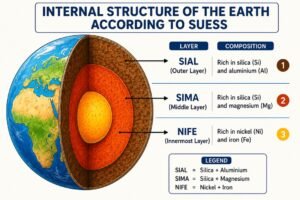
(1) सियाल (SIAL)
पृथ्वी का सबसे ऊपरी परत सिलिकन & अलुमिनियम से निर्मित है। The Earth’s uppermost layer is made of silicon and aluminium.
(2) सिमा (SIMA)
स्वेस ने मध्यवर्ती परत को सिमा से संबोधित किया है और उन्होंने बताया कि सिमा सिलिकन & मैग्नेशियम से बना है। Suess called the intermediate layer Sima and stated that it is made up of silicon and magnesium.
(3) निफे (NIFE)
पृथ्वी के सबसे आंतरिक भाग को निफे से संबोधित किया है और बताया कि यह निकेल & लोहा से बना है। The innermost part of the Earth is called the Nife, and it is made up of nickel and iron.
भूकम्पीय साक्ष्यों के आधार पर पृथ्वी की आंतरिक संरचना
(Internal Structure of the Earth Based on Seismic Evidence):-
भूकम्पीय साक्ष्यों के आधार पर पृथ्वी की आंतरिक संरचना का सबसे अधिक वैज्ञानिक अध्ययन प्रस्तुत किया जाता है। जिसके अनुसार पृथ्वी को तीन परतों में बाँटा गया है-
Based on seismic evidence, the most scientific study of the Earth’s internal structure is presented. According to this, the Earth is divided into three layers.
1. भूपर्पटी (Crust)
2. भू-प्रावर (Mantle)
3. क्रोड (Core)
(1) भूपर्पटी (Crust):-
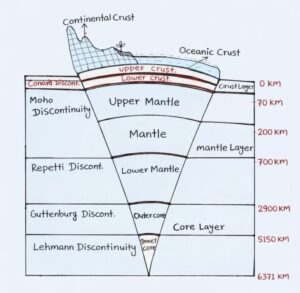
यह पृथ्वी का सबसे ऊपरी एवं पतली परत है। पृथ्वी के कुल आयतन का 0.5% और कुल द्रव्यमान का 0.2% Crust में शामिल है। इसकी औसत मोटाई 33 किमी० है। महाद्वीपों पर इसकी अधिकतम मोटाई 70 किमी० तक और महासागरीय क्षेत्र में औसत मोटाई 5 किमी० है।
The Crust is the uppermost and thinnest layer of the Earth. It accounts for about 0.5% of the Earth’s total volume and 0.2% of its total mass. Its average thickness is about 33 km. Its maximum thickness is about 70 km beneath continents, while its average thickness in oceanic areas is about 5 km.
इसमें परतदार चट्टानों की प्रधानता होती है। लेकिन महाद्वीपीय भागों में परतदार चट्टानों के नीचे ग्रेनाइट चट्टान की परत मिलती है जबकि महासागरीय भूपटल पर बैसाल्ट चट्टाने मिलती है।
Layered (sedimentary) rocks are dominant in the crust. However, beneath the sedimentary rocks in continental areas, a layer of granite is found, while basaltic rocks are found in the oceanic crust.
★ भूपर्पटी की रासायनिक संरचना से स्पष्ट होता है कि इसमें सर्वाधिक ऑक्सीजन (46.80%), सिलिकन (27.72%) अल्युमीनियम (8.13%) पायी जाती है। यह पृथ्वी का वह मण्डल है जिसमें प्राथमिक तरंग, द्वितीयक तरंग, सतही तरंग, P*, S*, Pg & Sg जैसे भूकम्पीय तरंग चला करते है।
The chemical composition of the crust shows that oxygen (46.80%), silicon (27.72%), and aluminium (8.13%) are the most abundant elements. It is the Earth’s layer through which seismic waves such as Primary (P), Secondary (S), Surface, P*, S*, Pg and Sg waves travel.
भूपर्पटी भी दो भागों में विभक्त है (The crust is further divided into two parts):-
1. महासागरीय भूपटल /Oceanic Crust
2. महाद्वीपीय भूपटल /Continental Crust
महाद्वीपीय भूपटल का घनत्व कम (2.75) है जबकि महासागरीय भूपटल का घनत्व अधिक (3.75) है। यही कारण है कि महाद्वीपीय भूपटल फुला/खुला हुआ है जबकि महासागरीय भूपटल धँसा हुआ है। महाद्वीपीय भूपटल में भी अलग-अलग घनत्व की चट्टाने पायी जाती है। जैसे:- पर्वतीय चट्टानों के घनत्व सबसे कम होता है। इससे अधिक घनत्व पठारों का और पठारों से ज्यादा घनत्व मैदानी चट्टानों में होता है।
The density of the continental crust is low (2.75), while the density of the oceanic crust is high (3.75). This is why the continental crust is uplifted, whereas the oceanic crust is depressed. The continental crust also contains rocks with different densities. Mountain rocks have the lowest density, followed by plateau rocks, while plain rocks have a higher density.
(2) भू-प्रावार (Mantle):-
भू-प्रावार की मोटाई मोहो असम्बद्धता से 2900 KM तक है। पृथ्वी के कुल आयतन का 83% और कुल द्रव्यमान का 68% भाग भूप्रावार में शामिल है। यह अधिक तापमान के कारण पिघली हुई अवस्था (द्रव) के समान है। भूप्रावार पृथ्वी का वह मण्डल है जिसमें प्राथमिक तरंग तो संचरित होती है लेकिन द्वितीयक तरंग विलुप्त हो जाती है। इसका निर्माण सिलिकन & मैग्नेशियम जैसे तत्वों से हुआ है। भूप्रावार का घनत्व 3 से 5.5 तक मानी जाती है।
The thickness of the mantle extends from the Mohorovičić Discontinuity (Moho) to a depth of about 2,900 km. It accounts for about 83% of the Earth’s total volume and about 68% of its total mass. Due to its high temperature, it is considered to be in a molten or fluid-like state. In the mantle, primary (P) waves can travel, while secondary (S) waves disappear. The mantle is mainly composed of elements such as silicon and magnesium. Its density is considered to range from about 3 to 5.5.
★ भूपर्पटी और भूप्रावार के बीच एक संक्रमण पेटी पायी जाती है जिसे मोहोअसम्बद्धता (Moho Discontinuty) कहते है। A transition zone is found between the crust and mantle, which is called the Moho Discontinuity.
★ क्रस्ट और मेंटल के ऊपरी भाग को मिलाकर स्थलमण्डल/लिथोस्फेयर कहा जाता है। The crust and the upper part of the mantle together are called the lithosphere.
(3) क्रोड(Core)/अंतरतम:-
यह पृथ्वी का केंद्रीय भाग है। इसका घनत्व -10 से 13.6 g/cm3 है। पृथ्वी के कुल आयतन का 16% एवं द्रव्यमान का 32% भाग क्रोड में शामिल है। क्रोड पृथ्वी का वह मण्डल है जसमें केवल प्राथमिक तरंगे गुजरती है। यह मण्डल निकेल & लोहा से निर्मित है। इसी कारण से पृथ्वी में चुम्बकीय गुण है।
This is the central part of the Earth. Its density is 10 to 13.6 g/cm³. The core accounts for about 16% of the total volume and 32% of the total mass of the Earth. The core is the layer of the Earth through which only primary waves (P-waves) pass. It is mainly made up of nickel and iron. Therefore, it is associated with the magnetic properties of the Earth.
क्रोड अत्याधिक दबाव के कारण ठोस भाग के रूप में परिणत हो चुका है। क्रोड की औसत मोटाई 3471 KM है। Mantle और Core के बीच में एक संक्रमण पेटी पायी जाती है जिसे गुटेनबर्ग असम्बद्धता कहते हैं। पृथ्वी की आंतरिक संरचना को नीचे के चित्रों में भी देखा जा सकता है।
Due to extremely high pressure, the core has become solid in nature. The average thickness of the core is about 3,471 km. A transition zone is found between the mantle and the core, known as the Gutenberg Discontinuity. The internal structure of the Earth can also be seen in the figures given below.
निष्कर्ष (Conclusion):-
इस तरह उपर्युक्त तथ्यों से स्पष्ट है कि पृथ्वी की आंतरिक संरचना के संबंध में भूकम्पीय तरंग सबसे अधिक वैज्ञानिक साक्ष्य प्रस्तुत करते हैं। Thus, it is clear from the above facts that seismic waves provide the most scientific evidence about the internal structure of the Earth.

Leave a Reply